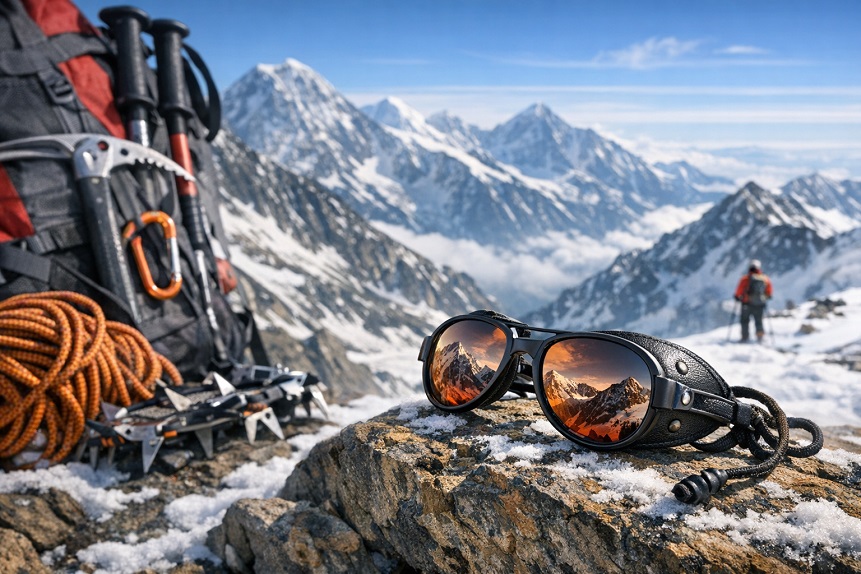
Most people who travel to altitude — for skiing, hiking, climbing, or simply visiting a high-elevation city — are prepared for the possibility of headache, breathlessness, and disturbed sleep. What they’re rarely prepared for is what happens to their eyes. Altitude affects visual function in ways that range from mildly inconvenient to genuinely performance-limiting, driven by a combination of reduced oxygen, increased UV radiation, lower humidity, and, at extreme elevations, direct physiological effects on the visual system itself.
Understanding the altitude-vision relationship is useful for anyone whose plans involve meaningful elevation gain — and the threshold at which relevant changes begin is lower than most people assume.
UV Radiation: The Altitude Multiplier
The most consistent and clinically significant eye health concern at altitude is elevated UV exposure. The atmosphere absorbs UV radiation, and at high altitude there is simply less atmosphere between you and the sun. UV intensity increases by approximately 10% for every 1,000 meters of elevation gain. At 3,000 meters — the elevation of many popular ski resorts — UV exposure is roughly 30% higher than at sea level. At 5,000 meters — base camp territory for serious mountain climbers — it’s 50% higher. At 6,000 meters and above, UV levels are extreme by any metric.
Snow dramatically compounds this. Fresh snow reflects approximately 80% of incident UV radiation back upward, meaning someone at altitude on a snow surface is receiving direct UV from above and reflected UV from below simultaneously. The underside of the eyelid, the inferior conjunctiva, and the lower cornea — surfaces that receive minimal UV in most everyday environments — become significant exposure zones when reflected UV from snow is intense. Standard sunglasses that sit away from the face and leave a gap below the lens don’t address this exposure adequately.
Photokeratitis — the corneal equivalent of sunburn — is the most common acute eye injury in mountain environments. The pain, photophobia, tearing, and temporary vision blur it causes typically begin six to twelve hours after exposure, which means the damage is often done before symptoms appear. A full day on a bright glacier without adequate eye protection can cause severe photokeratitis that is temporarily debilitating. Treatment is supportive — dark environments, lubricating drops, analgesics — and recovery typically occurs within 24 to 48 hours, but the experience is memorable enough that it only needs to happen once to permanently change sunglasses habits.
Prevention is straightforward: category 3 or 4 lenses with UV400 protection and full side coverage, worn throughout the day whenever on snow or open terrain. Glacier glasses — the close-fitting wraparound or side-shield designs used by mountaineers — exist for good reason. At elevations above 4,000 meters, they’re not optional equipment for anyone spending time in the outdoors.
The long-term implications of accumulated UV exposure are covered in the article on UV light and the long-term damage you can’t see.
Hypoxia and Visual Function
The eye is the most oxygen-dependent organ in the body relative to its size. The photoreceptors of the outer retina have among the highest oxygen consumption rates of any cell type, and the retinal vasculature operates under tight autoregulatory control to maintain adequate oxygen delivery despite changes in systemic perfusion pressure. When ambient oxygen levels fall at altitude, the eye’s regulatory systems are challenged in ways that measurably affect visual function — especially in the dark.
Night vision is the first casualty of altitude-related hypoxia. Rod photoreceptors, which drive low-light vision, are exquisitely sensitive to oxygen availability. Research conducted as far back as World War II showed that aircrew at altitude — before pressurized cabins were standard — experienced significant degradation of dark-adapted vision at elevations above 10,000 feet. Supplemental oxygen restored their night vision within minutes. The same mechanism operates, at a more modest scale, for hikers and climbers at moderate altitude.
At elevations between 8,000 and 12,000 feet, dark adaptation is measurably slower and the final level of dark-adapted sensitivity is reduced compared to sea level. This matters practically for mountaineers making predawn summit attempts, hunters at high elevation during low-light hours, and anyone driving on mountain roads after dark. The functional impairment is real even when the person experiencing it doesn’t fully register it as visual.
At higher elevations — above 14,000 to 16,000 feet — other hypoxia-related visual effects emerge. Contrast sensitivity declines. Color discrimination accuracy decreases, particularly for complex hue distinctions. These changes are partly retinal and partly cortical, as the visual processing centers of the brain are also affected by reduced oxygen delivery. Most resolve with acclimatization or descent, though severe hypoxia at extreme altitude can cause transient or, in rare cases, persistent visual field changes.
Dry Eyes at Altitude
High-altitude environments are almost universally dry. Low absolute humidity — a consequence of cold air’s reduced water-holding capacity — combined with exposure to wind and intense solar radiation creates conditions that accelerate tear evaporation significantly. Contact lens wearers are particularly affected: the combination of dry mountain air, high UV, and the increased blinking associated with dry-eye irritation often makes contact lens wear uncomfortable or impractical above certain elevations.
Symptoms are predictable: gritty or scratchy sensation, foreign body feeling, intermittent blurred vision from unstable tear film, and increased sensitivity to wind and sun. These symptoms typically worsen through the day and improve after rest in a sheltered environment. Lubricating eye drops used proactively — not just reactively when symptoms appear — significantly improve comfort for most people. Preservative-free unit-dose artificial tears are preferable, as preservatives can irritate already-stressed ocular surfaces.
Wraparound goggles or glasses that reduce direct wind contact with the ocular surface are the most effective physical intervention for dry-eye symptoms in mountain environments. Ski goggles, which are already standard equipment in cold mountain conditions, serve this function as well as providing UV protection. At lower elevations where goggles aren’t worn, frames with more coverage and less gap between lens and face reduce wind exposure to the eye meaningfully.
Hydration is a factor that’s easy to underestimate at altitude. High-elevation environments increase fluid loss through respiration as well as through the skin, and even mild dehydration reduces tear production and worsens dry eye symptoms. Maintaining adequate hydration is one of the simplest interventions for altitude-related eye comfort.
High-Altitude Retinal Hemorrhages
At extreme elevations — typically above 5,000 meters — a more serious ocular complication can occur: high-altitude retinal hemorrhages (HARH). These are small flame-shaped bleeds in the superficial retinal nerve fiber layer, visible on ophthalmoscopy, caused by the vascular changes associated with severe acute mountain sickness and high-altitude cerebral edema.
HARH are relatively common at extreme altitude — seen in a significant proportion of climbers above 6,000 to 7,000 meters — and are usually asymptomatic unless they occur at or near the fovea. When a hemorrhage involves the fovea, the result is a scotoma (blind spot) in central vision that causes significant visual impairment. Most peripheral hemorrhages resolve completely with descent and recovery. Foveal involvement is rarer but may leave permanent visual effects.
High-altitude retinal hemorrhages are more a marker of severe altitude illness than an isolated ocular condition — they occur in the context of the systemic vascular dysregulation that characterizes acute mountain sickness. Descent and management of altitude illness is the appropriate response. For the large majority of recreational visitors to altitudes below 4,000 to 5,000 meters, HARH are not a practical concern.
Note: Any visual symptoms at altitude — including sudden visual field changes, a persistent scotoma, or significant vision disturbance — warrant prompt descent and medical evaluation. Some altitude-related visual events can indicate serious neurological or vascular events requiring emergency management.
Contact Lenses at Altitude
Contact lens wearers traveling to altitude face a specific set of challenges. Reduced humidity and increased wind exposure accelerate lens dehydration and corneal drying. UV exposure through the corneal surface is increased, and while some contact lenses offer UV blocking, they don’t cover the conjunctiva and periocular area that standard sunglasses protect. Hygiene and lens care can be practically difficult in remote mountain environments without reliable access to clean water.
For day hikes and ski resort visits at moderate elevation, contact lens wear with quality UV-blocking sunglasses over the top is perfectly reasonable for most people. For extended backcountry, glacier, or high-altitude climbing, many experienced mountaineers transition to spectacles with glacier glasses rather than managing the hygiene and comfort challenges of contact lenses in remote alpine environments. Daily disposable lenses, if used, eliminate the contamination risk associated with lens cases and solution in the field.
Practical Preparation for Altitude Travel
The essentials for eye health at significant elevation reduce to a short list. UV400-rated lenses with appropriate darkness for snow conditions — category 3 for general ski resort use, category 4 or glacier glasses for glacier travel and extreme elevation. Side and peripheral coverage that addresses reflected UV from below. Lubricating eye drops for dry environment management. Adequate hydration. And, for contact lens wearers, a backup pair of spectacles in case lens wear becomes impractical.
For those who also want nutritional support for the increased photo-oxidative stress and macular light filtering demands of high-altitude environments, the dietary carotenoids that build macular pigment are directly relevant. The relationship between lutein and zeaxanthin intake and macular light-filtering capacity is covered in the article on lutein for eye health. Those interested in a complete nutritional support picture can find a detailed ingredient analysis in the Performance Lab Vision review.