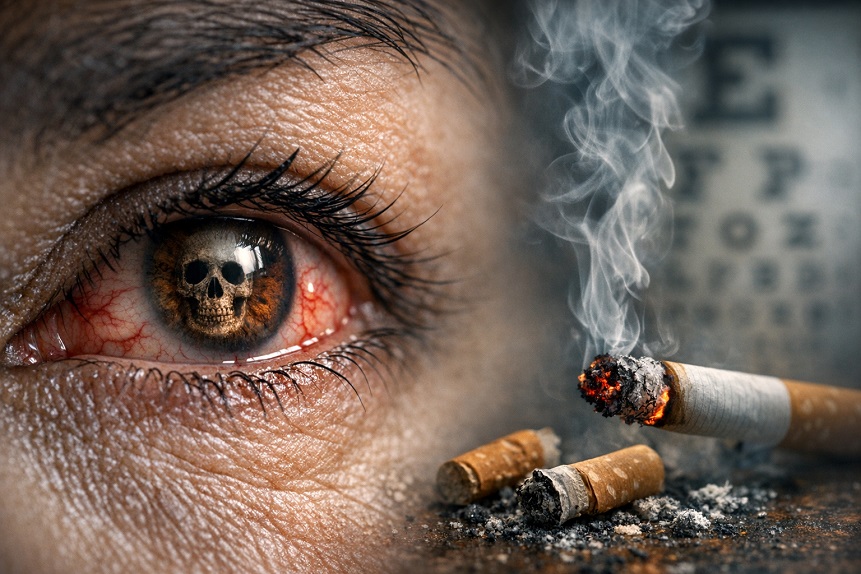
Smokers know the cardiovascular and pulmonary risks. Most have been told about cancer risk more times than they care to count. What rarely enters the conversation is what smoking does to vision — and the picture there is, if anything, more disturbing than most people expect, because the damage is both severe and largely preventable even in those who have smoked for years.
Tobacco smoke contains thousands of chemical compounds, a significant proportion of which are either directly toxic to ocular tissues or generate the oxidative stress that accelerates almost every major form of age-related eye disease. The eye is not an innocent bystander in a smoker’s body. It’s a direct target.
Macular Degeneration: The Largest Risk
Among all the modifiable risk factors for age-related macular degeneration, smoking stands alone. The relative risk for AMD in current smokers compared to lifetime non-smokers is approximately two to four times higher across multiple large prospective studies. This is not a marginal association — it’s among the strongest modifiable risk relationships in all of ophthalmology.
The mechanism is not subtle. Cigarette smoke generates an extraordinary quantity of reactive oxygen species — both in the smoke itself and through the systemic oxidative stress it triggers in exposed tissues. The retinal pigment epithelium, already operating under the highest oxidative burden of any cell type in the body, is simply overwhelmed by the additional load that smoking creates. Macular pigment carotenoids — lutein and zeaxanthin — are depleted faster in smokers than in non-smokers, reducing the protective optical filtering capacity that these compounds provide to the macula.
Smoking also reduces choroidal blood flow to the macula through nicotine-driven vasoconstriction and the endothelial damage caused by cigarette smoke constituents. The combination of depleted antioxidant reserves and reduced oxygen and nutrient delivery to the retinal pigment epithelium creates exactly the conditions under which drusen accumulate, RPE cells fail, and AMD advances.
Former smokers retain elevated AMD risk for many years after cessation — risk that declines progressively but does not fully return to never-smoker levels for more than a decade. This is discouraging in one sense and clarifying in another: the message is not “quitting is pointless because damage is done.” The message is “quitting now is better than quitting in five years, which is better than not quitting at all.” The trajectory matters even if the starting point is suboptimal.
Cataracts: Accelerated by Every Cigarette
The association between smoking and cataract formation is independent of, and additive to, the UV exposure association. All three major cataract subtypes — nuclear, cortical, and posterior subcapsular — show elevated rates in smokers, with dose-dependent relationships between pack-year exposure and cataract risk.
The lens depends on glutathione-based antioxidant defenses to maintain the protein solubility that keeps it transparent. Cigarette smoke constituents — particularly acrolein and other reactive aldehydes — directly deplete lens glutathione and inhibit the enzyme systems that regenerate it. The result is accelerated oxidation of crystallin proteins, protein aggregation, and progressive loss of lens transparency at a rate that outpaces what normal aging alone would produce.
Studies consistently find that smokers develop visually significant cataracts earlier and require cataract surgery at younger ages than non-smokers. The dose-response relationship is clear: heavier smokers develop cataracts earlier than lighter smokers, and former smokers have intermediate risk between current smokers and never-smokers depending on how long ago they quit and how much they smoked.
Glaucoma and the Optic Nerve
The relationship between smoking and glaucoma is less straightforward than the AMD and cataract associations, but it points consistently in one direction. Several large studies have found elevated glaucoma risk in smokers, with mechanisms that include impaired ocular blood flow autoregulation, increased IOP variability, and direct toxic effects of cigarette smoke constituents on retinal ganglion cells and the optic nerve.
Nicotine produces acute vasoconstriction that reduces ocular blood flow, and chronic smoking impairs the vascular autoregulatory systems that maintain stable optic nerve perfusion pressure despite fluctuations in systemic blood pressure. Optic nerve blood flow that is both reduced on average and more variable represents a worse supply environment for retinal ganglion cells that are already under pressure-related stress.
There is also evidence that cigarette smoke has direct neurotoxic effects on retinal ganglion cells independent of vascular mechanisms. Constituents of tobacco smoke reach the vitreous and retinal tissue through systemic circulation and produce oxidative damage to ganglion cell dendrites and axons in experimental models. The clinical translation of these findings continues to be investigated.
Dry Eye Disease
Smoking is among the established risk factors for dry eye disease, and the mechanism is multiple. Cigarette smoke is a direct ocular surface irritant — even passive exposure to secondhand smoke increases tear film instability and ocular surface inflammation in non-smokers. Active smokers are continuously exposing their conjunctival and corneal epithelia to a complex mixture of irritants that impair goblet cell function, degrade mucin production, and maintain chronic low-grade ocular surface inflammation.
The meibomian glands, whose lipid secretions form the evaporation-resistant outer tear film layer, are also affected. Systemic effects of smoking on lipid metabolism alter the composition of meibomian secretions in ways that reduce their ability to stabilize the tear film. Smokers have measurably higher dry eye prevalence than non-smokers across multiple population studies, and the relationship persists after controlling for age, sex, and contact lens use.
Thyroid Eye Disease and Smoking
One smoking-eye health connection that is less widely known but clinically significant involves thyroid eye disease — the autoimmune orbital condition associated with Graves’ hyperthyroidism. Smoking is the single most powerful modifiable risk factor for developing thyroid eye disease in people with Graves’ disease, with smokers having four to eight times higher risk than non-smokers with the same thyroid condition.
Smoking also worsens the severity of thyroid eye disease when it develops, and significantly reduces the effectiveness of radioiodine therapy for Graves’ hyperthyroidism — a treatment that can trigger or worsen orbital disease in smokers. For anyone with Graves’ disease or a family history of thyroid autoimmune conditions, smoking is not just a general health risk — it’s a specific and major determinant of whether serious orbital eye disease will develop.
Note: If you smoke and have noticed changes in your vision, have a family history of AMD or glaucoma, or have been diagnosed with Graves’ disease or another thyroid autoimmune condition, discuss your smoking status explicitly with your eye care professional and your primary care provider. Some of the eye conditions most strongly influenced by smoking benefit significantly from early intervention.
What Quitting Actually Changes
The risk trajectory after smoking cessation is encouraging without being instant. AMD risk begins declining after cessation and continues declining over years, though it takes more than a decade to approach never-smoker levels. Cataract risk shows similar gradual improvement. Dry eye symptoms often improve more rapidly — within weeks to months — as the direct irritant and inflammatory effects on the ocular surface resolve.
Nutritional support during and after cessation is worth considering specifically for the eye. Smokers characteristically have depleted serum levels of lutein, zeaxanthin, and vitamin C — the key macular and lens protective nutrients. Rebuilding these reserves through diet and supplementation after cessation accelerates the recovery of the antioxidant defenses that smoking has depleted. The dietary carotenoid picture for macular recovery is covered in the article on foods highest in lutein and zeaxanthin.
A note for those considering eye supplements while still smoking: the original AREDS formula included high-dose beta-carotene, which was later removed from the AREDS2 update after it was found to increase lung cancer risk in smokers. Former smokers and current smokers should use the AREDS2 formulation with lutein and zeaxanthin rather than any formulation containing high-dose beta-carotene. This is an important practical distinction for anyone in this situation.
The Honest Summary
No single lifestyle factor does more damage to the aging eye than smoking. The AMD association alone would be sufficient to make tobacco use a major eye health concern. The cataract acceleration, the optic nerve effects, the dry eye contribution, and the thyroid eye disease risk compound into a picture that is substantially worse than most smokers understand.
None of this is irreversible on the trajectory — cessation at any age improves the risk picture — but the case for quitting as soon as possible is unambiguous from an eye health perspective, independent of all the cardiovascular and oncological reasons that are already better known. For those working to rebuild the nutritional defenses that smoking has eroded, the Performance Lab Vision review examines the evidence-supported formulation that addresses the key protective nutrients.