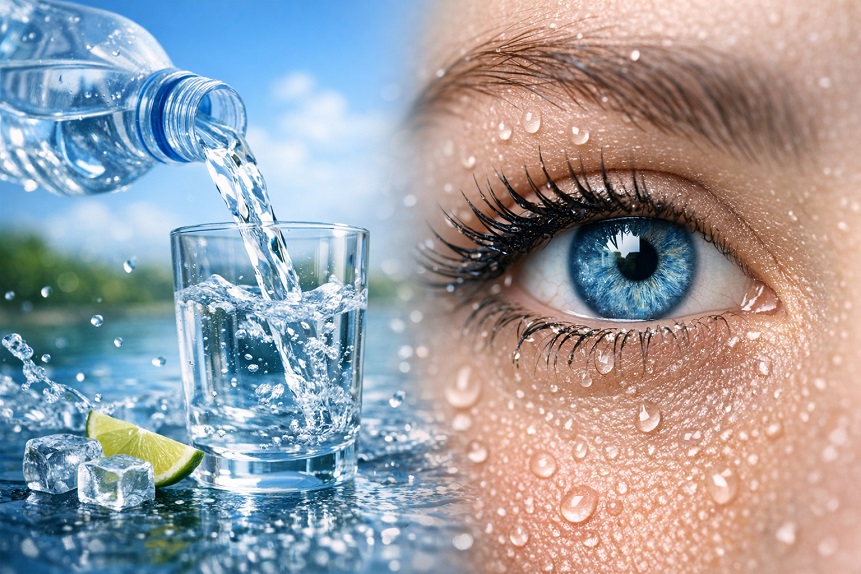
The relationship between hydration and eye health is one of those topics that sounds straightforward until you look closely, at which point it becomes considerably more interesting. Yes, dehydration worsens dry eye symptoms. That much most people have noticed. But the connections run deeper than tear film volume, touching intraocular pressure regulation, lens transparency, contrast sensitivity, and the overall performance of the visual system under demand. The eye is a fluid-dependent organ in ways that go well beyond the obvious.
Most people operate in a state of mild intermittent dehydration without fully recognizing it — particularly during exercise, in dry environments, at altitude, or in air-conditioned offices. The eyes, which depend on adequate fluid status for multiple distinct physiological functions, are among the first places where that deficit shows up in measurable and sometimes noticeable ways.
How the Eye Depends on Fluid Balance
The eye maintains two distinct fluid compartments, each serving different physiological functions and each sensitive to hydration status in different ways.
Aqueous humor fills the anterior segment of the eye — the space between the cornea at the front and the lens at the back. It’s continuously produced by the ciliary body, flows through the anterior chamber, and drains through the trabecular meshwork and other outflow pathways. This continuous flow maintains intraocular pressure and delivers nutrients — particularly glucose, amino acids, and ascorbic acid — to the avascular cornea and lens, which have no direct blood supply.
The vitreous humor fills the posterior segment between the lens and the retina. It’s a gel-like structure composed predominantly of water (roughly 98%) with a collagen and hyaluronic acid matrix that maintains the eye’s shape and provides a stable optical medium for light transmission to the retina. Unlike aqueous humor, the vitreous is largely static and turns over very slowly across a lifetime.
Systemic dehydration affects aqueous humor production and composition. When the body is depleted of fluid, the ciliary body produces less aqueous humor, reducing the constant replenishment of nutrients to the cornea and lens. Corneal hydration — essential for maintaining its precise curvature and optical clarity — depends on the balance between aqueous humor supply, epithelial transport mechanisms, and tear film contributions. Significant dehydration can alter corneal hydration status in ways that affect visual clarity and refractive stability.
Dehydration and Intraocular Pressure
The relationship between hydration status and intraocular pressure is more complex than a simple “dehydration raises IOP” statement, but it’s relevant enough to warrant careful explanation.
Mild to moderate dehydration — the kind produced by a long outdoor workout, a day in hot weather without adequate fluid replacement, or a night of alcohol consumption without compensating hydration — can produce transient changes in intraocular pressure through multiple mechanisms. Reduced aqueous humor production can lower IOP slightly. Changes in blood osmolarity affect the osmotic gradients that drive aqueous production and vitreous fluid balance. Vascular autoregulatory changes affect choroidal blood flow and ocular perfusion pressure.
For most healthy people, these fluctuations are within the normal range and clinically inconsequential on a day-to-day basis. For people with glaucoma or elevated IOP, significant dehydration-induced pressure changes can matter more, and severe rapid rehydration after significant dehydration can produce IOP spikes that are relevant in glaucomatous eyes. The clinical guidance for glaucoma patients generally includes consistent hydration as a component of IOP management — not aggressive loading of large fluid volumes (which can transiently raise IOP) but steady, consistent fluid intake throughout the day.
The Tear Film Connection
The most direct and consistently noticeable way dehydration affects the eyes is through the tear film. Adequate hydration is a prerequisite for normal tear production volume. The lacrimal glands that produce the aqueous component of tears — the dominant component by volume — are essentially fluid-secreting glands whose output reflects systemic fluid availability alongside the neural and hormonal signals that regulate them.
Even mild dehydration reduces tear production measurably. A study measuring tear film osmolarity and stability in subjects before and after induced mild dehydration found significant increases in tear osmolarity — the salt concentration of tears that rises as tear volume falls — within the range associated with dry eye disease onset. The same degree of dehydration that produces early exercise fatigue (roughly 1 to 2% of body weight in fluid loss) produces tear film changes that can cause or worsen dry eye symptoms.
For people with pre-existing dry eye disease, dehydration dramatically lowers their threshold for symptomatic flare. Air travel — which combines cabin humidity levels of 10 to 20% with the dehydration from recirculated air and often reduced fluid intake — is a reliably miserable dry eye trigger precisely because both the external environment and internal hydration status are working against the tear film simultaneously.
The broader dry eye picture and management approaches are covered in the article on dry eyes as you age, which covers the tear film architecture in detail.
Contact Lenses and Dehydration
Contact lenses interact with hydration status in a way that regular eyeglass wearers don’t encounter. Soft contact lenses are themselves hydrogel devices — they contain anywhere from 38 to 78% water depending on the material — and they maintain that water content by drawing it partly from the tear film. In a well-hydrated eye with a stable tear film, this equilibrium is comfortable. In a dehydrated eye with a reduced tear film, lenses can dehydrate slightly and tighten against the corneal surface, reducing oxygen transmission, increasing lens awareness, and causing discomfort that typically worsens through the day.
Many contact lens wearers who experience end-of-day lens discomfort — a very common complaint — find that consistent hydration throughout the day meaningfully extends their comfortable wearing time. Lubricating drops designed for use with contact lenses add a topical fluid layer that helps, but they’re more effective as a supplement to adequate systemic hydration than as a substitute for it.
Visual Performance and Fluid Status
Dehydration affects cognitive performance broadly, and visual processing is part of that picture. The visual cortex requires adequate cerebral perfusion, which dehydration impairs through reduced blood volume and altered vascular tone. At modest dehydration levels — the range most people encounter during typical daily activities — measurable reductions in visual attention, tracking accuracy, and reaction time have been documented in experimental studies.
Athletes operating in warm conditions or with high sweat rates are particularly exposed to these effects. A cyclist or runner who begins a long event well-hydrated and finishes it mildly dehydrated is processing visual information — judging distances, reading terrain, tracking competitors — with a marginally less efficient visual system by the end of the event. In sports with fine visual demands, this matters. The article on vision and athletic performance covers the broader environmental factors affecting sporting visual function.
Screen-intensive work, which already stresses the visual system through sustained near focus and reduced blink rate, is made more demanding by dehydration. The combination of reduced tear production, reduced corneal hydration, and mild cortical inefficiency compounds the digital eye strain that extended screen work produces. Hydration is not a replacement for screen break habits, but it’s a meaningful contributor to visual comfort and clarity through a long workday.
How Much Fluid Is Actually Enough
The eight glasses per day prescription is a round number rather than a precision target, and individual requirements vary considerably by body size, activity level, climate, diet, and health status. A more practical framework: urine color provides a reasonable real-time hydration indicator. Pale straw-yellow suggests adequate hydration. Darker yellow suggests that drinking is warranted. Dark amber suggests meaningful dehydration has already occurred. Colorless urine may indicate overhydration, which is less common in everyday life but relevant for athletes consuming large fluid volumes.
Consistent intake distributed across the day is more beneficial for tear film stability than large periodic volumes. Large rapid fluid loads transiently dilute blood osmolarity and can produce brief IOP fluctuations, while producing urine more rapidly than the lacrimal glands benefit from the increased fluid availability. The same daily total spread across regular, moderate intake throughout waking hours supports steadier lacrimal gland output and more stable tear film.
Foods contribute meaningfully to fluid intake. Fruits, vegetables, soups, and dairy products have high water content, and someone eating a vegetable-rich diet is getting meaningful fluid from food even before accounting for beverages. Caffeinated beverages — despite their mild diuretic effect — contribute net fluid in the quantities most people consume them, and don’t need to be excluded from hydration accounting for most people at normal intake levels.
Note: Sudden changes in visual clarity associated with fluid shifts — such as vision changes following rapid rehydration or significant dehydration — and any persistent visual changes should be evaluated by an eye care professional. People with glaucoma or other conditions where intraocular pressure management is important should discuss hydration habits with their eye care provider.
A Simple Variable With Real Returns
Hydration is not a dramatic intervention. It doesn’t reverse macular degeneration or cure dry eye disease. But it’s a foundational variable that affects tear production, corneal health, intraocular pressure stability, and visual processing efficiency — and maintaining it costs nothing and requires nothing more complicated than drinking consistently through the day.
In the context of a broader approach to eye health that includes UV protection, dietary carotenoids, regular eye exams, and appropriate supplementation, consistent hydration fills the role it should — not a star player, but a reliable contributor whose absence is noticed. For the nutritional side of a comprehensive eye health strategy, the Performance Lab Vision review covers the evidence on the key ocular nutrients that work alongside good hydration habits.