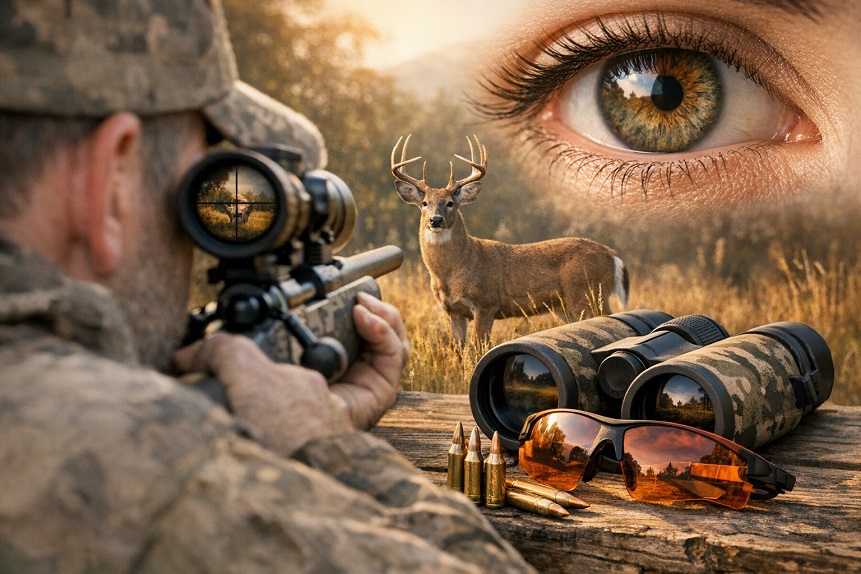
There’s an old shooting instructor saying that the most important piece of equipment a shooter owns isn’t the rifle — it’s the two pieces of optical equipment mounted in their skull. Experienced hunters and competitive shooters know this in a bone-deep way. When you’ve missed a shot you had every right to make, you tend to revisit every variable. Often enough, the answer isn’t the fundamentals. It’s the vision.
Shooting sports and hunting place a specific and demanding set of requirements on the visual system. Target identification at distance, depth perception across variable terrain, tracking moving animals or clay targets, and performing reliably in low-light conditions at dawn and dusk — these are all genuine visual performance tasks that respond to training, equipment, and biological maintenance.
Dominant Eye and Why Every Shooter Needs to Know Theirs
Eye dominance is the starting point for every serious discussion about shooting vision. The dominant eye is the one your brain preferentially uses for sighting tasks. When both eyes are open, the dominant eye leads. When one eye is closed, you lose peripheral awareness and depth perception.
The standard approach is to shoot with both eyes open, using the dominant eye to align the sight picture. Problems arise when hand dominance and eye dominance don’t match — a right-handed shooter with a left dominant eye, for example, faces a genuine alignment conflict. Some adapt by training the non-dominant eye to take over sighting tasks; others modify their head position; others switch to dominant-side shooting altogether.
None of these solutions works particularly well if the shooter doesn’t know which eye is dominant to begin with. A straightforward check: extend both hands and form a small triangle between thumbs and forefingers. Focus on a distant object through the triangle with both eyes open. Close each eye alternately. The eye that keeps the object centered in the triangle is dominant. Many people are surprised to discover the answer doesn’t match their handedness.
Depth Perception and Distance Judgment
At hunting distances — often 100 to 400 yards for rifle hunters — the binocular depth cues that work well at close range have diminished usefulness. At those distances, the brain increasingly relies on monocular cues: atmospheric haze, apparent size of familiar objects, texture gradient, and parallax during head movement.
This is where visual acuity and contrast sensitivity intersect with depth perception in a practical way. A target at 300 yards that’s poorly resolved — because acuity is reduced, or because haze reduces contrast — provides less reliable size and texture cues. The shooter’s distance estimate becomes less precise. Shot placement suffers not because of form breakdown, but because the visual input that informs the shot was degraded.
Optics help significantly here. A quality riflescope with appropriate magnification compensates for distance-related acuity limits and brings depth cues back into a functional range. But the quality of visual processing behind the scope still matters. Two shooters looking through the same glass will extract different amounts of useful information depending on the health of their visual systems.
Dawn and Dusk: The Critical Shooting Hours
The most active game movement — and by extension, the most demanding shooting conditions — often occurs in the thirty to sixty minutes around sunrise and sunset. These are also the hours when the visual system is under the most stress. Low-light conditions require a shift from cone-dominated photopic vision to rod-dominated scotopic vision, a process called dark adaptation that takes time and degrades with age.
Rhodopsin, the light-sensitive protein in rod cells, must regenerate after exposure to bright light. A hunter who has been driving with headlights and walking under a flashlight doesn’t arrive at their stand with a fully dark-adapted visual system. They arrive with rhodopsin partially bleached and rods only partially operational. The first fifteen to twenty minutes in the field, before adaptation completes, are visually compromised minutes.
Nutritional support for rhodopsin regeneration is one area where the evidence is reasonable. Vitamin A is the direct precursor to the retinal molecule embedded in rhodopsin. Deficiency — which is more common than most people in developed countries recognize, particularly in those with highly processed diets — impairs both the speed and completeness of dark adaptation.
The mechanisms of dark adaptation and how nutrition supports night vision are covered in detail in the article on dark adaptation and how eyes adjust to low light.
Contrast Sensitivity and Target Identification
A deer standing in the tree line at dusk is not a high-contrast target. It’s a brown shape against a brown-gray-green background, partially obscured by branches, in light that barely qualifies as light. Identifying that target — confirming the species, judging antler size if relevant, verifying the shot angle — requires genuine contrast sensitivity, not just acuity.
This distinction matters because many hunters with corrected 20/20 vision assume their vision is not a limiting factor in hunting performance. But visual acuity tests are conducted in well-lit rooms with high-contrast black letters on white charts. They tell you almost nothing about how your visual system performs at dusk, against a camouflage-like background, at 200 yards.
Macular pigment density plays a meaningful role in contrast sensitivity, particularly under low-light conditions. The carotenoids lutein and zeaxanthin that make up macular pigment function partly as a filter that reduces short-wavelength light scatter within the eye, increasing effective contrast. Hunters who support macular pigment through diet or supplementation are, in effect, putting better glass between themselves and the target.
Target Tracking for Wing Shooters
Waterfowl and upland bird hunters, along with clay target shooters, face a fundamentally different visual challenge: fast-moving targets against rapidly changing backgrounds. A pheasant flushing from cover and crossing in front of a treeline requires the visual system to maintain a clean object boundary on a small, fast target against a complex, variable backdrop.
The visual skills involved here overlap with those in racket sports and other fast-ball sports. Dynamic visual acuity — the ability to resolve detail on a moving target — determines how clearly the shooter can read the bird’s flight path and anticipate the lead. Reaction time determines how quickly that information translates into movement. Both respond to training and to the quality of the visual system’s underlying architecture.
Clay target shooters who have worked with sports vision specialists often report the biggest gains coming from improved target pickup — finding the clay in the visual field faster after it emerges from the trap. This is a contrast sensitivity and attention control task as much as a tracking task. The articles on motion detection and sport and visual reaction time cover these mechanisms for anyone who wants to dig into the training applications.
Eye Protection and Long-Term Health
Protective eyewear in shooting sports serves obvious ballistic safety functions. But it also has a less-discussed visual performance role. Quality shooting glasses in appropriate tints improve target contrast in specific light conditions: yellow and amber tints increase contrast in overcast or low-light conditions; gray tints reduce overall brightness without color distortion in direct sun; rose tints can improve target visibility against blue-sky backgrounds.
UV protection matters for hunters who spend long days outdoors across a full season. Cumulative UV exposure is one of the well-established risk factors for cataract development and macular degeneration — conditions that tend to emerge in the fifties and sixties but are building well before that. The hunter who takes their vision seriously in their forties and invests in proper UV protection and dietary carotenoids is making an investment that pays off across decades of use.
Note: Any sudden changes in vision, difficulty with dark adaptation beyond what’s typical for your age, or new visual symptoms should be evaluated by an eye care professional. Some symptoms can indicate conditions that affect shooting safety and require medical management.
Maintaining the Equipment That Matters Most
Hunters who spend significant money on optics, firearms, and equipment often spend very little on the eyes that use all of it. That’s a priorities misalignment worth examining. The scope can be replaced. The visual system you’re born with has to last a lifetime, and its performance at sixty depends substantially on decisions made at forty.
Dietary carotenoids for macular pigment, vitamin A for rhodopsin function, UV protection for long-term structural health, and basic annual eye exams are all straightforward interventions with meaningful returns for anyone who depends on their eyes for high-demand performance in the field. For a detailed look at how supplementation fits into this picture, the Performance Lab Vision review examines the ingredient evidence behind a well-regarded formulation.