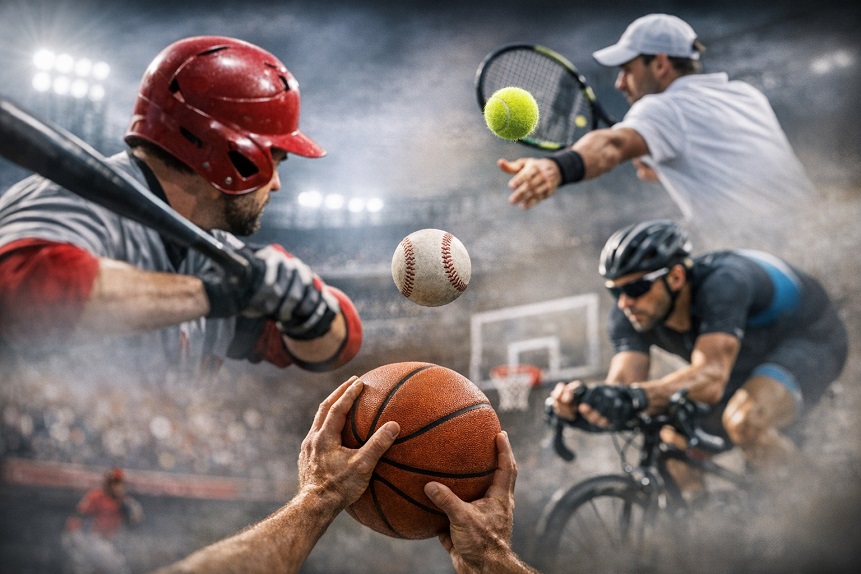
Ask any serious athlete about their vision training program and you’ll probably get a blank look, a mention of 20/20 acuity, and a quick subject change. The sports world has fully embraced strength training, reaction time, sleep optimization, and nutritional periodization. Visual performance, by comparison, has been mostly ignored — treated as a fixed biological given rather than a trainable and maintainable performance variable.
Within visual performance, contrast sensitivity is the most overlooked piece of all. It doesn’t show up on standard eye chart tests. Most athletes have no idea what their number is. And yet there’s a growing body of evidence that it may be one of the more decisive visual factors separating elite performers from the merely excellent.
What Contrast Sensitivity Actually Is in a Sports Context
Contrast sensitivity is the visual system’s ability to detect differences in luminance between adjacent areas — essentially, how well you distinguish an object from its background when they’re similar in brightness or color. It’s distinct from acuity, which measures resolution of fine detail under high-contrast conditions.
In a controlled environment, this is a fairly academic distinction. On a sports field, it’s everything. A cricket ball viewed against a gray sky, a puck sliding across shadowed ice, a running back cutting against a crowd of similarly dressed players, a ball landing in the contact zone of a shadowed tennis court — all of these are low-contrast visual tasks. The athlete who resolves them clearly and quickly holds an advantage that acuity tests won’t capture and most coaches won’t see.
Two athletes can both read the bottom line of an eye chart and have meaningfully different contrast sensitivity. One of them will track a ball in murky light more reliably. One of them will pick up subtle body language cues from opponents more quickly. The difference in function is real; the difference on the eye chart is zero.
Sport-Specific Applications
The role of contrast sensitivity shifts depending on the sport, but it’s present in essentially all of them. A few examples where it’s particularly decisive:
Baseball and Cricket Batting
Batters in both sports face one of the fastest and most visually demanding tasks in all of sport. A cricket fast bowler delivers at 90-plus miles per hour; a major league fastball arrives in under 400 milliseconds. Reading late movement, picking up seam orientation to anticipate break, and locating the ball against stadium lighting and crowd backgrounds are all contrast sensitivity tasks as much as acuity tasks.
Research with elite baseball players has found that their contrast sensitivity consistently exceeds population norms. Whether this reflects selection — better-sighted players advance further — or adaptation through sustained training and nutritional optimization is unclear, but the gap is consistent and large enough to be meaningful.
Hockey and Ice Sports
Ice reflects light in complex, variable ways that create constant low-contrast challenges. A black puck sliding across bright ice, partially obscured by skates, bodies, and boards, requires sustained contrast discrimination to track. Elite hockey players report that one of the clearest signs of fatigue in a long shift is losing the puck briefly in the visual field — a direct consequence of contrast sensitivity degradation under sustained effort.
Combat Sports and Martial Arts
In boxing, wrestling, and mixed martial arts, reading subtle positional shifts in an opponent happens at close range in variable arena lighting. The margin between detecting a weight shift that precedes a punch and missing it entirely is often a contrast sensitivity margin — the athlete who resolves low-contrast postural cues faster gains a processing edge that can define the outcome of a round.
Field Sports in Variable Light
Rugby, soccer, and American football all ask players to track multiple bodies in motion while identifying the ball and reading opponent movement. Morning and evening games, overcast conditions, and artificial lighting at night all challenge contrast sensitivity in different ways. Players who maintain strong contrast sensitivity across all these lighting conditions are more reliable performers; their game doesn’t fluctuate with the weather or the time of day in the same way.
How Fatigue Attacks Contrast Sensitivity First
Here’s the detail that should get every athlete’s attention: contrast sensitivity degrades before acuity does under conditions of fatigue, hypoxia, and sustained visual stress. It’s more sensitive to physical and nutritional state than the visual functions that typically get measured.
This means that an athlete who is tiring in the fourth quarter, the third set, or the back nine may still pass a standard acuity check. They’re not “going blind.” But their contrast sensitivity has already taken a hit, and they’re processing the visual field less efficiently than they were an hour earlier. The errors that follow — the misjudged shot, the missed cut, the timing breakdown on a serve return — often get attributed to physical or mental fatigue when the proximate cause is actually visual.
Macular pigment, the layer of lutein and zeaxanthin concentrated in the central retina, functions partly as a contrast enhancer. It filters short-wavelength light scatter within the eye, which improves the signal-to-noise ratio for contrast discrimination. Higher macular pigment optical density correlates with better contrast sensitivity scores, and the relationship holds across a range of light conditions.
The nutritional foundations of macular pigment are explored in the article on zeaxanthin and lutein and how they work together, which covers the roles these two carotenoids play at the tissue level.
Contrast Sensitivity and Game Reading
Contrast sensitivity isn’t only about tracking objects. It extends to reading the broader visual scene — detecting patterns, anticipating movement, processing opponent body language. A basketball defender with excellent contrast sensitivity picks up the subtle weight shift that precedes a drive earlier. A goalkeeper detects the body lean that telegraphs a penalty kick direction in the critical frames before contact.
Sports scientists studying anticipatory behavior in elite athletes have found that much of what looks like superior reaction time is actually superior visual information pickup. The expert doesn’t react faster to the same stimulus. They extract more signal from an earlier, lower-contrast cue. By the time the novice has enough information to act, the expert has already moved.
This is why contrast sensitivity sits at the upstream end of the whole reaction chain. Reaction time matters; visual reaction time training is a legitimate path to performance gains. But you can train reaction to stimuli all day and still be limited by how quickly and clearly you detect the stimuli in the first place.
Training and Maintaining Contrast Sensitivity
Contrast sensitivity responds to both training and biological maintenance. On the training side, stroboscopic glasses — which intermittently block vision to force more efficient visual processing — have shown measurable effects on contrast sensitivity in athlete populations. Low-contrast tracking drills, which deliberately reduce visual clarity to challenge the system, also appear effective with consistent practice.
On the maintenance side, the evidence points firmly at macular pigment density. This isn’t a supplement-industry talking point. The association between lutein and zeaxanthin intake, macular pigment optical density, and contrast sensitivity scores has been documented in peer-reviewed research with athlete and non-athlete populations alike. Building and sustaining macular pigment is the closest thing to a biological upgrade for contrast sensitivity that current research supports.
UV protection also plays a role. Cumulative UV damage to the lens and retina progressively reduces contrast sensitivity over decades. Athletes who spend significant time outdoors — which is most of them — accumulate exposure that matters, and quality UV-protective eyewear during outdoor training is a long-term investment in contrast sensitivity maintenance.
Getting Measured
If you’re a serious athlete and you’ve never had your contrast sensitivity measured, consider adding it to a sports vision evaluation. The Pelli-Robson chart and CSV-1000 test are the most commonly used clinical tools. The results provide a baseline that makes it possible to track whether training and nutritional interventions are having an effect — a much more useful feedback loop than waiting to see if your game feels sharper.
For athletes who want to address the nutritional side with a purpose-built formulation, the Performance Lab Vision review examines how the ingredient stack maps to the research on macular pigment, contrast sensitivity, and visual performance under demand.
Note: Persistent or sudden changes in contrast perception should be evaluated by an eye care professional, as they can sometimes indicate underlying ocular or systemic conditions requiring medical attention.