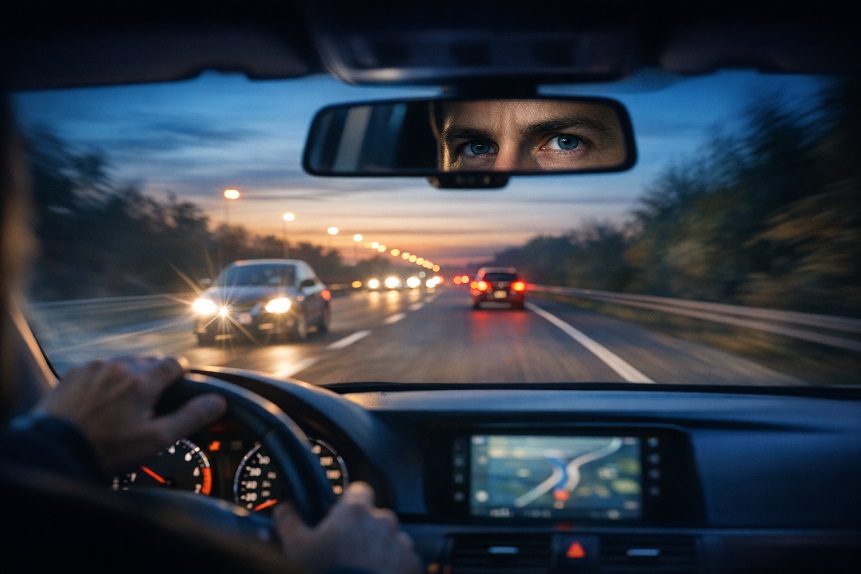
Most drivers think about their vision in exactly two contexts: reading the eye chart at the DMV when renewing their license, and noticing that something has gone wrong. Between those two events, which might span a decade or more, the visual system that is doing most of the work in keeping them and everyone around them safe receives essentially no systematic attention.
This is a significant gap, because driving is one of the most demanding visual tasks that people perform in ordinary daily life. It requires simultaneous management of multiple visual streams: central acuity for reading signs and tracking the road ahead, peripheral awareness for detecting movement at the edges of the visual field, contrast sensitivity for detecting low-visibility objects, glare management under variable lighting, depth perception for judging distances and closing speeds, and the rapid eye movements needed to scan mirrors, instruments, and the road environment at the appropriate rates.
What vision research reveals about driving performance is both reassuring and sobering. Reassuring because many of the visual factors that affect driving performance are measurable, modifiable, and far better understood than most drivers know. Sobering because the standard eye test used for license renewal captures almost none of the visual functions most relevant to safe driving.
The Visual Functions That Driving Actually Requires
Understanding what the visual system is actually doing while a person drives reveals why the standard high-contrast static acuity test is such an inadequate proxy for driving visual competence.
Useful Field of View and Attentional Visual Processing
One of the most practically significant visual measures in driving research is the useful field of view (UFOV), which describes the area of the visual field from which a person can extract and use information without moving their eyes. It is distinct from simple visual field extent, measuring not just how far peripheral vision reaches but how quickly and accurately information can be processed from that periphery while attention is directed to a central task.
UFOV declines with age, with cognitive load, and with divided attention demands. Research has found that reduced UFOV is a strong predictor of driving accident risk, particularly for intersection accidents where peripheral targets must be detected while central attention is on the road ahead. UFOV is trainable, with computerized training programs producing improvements that have been associated with reduced accident rates in older drivers in randomized controlled trials. This is one of the best-supported examples of direct training benefits for real-world driving safety outcomes.
Contrast Sensitivity in the Real Driving Environment
Most driving hazards are not high-contrast black-on-white objects. A pedestrian in dark clothing at dusk, a cyclist at the edge of headlights at night, a debris-strewn stretch of road in rain, a junction marking faded by weathering: these are low-contrast hazard detection tasks that the eye chart says nothing about. Contrast sensitivity testing has been proposed as a more meaningful screening criterion for driving fitness than standard acuity testing, and research consistently finds it to be a better predictor of real-world driving performance in older drivers.
As covered in our article on contrast sensitivity, higher macular pigment optical density is associated with better contrast sensitivity through multiple mechanisms, including reduced intraocular scatter of the blue light that contributes to veiling luminance under challenging lighting conditions. This is one of the clearest practical driving performance implications of eye nutrition, and it operates continuously rather than being a one-time benefit.
Depth Perception and Distance Judgment
Accurate depth perception and distance judgment are foundational to safe following distance management, intersection gap acceptance, lane changing, and parking. Stereoscopic depth perception depends on the coordinated binocular function of both eyes, and it degrades when binocular coordination is impaired or when one eye is significantly worse than the other in terms of acuity or clarity. Monocular depth cues, including motion parallax, relative size, and perspective convergence, remain available even with reduced stereopsis and partly compensate. Drivers who have noted asymmetric vision between their two eyes, such as one eye with uncorrected blur or a cataract that affects one eye more than the other, may have reduced depth perception that affects distance judgment in ways that are not always consciously noticed.
How Vision Changes With Age Affect Driving Specifically
The age-related visual changes described in detail elsewhere on this site have specific and sometimes dramatic implications for driving performance that deserve direct discussion in this context.
The Night Driving Vulnerability
Night driving is where age-related visual changes are most practically consequential. Reduced maximum pupil dilation allows less light to reach the retina in dim conditions. Lens yellowing and increased intraocular scatter amplify glare from oncoming headlights. Slower rhodopsin regeneration extends the recovery period after each glare exposure. Rod photoreceptor loss in the peripheral retina reduces the sensitivity of peripheral hazard detection. The combination means that a driver in their 60s faces objectively worse visual conditions at night than they did at 35, in ways that standard license renewal tests do not capture.
Research has found that older drivers who restrict their night driving do so largely in response to these visual difficulties, representing a sensible self-regulation. But many do not restrict their driving, or do so insufficiently, because the changes are gradual and self-comparison is a poor calibrator of absolute performance. The nutritional approaches to supporting night driving visual performance, including macular pigment for glare and contrast, and rhodopsin-supporting berry anthocyanins for dark adaptation, are covered in detail in our article on supplements and night driving.
Glare Recovery and Intersection Safety
Intersection driving at night presents the highest visual challenge. The combination of oncoming headlights from multiple directions, street lighting that creates high-contrast pools of light and dark, and the need to detect pedestrians, cyclists, and other vehicles in variable lighting conditions simultaneously makes night intersections the most demanding visual environment in ordinary driving. Glare recovery time is particularly safety-critical here, since inadequate recovery after one headlight exposure can mean driving through the subsequent intersection decision with compromised central vision.
The macular pigment’s role in reducing the blue-light-mediated component of intraocular scatter, and therefore reducing the severity of each glare event, makes lutein and zeaxanthin nutrition specifically relevant to this intersection safety scenario. Dense macular pigment does not eliminate glare but reduces the contrast loss it causes and the recovery time it requires. This is a genuine safety benefit that operates at every intersection rather than requiring any behavioral change from the driver.
Motor Racing and Professional Driving: Vision at the Performance Extreme
At the performance extreme of driving, in circuit racing, rally driving, and other motorsport contexts, visual performance becomes as strategically important as vehicle setup and physical fitness. The visual demands at racing speeds are qualitatively different from ordinary driving, and the approaches that professional drivers and their teams use to address them offer instructive examples for understanding vision as a performance variable.
Vision Training in Professional Motorsport
Several Formula 1 teams have incorporated formal vision testing and training into their driver development programs, recognizing that visual reaction time, dynamic visual acuity, and peripheral awareness are measurable and trainable performance variables that contribute to lap times and racing decisions. A driver who detects a braking point marker fractionally earlier, who tracks a competitor’s wheel position with better precision, or who maintains sharper peripheral awareness of track limits under the demanding attentional load of high-speed racing has a genuine performance edge over one who does not.
The approach in elite motorsport parallels what sports science has found in other fast-reaction sports: visual skills can be systematically trained, and the biological quality of the visual system that supports those skills is a legitimate part of the preparation picture. Rally driving, in particular, places extraordinary demands on co-driver and driver communication of visual information under time pressure, creating a specific application for visual processing speed that is rarely paralleled in other athletic contexts.
Anti-Glare Strategies for Racing
Racing drivers face extreme glare challenges, particularly at dawn and dusk events, on high-reflectivity circuit surfaces, and in conditions where direct sun enters the cockpit. Tinted visors provide some protection, but the available tint levels are constrained by the need to maintain adequate visibility in lower-light sections of the circuit. The internal solution of dense macular pigment providing selective blue-light absorption is an advantage that operates regardless of visor choice or lighting conditions and does not create the visibility trade-offs that external optical solutions impose.
Driving as a Visual Performance Test Worth Taking Seriously
The standard approach to visual fitness for driving, a static acuity test at license renewal every decade, is not matched to the visual demands of the task. Research in driving vision consistently identifies contrast sensitivity, useful field of view, glare recovery, and peripheral detection as the functions most predictive of driving safety, none of which are routinely measured in license renewal contexts.
For drivers who want to take their visual fitness for driving seriously, the practical steps run from ensuring current refractive correction and having any symptoms of lens change assessed, through environmental management of glare in their vehicle, to the sustained nutritional support of macular pigment that provides the most durable and consistent contribution to contrast sensitivity and glare management. Our article on foods highest in lutein and zeaxanthin is a useful starting point for the dietary dimension of this approach, alongside the supplementation evidence covered throughout the eye nutrition section of this site.