
If you were designing an eye health supplement from scratch and reached for saffron as an ingredient, you would get some raised eyebrows. Saffron is known as the world’s most expensive spice by weight, harvested from the stigmas of Crocus sativus flowers by hand, three stigmas per flower, roughly 150,000 flowers per kilogram of finished spice. It colors rice golden, flavors paella and risotto, and has been valued in cooking for thousands of years. It is not the first place most people would look for eye health nutrition.
And yet the research on saffron for eye health is among the more compelling in the entire eye nutrition landscape. A series of clinical trials, several conducted by a prominent Italian research group and later replicated by independent teams, have found that saffron supplementation at modest doses produces measurable improvements in retinal function, including outcomes relevant to both early macular degeneration and general visual performance. For a spice rather than a purpose-designed pharmaceutical, this is a surprising and genuinely interesting finding.
Understanding why saffron has these effects requires looking at its active compounds, which are different from the carotenoids and anthocyanins that dominate most of the eye health ingredient conversation.
Saffron’s Active Compounds and How They Work
Saffron’s distinctive color comes from a family of compounds called apocarotenoids, specifically crocin and crocetin, which are chemically related to carotenoids but have a different structure and different biological properties. Its distinctive aroma and flavor come from safranal, a volatile compound that is itself a degradation product of picrocrocin, a bitter glycoside present in fresh saffron. These compounds are not interchangeable with the lutein, zeaxanthin, and anthocyanins that do most of the work in other eye health ingredients. They address different biological targets.
Crocin and Crocetin: Photoprotective Antioxidants
Crocin and crocetin are potent antioxidants that have demonstrated specific protective activity in retinal tissue in research models. Crocin is water-soluble, which is unusual for a carotenoid-related compound and means it can reach tissue compartments that fat-soluble carotenoids cannot. Crocetin is fat-soluble. Together they provide antioxidant coverage across both aqueous and lipid environments within retinal cells. Research has shown that crocin and crocetin protect photoreceptors against light-induced oxidative damage and reduce the release of inflammatory markers in retinal tissue under stress conditions.
In animal models of retinal degeneration, saffron extracts have demonstrated significant photoreceptor protection, slowing the rate of photoreceptor loss under conditions designed to induce retinal stress. These findings drove the human clinical work that followed, and the translation from animal model to human outcomes in saffron research has been more successful than for many ingredients where the animal model findings have not held up in clinical trials.
Safranal and Retinal Signaling
Safranal, the aromatic compound responsible for saffron’s distinctive scent, has attracted specific interest for its effects on retinal function beyond antioxidant protection. Research has found that safranal influences the electrical activity of photoreceptors and retinal ganglion cells in ways that suggest a role in supporting the signal transmission chain that converts light into neural impulses. This is a different mechanism from the structural protection provided by antioxidant carotenoids and represents a dimension of saffron’s activity that has no clear parallel in other eye health ingredients.
The Clinical Evidence: What the Trials Have Found
The clinical research on saffron for eye health is centered on a series of trials conducted primarily at the Università Politecnica delle Marche in Italy, led by researcher Silvia Bisti and colleagues, and subsequently replicated and extended by other groups. The outcomes they have examined include electroretinography (electrical measurements of retinal function), visual acuity, and contrast sensitivity.
Improvements in Early AMD: The Italian Trials
A landmark trial published in Investigative Ophthalmology and Visual Science enrolled participants with early AMD and assigned them to receive 20 mg of saffron daily or placebo for three months. The saffron group showed statistically significant improvements in retinal flicker sensitivity, measured by electroretinography, compared to the placebo group. Retinal flicker sensitivity is a measure of how quickly the retina can respond to rapid changes in light, and it is an early indicator of retinal health that declines in age-related macular disease. A follow-up trial extended the supplementation period and found that the improvements were maintained over longer treatment periods and reversed when supplementation was discontinued, demonstrating a direct relationship between saffron intake and retinal function.
A subsequent study from a separate research group in Australia largely replicated these findings, providing independent confirmation that saffron’s effects on retinal function are reproducible across different populations and research teams. The Australian trial found significant improvements in both best-corrected visual acuity and contrast sensitivity in early AMD patients receiving saffron supplementation. These are not subtle or borderline findings. They represent measurable improvements in functional vision from a food-derived compound at a dose equivalent to a modest daily supplementation amount.
What This Means for People Without AMD
The saffron trials have predominantly enrolled people with early AMD rather than healthy eyes, which is a common feature of nutritional eye research (it is easier to demonstrate improvement when there is room to improve). The relevance to people without diagnosed AMD is indirect but reasonable: the biological mechanisms that saffron appears to support, photoreceptor function, retinal electrical activity, and protection against oxidative damage, operate continuously in all eyes, not just those with existing disease. Supporting these mechanisms in healthy eyes through consistent nutritional intake represents a proactive application of the same science that has shown benefits in compromised eyes.
This is the same logic that underpins the preventive use of lutein and zeaxanthin. The AREDS2 evidence was generated in AMD patients, but the application to healthy eyes with high oxidative stress exposure (including from screens) is a reasonable extension of the underlying biology. Our article on the role of nutrition in age-related vision decline covers this preventive logic more broadly.
Saffron and Visual Performance: The Flicker Sensitivity Connection
One of the specific outcomes improved in the saffron trials, retinal flicker sensitivity, is directly connected to a visual performance dimension that has practical relevance beyond the AMD context.
What Retinal Flicker Sensitivity Actually Measures
Flicker sensitivity refers to the ability of the retina to detect and respond to rapidly alternating light stimuli. High flicker sensitivity means the visual system can detect fast changes in the visual environment with greater precision. This is not an abstract laboratory measure. It underlies the ability to detect motion in peripheral vision, to track fast-moving objects, and to perceive subtle flickering or screen refresh artifacts. For athletes, gamers, and drivers, flicker sensitivity is a component of the visual reaction speed that determines how quickly the eye detects a cue and initiates a response.
The improvement in retinal flicker sensitivity documented in saffron trials therefore has a performance dimension that connects saffron to the visual performance conversation beyond its more commonly discussed role in AMD prevention. This cross-silo relevance, touching on both age-related eye health and active visual performance, makes saffron one of the more interesting ingredients in a comprehensively designed eye supplement. Our article on vision and athletic performance provides context for why flicker sensitivity matters in competitive and active contexts.
Saffron in Supplement Formulas: Quality and Dose Considerations
Given that saffron is the most expensive spice in the world, there are obvious incentives for economizing on the amount or quality of saffron included in supplements. A few practical points are worth knowing when evaluating saffron-containing products.
The Dose Used in Clinical Research
The Italian and Australian clinical trials used 20 mg of saffron daily, typically as a standardized extract specifying its safranal content. Twenty milligrams of high-quality saffron extract is not a large amount in culinary terms, but it is enough to carry the active compound load studied in the research. Products that list saffron without specifying the amount or standardization make it impossible to assess whether a dose relevant to the clinical evidence is present.
Standardization to Safranal
As with other botanical ingredients in eye supplements, standardization to a defined active compound percentage is the clearest indicator of quality and consistency. Saffron standardized to 0.3 percent safranal, which is the specification used in the most rigorous research preparations, provides a defined amount of the active aromatic compound per serving. This specification on a label indicates that the manufacturer has characterized the active content rather than simply including saffron as a label ingredient without active compound verification.
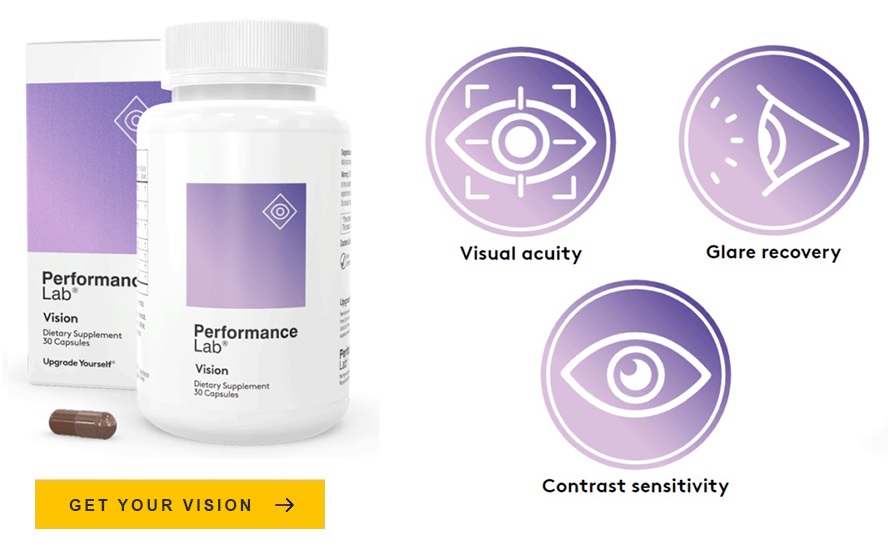
For a complete look at how saffron sits alongside the other six ingredients in a well-designed eye supplement formula, our Performance Lab Vision review covers the full rationale, including how the saffron content in that formula is specified.
The Spice That Earned Its Place in Eye Health Science
Saffron’s presence in eye health research is a good reminder that useful biology does not always come from purpose-designed pharmaceuticals. A spice that has been used in food for millennia turns out to contain compounds with specific and meaningful effects on photoreceptor function, retinal electrical activity, and protection against the oxidative damage that underlies the most common form of irreversible vision loss in older adults.
For an ingredient with a clinical evidence base this solid, the surprise is not that it is included in serious eye supplements. The surprise is that it is not more widely known outside the research community. If you want to understand how saffron fits alongside astaxanthin, lutein, zeaxanthin, bilberry, and blackcurrant in a formula designed around the ingredients with the strongest eye health evidence, our full review covers all six ingredients in a single, integrated assessment.