
Watch a professional baseball batter face a 95-mile-per-hour fastball and the physics become uncomfortable quickly. The ball travels the 60 feet between the mound and home plate in roughly 400 milliseconds. A batter needs approximately 150 to 200 milliseconds to initiate and execute a swing. That leaves somewhere between 200 and 250 milliseconds to detect the ball, process its trajectory, decide whether to swing and where, and begin the motor command. The human visual system processes information with a lag of roughly 100 milliseconds between the light hitting the retina and a conscious perception forming. The math is unforgiving, and yet skilled batters connect with remarkable regularity.
They manage it not because they are somehow exempt from physics, but because they are extracting visual information earlier, more completely, and more efficiently than unskilled observers. They are not just faster physically. They are faster visually. The distinction matters because it means that visual performance in sport is a genuine skill dimension, one that varies between athletes, that responds to training, and that has a nutritional substrate that most coaches and athletes have barely begun to consider.
Visual performance in athletic contexts is not a single capability. It is a collection of distinct skills, each measurable, each trainable to some degree, and each influenced by the biological health and nutritional status of the visual system that underlies them.
The Visual Skills That Athletic Performance Actually Depends On
Sports vision research has spent four decades identifying and measuring the specific visual capabilities that distinguish elite athletes from recreational ones. The findings are consistent enough to describe a cluster of visual skills that matter in sport and that elite athletes tend to outperform the general population on, even when matched for general intelligence and reaction time measured non-visually.
Dynamic Visual Acuity: Seeing Clearly What Is Moving
Static visual acuity, the kind measured on an eye chart, tells you how clearly you can see a stationary high-contrast object under ideal conditions. Dynamic visual acuity is the ability to resolve detail in a moving object, which is a different and substantially more demanding visual task. A cricket ball traveling at 80 miles per hour, a tennis ball spinning after a kick serve, a hockey puck deflecting off a post all require dynamic visual acuity for reliable tracking and response. Research has consistently found that elite athletes in ball sports have superior dynamic visual acuity compared to recreational athletes and non-athletes, even when their static acuity is comparable.
Dynamic visual acuity is partly a function of smooth pursuit eye movement quality, the ability to track a moving object with accurate, coordinated eye movements that keep it centered on the fovea. Athletes who train extensively in ball-tracking sports show measurable improvements in pursuit accuracy, suggesting that this component of dynamic visual acuity responds to sport-specific visual experience. The extraocular muscles that execute pursuit movements, like other muscles, adapt to the demands placed on them.
Peripheral Awareness and the Wide Visual Field
The vast majority of sports require awareness of the full visual scene, not just the central focal object. A basketball player needs to know where teammates and defenders are across the entire court while focusing on the ball. A football receiver needs peripheral awareness of approaching defenders while tracking the ball. A racing cyclist needs peripheral detection of hazards while maintaining forward gaze on the course ahead. This peripheral awareness depends on the sensitivity of the rod-dominant peripheral retina and the neural processing systems that monitor the wider visual field while central vision is engaged with a specific task.
Research has found that elite team sport athletes show superior peripheral detection thresholds compared to less experienced athletes, and that experienced athletes use their peripheral visual information more efficiently, making better decisions with less reliance on direct fixation of secondary targets. This appears to reflect genuine perceptual learning rather than simply better peripheral acuity, which does not differ markedly between groups. Experienced athletes have learned to extract more useful information from the same peripheral visual input.
Visual Reaction Time: The Speed That Wins and Loses
Visual reaction time is the interval between a visual stimulus appearing and a correctly initiated motor response beginning. It has two components: the perceptual component, how quickly the visual system detects and processes the stimulus, and the decision-motor component, how quickly the appropriate response is selected and initiated. Both matter for athletic performance, and they respond to different types of training and nutritional support.
How Elite Athletes Reduce Effective Reaction Time
The counterintuitive finding from reaction time research in sport is that many elite athletes do not actually have faster raw visual reaction times than non-athletes when tested in simple reaction time paradigms. What they have is a superior ability to use advance visual cues, picking up postural and movement information from an opponent before the critical event occurs, which effectively gives them a head start on the reaction that allows them to respond in time. A tennis player who reads the server’s ball toss, shoulder angle, and racket face orientation before the serve is delivered is not reacting to the ball. They are responding to the cues that predict where the ball will go, which dramatically reduces the effective time pressure they face.
This anticipatory visual skill is trainable, primarily through deliberate sport-specific practice that exposes athletes to high volumes of the specific cue patterns relevant to their sport. The neural efficiency with which the visual system processes these cues is also influenced by its biological health. The retinal signaling speed that determines how quickly visual information is transmitted from photoreceptors to the brain, supported by the photoreceptor-protective nutrition discussed in our article on astaxanthin for eye health, contributes to the raw speed of visual information processing that underlies all reaction time performance.
The Role of Contrast Sensitivity in Reaction Speed
An underappreciated contributor to visual reaction time in sport is contrast sensitivity. If an athlete cannot reliably detect a low-contrast object or motion cue, their reaction to it is slower not because their motor system is slow but because their visual detection is delayed by the time required to accumulate enough sensory evidence to cross the detection threshold. Better contrast sensitivity means objects are detected earlier in their approach, which effectively extends the available reaction window without changing the physical speed of either the stimulus or the response.
This is one of the practical performance implications of macular pigment density discussed in our contrast sensitivity article. Higher macular pigment optical density is associated with better contrast sensitivity across multiple spatial frequencies, including the intermediate frequencies most relevant to object detection in natural visual environments. Building macular pigment through consistent lutein and zeaxanthin intake is therefore a nutritional strategy with indirect but genuine relevance to visual reaction time in sport.
Eye Movement Skills: The Physical Performance of Vision
The muscles that move the eyes are as much a part of athletic visual performance as the photoreceptors and neural processing systems. Their speed, accuracy, and coordination determine how efficiently visual attention is directed and maintained during fast, complex movement environments.
Saccades: The Fast Directional Shifts
Saccades are the rapid, high-velocity eye movements used to shift gaze from one location to another. They are the fastest movements the human body makes, reaching peak velocities of several hundred degrees per second, and they happen dozens of times per minute during normal visual behavior. In sport, saccade accuracy and speed determine how quickly an athlete can check multiple locations, shift attention between a primary and secondary target, and update their situational awareness during play.
Saccadic performance has been found to differ between athletes and non-athletes and between skill levels within sport, with more skilled athletes making more accurate and better-directed saccades that gather more relevant information per unit time. Saccadic fatigue, a reduction in saccade accuracy and speed with sustained visual demand, is relevant in sports with extended play times and may be one of the mechanisms through which general fatigue degrades performance in late game situations even when physical fatigue is not the primary limiting factor.
Vergence: The Depth and Coordination Dimension
Vergence movements, the inward or outward rotation of the two eyes to maintain binocular fusion as objects move toward or away from the observer, are critical for accurate depth perception and ball-tracking in three-dimensional space. Convergence insufficiency, the difficulty maintaining accurate vergence for near or approaching objects, reduces depth perception accuracy and can impair the ability to judge ball arrival timing. It is more common than generally recognized and is specifically relevant to sports involving fast-approaching or receding objects.
Supporting the Visual Athlete Nutritionally
The visual performance dimensions described above are primarily trained through sport-specific practice. But the biological substrate on which all of them depend, the photoreceptors, the retinal signal transmission, the macular antioxidant defenses, the ciliary muscles that support accommodation during tracking tasks, all respond to nutritional status.
Macular Pigment for Contrast and Glare
Building macular pigment through consistent lutein and zeaxanthin intake supports contrast sensitivity and reduces glare sensitivity, both of which have direct relevance to visual performance in outdoor and variable-lighting sports conditions. The 10 mg lutein and 2 mg zeaxanthin daily standard supported by the clinical evidence provides a meaningful foundation for athletes who want to optimize the optical quality of their visual input. The time course is months rather than weeks, which means starting consistent supplementation during the off-season or preseason rather than immediately before competition produces the most meaningful benefit.
Astaxanthin for Accommodative Endurance
In sports involving sustained visual tracking at varying distances, the ciliary muscles that control accommodation are under sustained demand throughout play. Astaxanthin, with its clinical evidence for supporting ciliary body function and reducing accommodative fatigue, is specifically relevant for athletes in sports with high visual tracking demands. A goalkeeper tracking a ball through multiple deflections, a tennis player processing split-second approach shots, or a racing driver managing visual information at high speed over extended periods are all placing accommodative and extraocular muscle demands on their visual systems that nutritional support can help sustain. The evidence for astaxanthin in this context is reviewed in our astaxanthin for eye health article.
Vision Is a Performance System Worth Training
The sports science community has been slow to bring eye health nutrition into the performance conversation that vision training has established over the past two decades. The two approaches address different aspects of the same system: vision training improves the perceptual skills and neural efficiency with which the visual system processes information; eye nutrition optimizes the biological substrate on which those skills run. Athletes who invest in one without the other are leaving performance on the table.
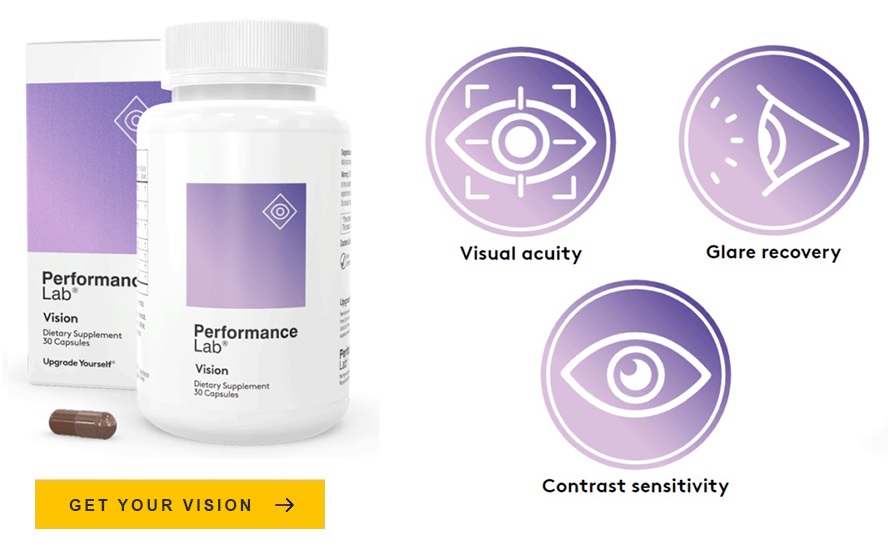
For a complete picture of visual reaction time training and supplementation specifically, our dedicated article on visual reaction time covers both dimensions in depth. And for the overview of how visual nutrition fits together in a single daily formula designed for performance-oriented individuals, our Performance Lab Vision review covers the relevant ingredients and the evidence behind each.