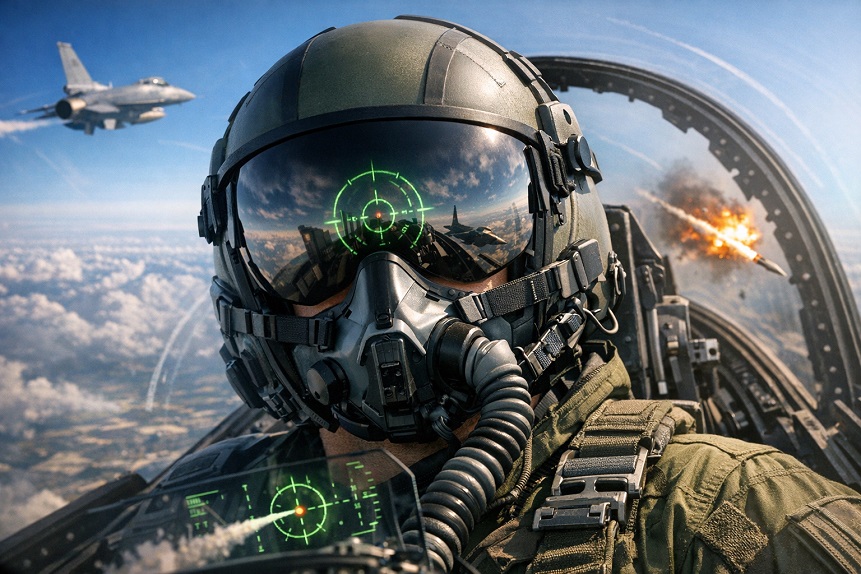
If you want to find the human beings who have thought most carefully about visual performance, look past the ophthalmology clinics and the sports vision labs. Look at fighter pilot selection programs. Military aviation has been stress-testing human visual performance under extreme operational demands for the better part of a century, and the lessons learned are far more applicable to everyday life than most people realize.
Fighter pilots operate in an environment that punishes every visual weakness. Cockpit scanning at several hundred miles per hour. Target identification at distances where the margin between friend and foe can be a silhouette detail. Dark adaptation in seconds rather than minutes. Situational awareness across 360 degrees of airspace while managing instrument panels, radio communications, and gravitational forces that compress blood toward the lower body and away from the eyes. It is, without exaggeration, the most visually demanding occupational environment humans have designed.
The Visual Standards — and Why They’ve Changed
Early military aviation required near-perfect uncorrected vision for candidates. The reasoning was partly practical and partly the result of limited options: corrective technology wasn’t reliable enough in early flight environments, and the assumption was that only naturally excellent vision would perform under pressure.
Modern programs have revised that calculus considerably. Corrected vision to specific standards is now accepted in most major air forces. What hasn’t changed is the emphasis on functional visual performance beyond acuity: contrast sensitivity, depth perception, color discrimination, dark adaptation, and the capacity for sustained high-load visual processing across long missions.
The shift is instructive. The military moved from measuring static acuity to measuring functional visual performance because operational experience made it clear that static acuity was an incomplete predictor of real-world performance. That lesson is worth applying in any context where vision matters under demand.
Cockpit Scanning: A Master Class in Attention Control
Fighter pilots don’t look at things the way most people do. They’re trained in highly specific scanning patterns — systematic sequences for instrument checks, threat detection, terrain awareness — that distribute visual attention efficiently across a complex environment without dwelling anywhere too long or missing critical areas.
This is trained behavior, not natural behavior. The untrained eye has a strong tendency to fixate: to stare at something interesting and neglect the visual periphery. In a cockpit, fixation kills. A pilot who stares at a developing threat at ten o’clock for two seconds has missed everything that happened at two o’clock during that window.
The technical term for this failure mode is “tunneling” — the narrowing of effective visual field under stress or cognitive load. Every high-performance environment has its version of tunneling. The basketball player who locks onto one defender. The driver who focuses on the obstacle ahead and stops scanning mirrors. The surgeon who focuses on one tissue structure and loses spatial context. The training principles fighter pilots use to combat tunneling have applications wherever sustained wide-field visual attention is required.
Peripheral vision training — drills that force processing of peripheral stimuli while maintaining central focus — is one direct application. The training context shifts, but the underlying skill being developed is the same one that keeps a pilot’s effective visual field wide under pressure. Athletes working on these skills will find relevant discussion in the article on motion detection and sport.
Dark Adaptation on Demand
Night missions create a visual demand that has no peacetime civilian equivalent: transitioning from a brightly lit cockpit environment to complete darkness, as fast as possible, with full operational effectiveness required throughout. Military aviation has developed detailed protocols around this problem.
Red cockpit lighting is the classic solution. Red light has the least effect on rhodopsin, the light-sensitive pigment in rod cells responsible for low-light vision. By using red-spectrum lighting for all cockpit illumination during night operations, pilots preserve the dark adaptation they need for outside-the-cockpit awareness while still being able to read instruments inside.
Nutrition is part of the dark adaptation equation as well. Vitamin A is the direct metabolic precursor to retinal, the chromophore embedded in rhodopsin. Military nutritional research identified vitamin A deficiency as a genuine dark adaptation impairment decades before it became a topic in civilian sports nutrition. The relationship between rhodopsin, dark adaptation, and carotenoid nutrition is covered in depth in the article on rhodopsin explained.
What pilots figured out through operational necessity — that nutritional status directly affects low-light visual performance in ways that can’t be corrected by equipment alone — is just as true for hunters, night drivers, and anyone who spends time operating in low-light conditions.
G-Force and the Visual System
High-G maneuvers present a unique challenge to the visual system that has no real civilian analog, but the underlying physiology reveals something important about how visual function depends on blood flow and intraocular pressure.
Under high positive G-forces, blood is pushed toward the lower body and away from the brain and eyes. Pilots experience “grayout” — a loss of peripheral vision that progresses toward total visual blackout — as retinal perfusion decreases. Anti-G suits and specific muscle-tensing techniques (the AGSM, or anti-G straining maneuver) counteract this by maintaining blood pressure in the upper body.
The practical lesson for most people isn’t about G-forces. It’s about the fundamental dependence of retinal function on adequate blood supply and intraocular pressure management. Conditions like glaucoma, hypertension, and diabetes impair retinal blood flow through different mechanisms but with overlapping functional consequences. The visual system is not a passive optical instrument. It’s a living tissue with metabolic demands, and performance reflects whether those demands are being met.
Visual Search and Threat Detection
Beyond cockpit scanning, pilots develop highly refined visual search strategies for threat detection. At combat ranges, identifying a hostile aircraft against sky or terrain backgrounds is a contrast sensitivity task performed at extreme speed. Pilots train to look for movement cues, shape recognition at low contrast, and characteristic silhouettes that encode aircraft type.
This is sports vision on a life-or-death scale, and the training methods developed for it have real civilian applications. Stroboscopic training — which fighter pilot vision research helped pioneer — has now found its way into NFL training rooms and major league baseball organizations. The principle is the same: intermittently removing visual input forces the brain to process information more efficiently, developing the predictive visual processing that performs better under real-world conditions than pure reactive tracking.
The overlap between pilot visual training and sport-specific visual performance is discussed in the article on visual reaction time and how to train it, which covers some of these training applications in detail.
What Everyday People Can Actually Take From This
The fighter pilot example isn’t just an interesting extreme case. It’s a stress test that reveals, under maximum demand, what the visual system needs to perform. The variables that degrade under those demands are the same ones that degrade, more subtly, in sports performance, sustained screen work, night driving, and any visually demanding activity.
Several principles transfer directly:
Scanning beats fixating. Training deliberate wide-field visual attention — forcing the eyes to scan rather than stare — improves situational awareness in any complex visual environment. Drivers, athletes, and anyone responsible for monitoring a complex scene benefits from this.
Nutrition supports function at the tissue level. Rhodopsin requires vitamin A. Macular pigment requires lutein and zeaxanthin. Contrast sensitivity tracks macular pigment density. These relationships hold whether you’re flying a combat sortie or playing recreational tennis.
Fatigue attacks vision before it’s obvious. The progressive narrowing of effective visual field under cognitive and physical load — the tunneling effect — begins well before the athlete or operator feels impaired. Recognizing the early signs and having strategies to counteract them is a skill that can be developed.
The visual system is trainable and maintainable. The military doesn’t treat pilot vision as fixed. It trains visual skills systematically and maintains them through ongoing standards and nutritional protocols. Extending that philosophy to civilian athletic and occupational performance is a straightforward application of well-established principles.
Note: If you experience unexplained changes in peripheral vision, dark adaptation, or visual field, these warrant evaluation by an eye care professional. Some of these symptoms can be early indicators of conditions that benefit significantly from early detection and management.
The Long View
Fighter pilots, at the peak of their careers, fly with remarkable visual precision. They also tend to invest seriously in maintaining that precision — because the cost of not doing so is vivid and immediate in their world. For most of us, visual degradation is gradual and the consequences are more subtle: a putt misread, a ball lost in flight, a night drive that feels harder than it used to.
The same biological systems are at work in all of these cases. The principles of visual maintenance developed in the most demanding human operational environment on the planet are fully applicable to the rest of us. We just have to decide the returns are worth the attention. If you’re curious about what nutritional support for sustained visual performance looks like, the Performance Lab Vision review walks through the evidence in detail.