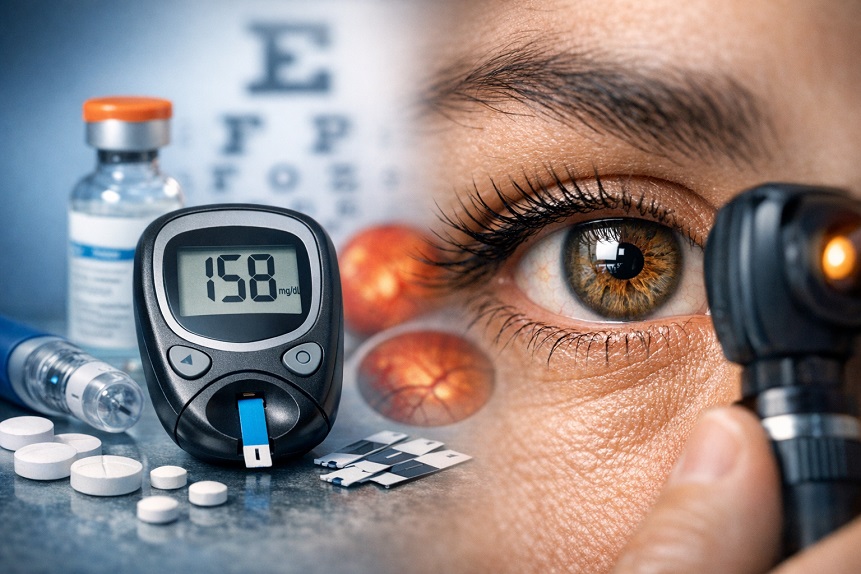
Diabetic retinopathy is the leading cause of new vision loss in working-age adults in developed countries. That single fact deserves a moment to register. In a world with macular degeneration, glaucoma, trauma, and infectious eye disease all competing for that grim distinction, diabetic retinopathy comes out on top in the 20-to-65 age bracket. And unlike most of its competition, it is substantially preventable — not by some novel pharmaceutical, but by the management of a condition that roughly 37 million Americans already know they have and many millions more have but haven’t yet been diagnosed with.
Diabetes affects the eye through multiple mechanisms, some universal to all diabetics and some dependent on the duration and severity of glucose dysregulation. Understanding which mechanisms are at work, when they become dangerous, and what can be done about them is the kind of knowledge that makes a real difference in long-term visual outcomes.
How Elevated Glucose Damages Ocular Tissue
The damage diabetes does to the eye is fundamentally vascular, though secondary neural and structural effects amplify it. Chronically elevated blood glucose harms ocular tissues through several overlapping biochemical pathways that are worth understanding in outline rather than as a single monolithic “diabetes is bad for eyes” statement.
The polyol pathway is one primary mechanism: glucose is converted to sorbitol by aldose reductase in cells that take up glucose independently of insulin — which includes pericytes and endothelial cells of the retinal vasculature, Schwann cells of the optic nerve, and the lens epithelium. Sorbitol accumulates in these cells, causing osmotic stress, depleting NADPH needed for antioxidant defense, and impairing cellular function. This is the same pathway that drives diabetic cataracts in the lens.
Advanced glycation end-products (AGEs) form when glucose non-enzymatically reacts with proteins and lipids, altering their structure and function. In retinal blood vessels, AGE accumulation thickens the basement membrane of capillaries, impairs pericyte adhesion, and triggers inflammatory and angiogenic signaling. AGEs accumulate proportionally to average glucose exposure over time — which is exactly what HbA1c measures, making it the most clinically relevant glucose-related risk marker for retinopathy development and progression.
Oxidative stress, generated in excess during hyperglycemia through multiple pathways, directly damages retinal capillary cells. Mitochondrial dysfunction in pericytes and endothelial cells under hyperglycemic stress reduces their ability to maintain capillary integrity and respond to the constant mechanical demands of circulation. When pericytes — the contractile cells that wrap retinal capillaries and regulate their tone — die, capillary microaneurysms develop: the first visible sign of diabetic retinopathy on fundus examination.
The Stages of Diabetic Retinopathy
Diabetic retinopathy develops through a fairly well-characterized progression, and understanding the stages helps clarify why early detection matters so much and what the risk at each stage actually is.
Non-proliferative diabetic retinopathy (NPDR) encompasses the earlier stages where changes are confined to the retinal microvasculature itself, without new blood vessel growth. Mild NPDR shows only microaneurysms — small outpouchings of weakened capillary walls. Moderate NPDR shows more extensive microaneurysms, dot and blot hemorrhages (blood leaking into the deeper retinal layers), hard exudates (lipid deposits from leaking vessels), and soft exudates (cotton-wool spots indicating nerve fiber layer infarcts). Severe NPDR shows more widespread hemorrhages across all four quadrants, venous beading, and intraretinal microvascular abnormalities. Severe NPDR carries a 15% annual risk of progressing to proliferative disease.
Proliferative diabetic retinopathy (PDR) is the advanced stage where the retina, deprived of adequate oxygen by the failing microvasculature, secretes angiogenic growth factors that drive the growth of new, fragile blood vessels on the retinal surface and into the vitreous. These neovascular fronds bleed easily, causing vitreous hemorrhage — a sudden dramatic loss of vision as blood fills the vitreous cavity. They can also contract, causing tractional retinal detachment. Both complications can result in severe permanent vision loss.
Diabetic macular edema (DME) can occur at any stage of retinopathy and is the most common cause of vision loss in diabetic patients. When retinal capillaries leak fluid into the central macular tissue, the resulting swelling distorts the precise photoreceptor architecture of the fovea, producing the blurred or distorted central vision that patients notice. DME is treatable — effectively so, with anti-VEGF injections and laser therapy — but best outcomes depend on early detection before permanent photoreceptor damage has occurred.
Why Most Diabetic Retinopathy Goes Undetected Until Too Late
The most frustrating aspect of diabetic retinopathy from a public health standpoint is that it is completely asymptomatic through most of its development. A patient with moderate NPDR — already at meaningful risk of visual loss — may have 20/20 vision and no visual complaints whatsoever. By the time they notice something is wrong, they often have PDR with vitreous hemorrhage or advanced DME that has already caused structural retinal damage.
This is precisely why annual dilated fundus examination is the standard of care for all diabetic patients, and why compliance with this recommendation is critical. The examination catches retinopathy at stages where intervention is most effective: laser photocoagulation, anti-VEGF injections, and vitrectomy all have dramatically better outcomes when applied before advanced structural damage has occurred rather than after it.
Type 1 diabetics typically begin annual retinal screening five years after diagnosis, as retinopathy is uncommon in the first few years. Type 2 diabetics should have a baseline retinal examination at diagnosis — not five years later — because type 2 diabetes frequently goes undiagnosed for years before detection, and retinopathy may already be present at the time of diagnosis. In practice, approximately 21% of newly diagnosed type 2 diabetics have some degree of retinopathy at diagnosis. The patient who assumed they’d start worrying about their eyes after a few years of having “just a bit of diabetes” may already be behind the curve.
Glucose Control: The Foundational Intervention
No intervention for diabetic retinopathy comes close to glucose control in terms of evidence strength and effect size. The Diabetes Control and Complications Trial for type 1 diabetes and the United Kingdom Prospective Diabetes Study for type 2 both demonstrated, with landmark clarity, that intensive glucose control reduces the incidence of retinopathy by approximately 76% and slows its progression significantly in those who already have early disease.
Every percentage point reduction in HbA1c corresponds to a meaningful reduction in retinopathy risk. This is not abstract. A type 2 diabetic who maintains HbA1c at 7.0% rather than 9.0% over a decade is protecting their retinal vasculature in a way that no retinal injection or laser treatment can substitute for. The interventions available after retinopathy is established — however effective — are repairing damage that better glucose management could have prevented.
Diet, exercise, medication adherence, and blood pressure control are the tools of glucose management. Exercise, in particular, deserves mention as a dual-purpose intervention: it improves insulin sensitivity and glycemic control while also independently improving retinal blood flow and reducing IOP. The article on exercise and vision covers these overlapping benefits in detail.
Blood Pressure and Kidney Health: The Amplifiers
Diabetic retinopathy is not driven by glucose alone. Blood pressure, which independently damages retinal vasculature, amplifies the damage that elevated glucose is already producing. Tight blood pressure control — targeting below 130/80 mmHg — reduces retinopathy progression independent of glucose control, and the combination of good glucose management and good blood pressure management is substantially more protective than either alone.
Diabetic nephropathy — kidney disease from diabetes — is also closely linked to retinopathy risk through shared microvascular mechanisms. Progressive kidney disease worsens anemia, fluid balance, and systemic inflammatory state in ways that further stress the retinal microvasculature. Comprehensive diabetes management that addresses glucose, blood pressure, and kidney health simultaneously represents the full protective strategy that the evidence supports.
Note: Diabetic patients who notice any sudden vision changes, new floaters, flashing lights, or areas of visual loss should seek urgent eye care evaluation rather than waiting for their next scheduled appointment. Vitreous hemorrhage and tractional retinal detachment require prompt assessment and often urgent intervention.
The Preventable Catastrophe
Diabetic retinopathy, at its worst, produces blindness in people who are often still young by any normal reckoning — in their forties, fifties, and early sixties, with decades of visual life ahead of them. The tragedy is not that it’s inevitable. It’s that the tools to prevent severe visual loss — glucose control, blood pressure management, regular retinal examination, and timely treatment when disease is found — exist, work, and are consistently underutilized.
For diabetic patients who are also attending to nutritional support for eye health, the key consideration is glucose management through diet as the primary priority, with antioxidant and carotenoid nutrition as a complementary layer. The article on the complete food guide for eye health covers the dietary pattern most consistent with both glycemic management and ocular nutritional support. The Performance Lab Vision review discusses the supplemental nutrients that provide additional antioxidant support alongside a well-managed diabetic diet.