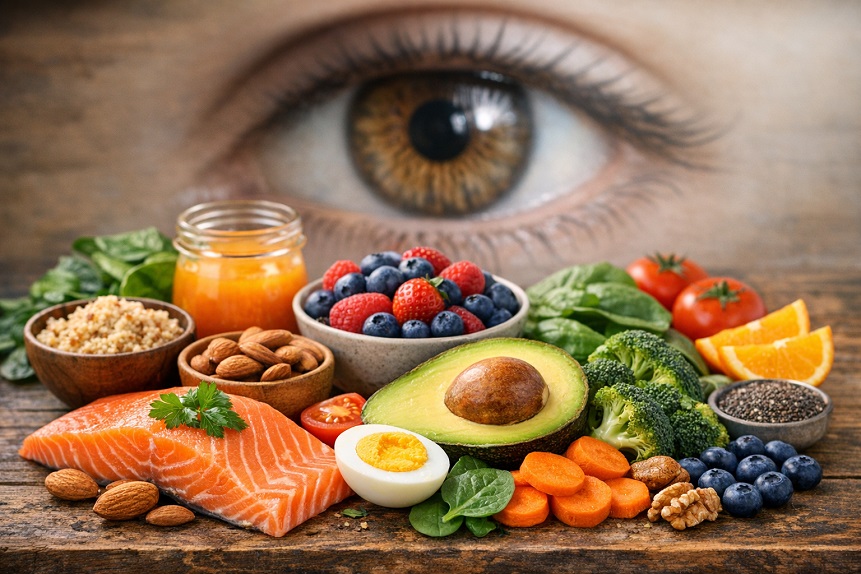
The nutrition and eye health story is one of the better-evidenced areas in dietary medicine, and yet most people who care about their vision have only a vague sense of which foods actually matter and why. They know leafy greens are “good for eyes” and they’ve heard of lutein, and that’s roughly where most people’s practical food knowledge stops.
The reality is more specific, more actionable, and frankly more interesting than that. Different foods protect the eye through different mechanisms. Some work by building the macular pigment that defends the central retina. Some support the tear film. Some protect the lens from oxidative damage. Some maintain the retinal vasculature that supplies oxygen to photoreceptors. Knowing which foods do which things — and in what quantities — turns “eating for eye health” from a vague aspiration into a practical food strategy.
Dark Leafy Greens: The Macular Foundation
Dark leafy greens are the single most important food category for macular health, and the gap between what most people eat and what the research suggests is protective is large enough to be worth taking seriously.
Kale and spinach lead the list by a substantial margin. A 100-gram serving of cooked kale delivers roughly 18 to 20 mg of lutein and zeaxanthin — the carotenoids that build macular pigment. A 100-gram serving of cooked spinach provides around 12 mg. By comparison, average lutein and zeaxanthin intake in Western populations is estimated at 1 to 2 mg per day. The research literature most consistently associates protective macular pigment density with intakes in the 10 to 20 mg daily range. That gap — a factor of 5 to 10 between typical intake and protective intake — explains a great deal about the macular degeneration burden in Western countries.
Collard greens, Swiss chard, turnip greens, and mustard greens are strong secondary sources in the same family. Cooked forms are meaningfully preferable to raw for lutein and zeaxanthin absorption, because cooking breaks down cell walls and releases the carotenoids from chloroplast membranes, improving bioavailability. Consuming these vegetables with a fat-containing food further enhances absorption, as carotenoids are fat-soluble and require dietary fat for micellar incorporation and uptake in the small intestine.
Broccoli and Brussels sprouts, while not in the top tier for carotenoid density, are good secondary sources and also provide vitamin C — an additional antioxidant nutrient relevant to both lens and retinal health.
Eggs: A Uniquely Bioavailable Source
Egg yolks contain lutein and zeaxanthin at lower absolute concentrations than dark leafy greens — roughly 0.2 to 0.3 mg per yolk — but in a fat-rich matrix that makes them exceptionally bioavailable. Several studies have found that the lutein and zeaxanthin from egg yolks raises serum carotenoid levels more effectively per milligram than equivalent doses from spinach or supplements, likely because the fat content of the yolk enhances micellar absorption without requiring additional dietary fat.
Eggs are also a rich source of choline and high-quality protein, and their eye health reputation is fully deserved. For people who find consistent dark leafy green consumption difficult to sustain, two to three eggs per day is a meaningful contribution to carotenoid intake. For people who already eat plenty of leafy greens, eggs add to the total and contribute bioavailable forms that complement vegetable-derived carotenoids.
The detailed comparison of lutein and zeaxanthin food sources and their relative contributions to macular pigment is covered in the article on foods highest in lutein and zeaxanthin.
Oily Fish: DHA and the Retinal Structure
The retina has one of the highest concentrations of docosahexaenoic acid (DHA) in the body. DHA is the dominant fatty acid in photoreceptor outer segment membranes, where its unique structural properties — extreme chain length and multiple double bonds — create the membrane fluidity required for rapid conformational changes in rhodopsin and cone opsins during phototransduction. Without adequate DHA, photoreceptor membrane function is compromised at a fundamental level.
The body can synthesize DHA from shorter omega-3 precursors, but this conversion is inefficient — particularly in older adults. The most reliable dietary source is preformed DHA from oily fish: salmon, mackerel, sardines, anchovies, herring, and trout. Two to three servings per week provides approximately 1 to 2 grams of combined EPA and DHA, a range associated with benefits for retinal DHA status and ocular surface health in clinical studies.
Observational studies consistently associate higher fish consumption with lower AMD risk, particularly for the neovascular form. DHA and EPA also have anti-inflammatory effects relevant to dry eye disease and ocular surface health — omega-3s modulate the inflammatory pathways involved in meibomian gland dysfunction, and clinical evidence for omega-3 supplementation in dry eye is broadly supportive even if individual trials have been mixed.
For those who don’t eat fish, algae-derived DHA supplements are the most directly usable alternative, bypassing the inefficient conversion chain entirely. Flaxseed, walnuts, and chia seeds provide ALA — the plant omega-3 precursor — but ALA conversion to DHA is limited and variable, and these sources alone are unlikely to maintain retinal DHA status at optimal levels.
Colorful Vegetables and Fruits: The Antioxidant Spectrum
Beyond lutein and zeaxanthin, a broad spectrum of dietary antioxidants supports eye health through complementary mechanisms. Vitamin C — abundant in bell peppers, citrus fruits, kiwi, and strawberries — is present in the aqueous humor of the eye at concentrations 30 to 50 times higher than in blood plasma, reflecting active concentration by ocular tissues that depend on it for antioxidant protection. The lens is particularly dependent on vitamin C for maintaining the glutathione-based antioxidant system that prevents crystallin protein aggregation.
Orange and yellow vegetables provide beta-carotene and other carotenoids, some of which are converted to vitamin A — the direct precursor to retinal, the chromophore in rhodopsin that enables low-light vision. Sweet potatoes, carrots, butternut squash, and orange peppers are excellent sources. While outright vitamin A deficiency is rare in Western populations, adequate dietary provitamin A supports rhodopsin regeneration and dark adaptation quality.
Berries — blueberries, bilberries, blackcurrants, and similar dark-pigmented fruits — contain anthocyanins and other polyphenols with documented effects on retinal blood flow and rhodopsin regeneration in several research models. The evidence for bilberry specifically in eye health has a long history and a reasonable mechanistic foundation, though clinical trial evidence for specific outcomes is more modest than the popular reputation of these foods suggests.
The polyphenols in green tea, dark chocolate (at high cocoa percentages), and olive oil contribute antioxidant and anti-inflammatory activity that supports overall ocular health as part of a Mediterranean-style dietary pattern, even if their individual eye health effects are difficult to isolate in epidemiological research.
Nuts and Seeds: Vitamin E and Zinc
Almonds, sunflower seeds, and hazelnuts are among the richest dietary sources of vitamin E, the primary lipid-soluble antioxidant protecting polyunsaturated fatty acid membranes — including the DHA-rich photoreceptor membranes — from oxidative damage. A small handful of almonds or sunflower seeds daily provides a meaningful contribution to vitamin E intake against the backdrop of an otherwise variable diet.
Pumpkin seeds, red meat, and shellfish (particularly oysters) are excellent sources of zinc, a mineral that appears in the AREDS2 formulation for good reason. Zinc is required for the function of numerous enzymes in the retinal pigment epithelium and is necessary for the conversion of beta-carotene to active vitamin A. The macula and RPE have among the highest zinc concentrations of any tissue in the body. Adequate dietary zinc from varied food sources is a straightforward target; the high doses used in AREDS2 trials are intended for people with intermediate AMD and are not generally recommended without clinical guidance.
Foods That Undermine Eye Health
The positive food list matters most, but a few dietary patterns clearly work against it. High-glycemic foods — refined carbohydrates, added sugars, white bread, sweetened beverages — are independently associated with higher AMD risk through advanced glycation end-product accumulation in retinal tissue and lens proteins. This is a consistent finding across multiple large cohort studies and has a plausible, well-characterized mechanism.
Ultra-processed foods that displace nutrient-dense alternatives are harmful to eye health in the same way they’re harmful to everything else — by crowding out the vegetables, fish, eggs, and whole foods that provide the specific nutrients the eye depends on. A diet built primarily around processed foods is a lutein-deficient, DHA-deficient, vitamin C-deficient diet with elevated glycemic load, and the retina reflects those choices over decades.
Putting It Together as a Daily Pattern
The most practical way to integrate eye-protective nutrition is to think in terms of anchor foods rather than individual nutrient targets. One substantial serving of cooked dark leafy greens daily. Eggs several times per week. Two to three servings of oily fish per week. Daily fruit and colored vegetables for antioxidant breadth. A small handful of nuts. Moderate whole grain carbohydrates in place of refined alternatives. Fish oil or algae-sourced DHA as a gap filler if fish intake is inconsistent.
This framework maps almost exactly onto a Mediterranean dietary pattern — which is no coincidence, given the consistent association between Mediterranean diet adherence and lower AMD, cataract, and dry eye risk across multiple populations. The broader evidence for dietary approaches to age-related vision decline is covered in the article on the role of nutrition in slowing age-related vision decline.
For people who want to ensure reliable coverage of the key eye-protective nutrients — particularly lutein and zeaxanthin at meaningful doses — targeted supplementation can bridge the gap between what a good diet provides and what the research suggests is optimal. The Performance Lab Vision review examines how a well-formulated eye supplement maps to the food-based evidence.