
Sometime in your early to mid-forties, something changes. You hold your phone a little further away. Restaurant menus become a lighting problem. You find yourself needing better light to read things that were no trouble six months ago. And then, with some mix of resignation and disbelief, you realize what’s happening: your eyes are aging.
It’s one of those biological transitions that feels sudden but has been accumulating for years. The forties are the decade when the visual system’s slow background changes become impossible to ignore. Some of what happens is completely normal — expected, predictable, manageable. Some is worth paying closer attention to. Knowing the difference matters, because the habits and decisions you make in your forties have real consequences for the quality of your vision in your sixties and beyond.
The Reading Problem Everyone Eventually Faces
The first change most people notice in their forties is difficulty focusing on close objects. Reading fine print, looking at a phone screen, threading a needle — tasks that were effortless start requiring effort. This is presbyopia, and it’s essentially universal.
The lens of the eye focuses by changing its curvature — a process driven by the ciliary muscles that surround it. In youth, the lens is pliable and responsive. With age, it progressively stiffens. The muscles are still working; the lens is less cooperative. The result is a reduced ability to shift focus from distance to close-up, a range that eye doctors call accommodation.
Presbyopia is not a disease. It’s an age-related structural change that affects virtually everyone, typically becoming noticeable between 40 and 45. If you’ve reached your mid-forties without it, you’re either mildly farsighted (in which case it may arrive earlier and more noticeably) or mildly nearsighted (in which case you may have a few extra years before it becomes a practical problem).
The mechanics of presbyopia and what reading glasses actually do are explained in detail in the article on presbyopia and why reading glasses happen.
Changes in Low-Light Vision
Around the same age, many people notice that night driving has gotten harder. Oncoming headlights scatter more. Recovery after a bright light takes longer. Reading highway signs requires a moment of concentration that it didn’t before.
Several mechanisms contribute to this. The pupil — which dilates in low light to let in more photons — becomes less responsive with age. A 45-year-old’s pupil at maximum dilation lets in measurably less light than it did at 25. The lens also begins a slow process of yellowing and developing microscopic opacities, scattering incoming light and reducing contrast.
Dark adaptation slows as well. The regeneration of rhodopsin, the light-sensitive pigment in rod photoreceptors, becomes less efficient with age, partly due to changes in the retinal pigment epithelium that supports photoreceptor function. The forty-something who walks into a dark restaurant from afternoon sun will take longer to adjust than they did a decade earlier.
These changes are normal in their early forms. When they’re severe, rapidly progressive, or accompanied by other symptoms, they warrant an eye exam. Night vision problems that seem disproportionate to age can occasionally indicate early cataracts, glaucoma, or nutritional deficiencies that are worth identifying and addressing.
Floaters and Flashes: A Common Source of Anxiety
Many people in their forties notice floaters for the first time — those semi-transparent specks or threads that drift across the visual field, especially noticeable against a bright sky or a light-colored wall. They’re caused by microscopic condensations in the vitreous gel that fills the eye. As the vitreous ages, it liquefies in places and the gel structure becomes less uniform.
Most floaters are benign and either become less noticeable over time or are present but ignored once the brain adapts. New floaters, however, especially if accompanied by flashes of light in the peripheral vision or a shadow at the edges of the visual field, are a different story. These can indicate a posterior vitreous detachment — where the vitreous pulls away from the retina — which is usually harmless but occasionally associated with retinal tears.
This is a case where the rule is clear: new onset of floaters combined with flashes or a visual field shadow warrants a prompt ophthalmology appointment, not a wait-and-see approach. Retinal tears that are caught early can be treated with minimal intervention. Ignored, they can progress to retinal detachment, which is a much more serious and complex problem.
Note: Any sudden increase in floaters, new flashes of light, or changes in your visual field should be evaluated by an eye care professional promptly. These symptoms can occasionally indicate conditions requiring urgent treatment.
Dry Eyes: Why the Forties Are a Common Onset Point
Dry eye disease becomes significantly more common starting in the forties. The lacrimal glands that produce tears become less efficient with age, and hormonal changes — particularly the perimenopause transition in women — accelerate this decline in tear production quality and quantity.
Symptoms range from a persistent scratchy or gritty sensation to intermittent blurred vision, excessive tearing (paradoxically, as the eye attempts to compensate for chronic dryness with reflex tearing), and discomfort with extended screen use. Digital eye strain and dry eye interact: blink rate drops significantly during screen work, and dry eyes are more vulnerable to screen-related irritation.
Dry eyes in your forties deserve attention for two reasons. First, they’re uncomfortable in a way that progressively degrades quality of life if untreated. Second, the ocular surface inflammation associated with chronic dry eye can, over time, affect corneal health and visual clarity. Getting ahead of it in your forties is much easier than managing advanced dry eye in your sixties.
What Actually Warrants a Call to Your Eye Doctor
Presbyopia, mild floaters, slightly increased glare sensitivity, and minor dry eye symptoms are all normal features of the vision landscape in the forties. They’re annoying rather than alarming. But the forties also coincide with the earliest possible onset of conditions that are neither annoying nor trivial, and that respond best to early detection.
Glaucoma, often called the silent thief of sight, typically produces no symptoms in its early stages. By the time visual field loss is noticeable, significant and irreversible optic nerve damage has already occurred. Intraocular pressure screening and optic nerve assessment — routine parts of a comprehensive eye exam — can catch it years before symptoms appear.
Early macular degeneration can also begin in the forties, though it’s more common in later decades. Distortion of straight lines (an Amsler grid test is a simple home screen), a subtle loss of sharpness in central vision, or difficulty with contrast in central vision are early symptoms that deserve evaluation.
If you haven’t had a comprehensive eye exam in the past two years and you’re in your forties, schedule one. Not because something is probably wrong, but because the conditions that can go wrong are far more manageable when caught early. This is a decade where an ounce of diagnostic attention is worth considerably more than a pound of reactive treatment.
The Proactive Forties: Building Vision Capital
The forties are also, counterintuitively, one of the better decades to build the habits and nutritional foundations that support long-term visual health. The structural changes that cause macular degeneration, cataracts, and accelerated contrast sensitivity loss are accumulating slowly in midlife. Dietary carotenoids — primarily lutein and zeaxanthin — build macular pigment that provides real protective value. UV exposure protection prevents cumulative lens and retinal damage. Blood pressure and blood glucose control matter for retinal vascular health.
None of these interventions is dramatic. All of them compound over decades. The person who takes them seriously at 42 arrives at 62 with measurably better visual reserves than the person who waited until problems were obvious.
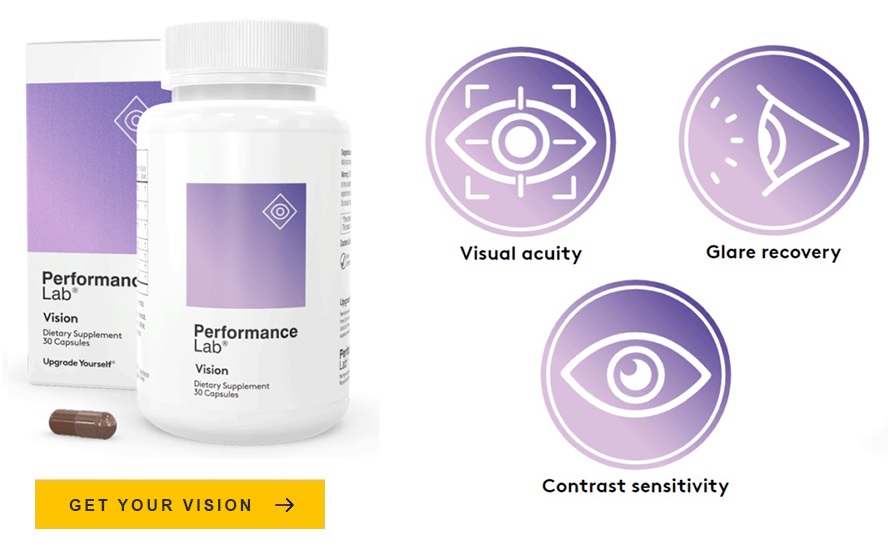
The specific nutrients that support macular health and their evidence base are covered in the article on the role of nutrition in slowing age-related vision decline, along with the Performance Lab Vision review for those interested in how targeted supplementation fits into this picture.
The Bigger Picture
Your forties are a visual inflection point. Some of what changes is just biology doing what it does — the lens stiffening, the pupil becoming a little less dramatic, the vitreous settling into middle age. Most of it is normal and manageable. Some of it is the first whisper of conditions that deserve early attention and proactive response.
The best approach is neither panic nor denial. It’s the same approach that works for every other system in the body at midlife: know what’s normal, know what’s not, get the right baseline measurements, and make the daily decisions that give you the best possible trajectory. Your eyes in your sixties will reflect the choices you make now.