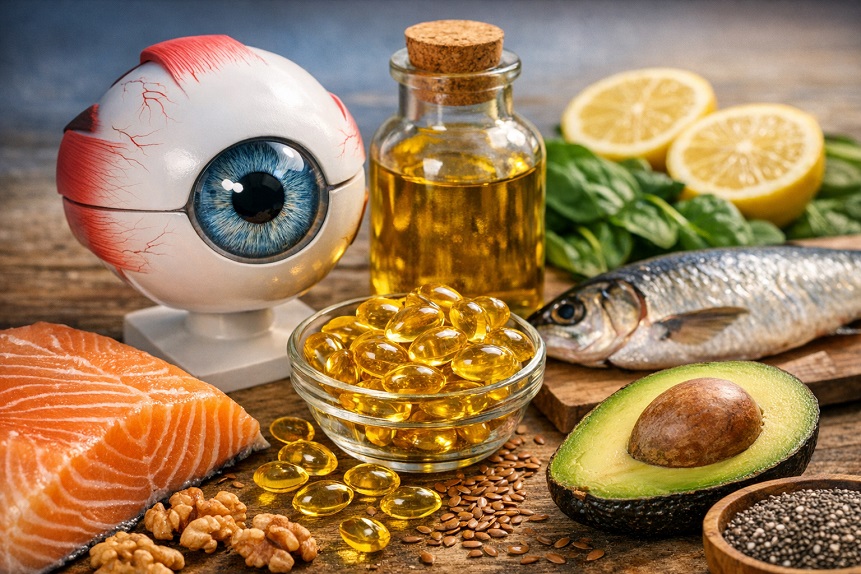
Omega-3 fatty acids have accumulated a substantial and occasionally contradictory body of evidence in eye health research. The popular claim — “omega-3s are good for your eyes” — is broadly true but lacks the specificity that’s actually useful. Good for which part of the eye? Which outcomes? At what doses? From which sources? The answers to these questions vary considerably depending on whether you’re talking about the retina, the ocular surface, or age-related disease risk, and whether you’re looking at observational studies, randomized trials, or mechanistic research.
Getting clear on what the evidence actually supports helps avoid both the mistake of dismissing omega-3s as overhyped and the opposite mistake of treating them as a universal eye health solution.
The Three Omega-3s That Matter for Eye Health
Omega-3 fatty acids are a family, not a single compound, and the distinctions between members of the family matter for eye health specifically.
DHA (docosahexaenoic acid) is the most structurally important omega-3 for the eye. It is the dominant fatty acid in photoreceptor outer segment membranes, present at extraordinarily high concentrations — roughly 50% of total fatty acids in the outer segments of rod photoreceptors. This concentration is not incidental. DHA’s unusual molecular structure — a very long chain with six double bonds — creates the membrane fluidity that allows rapid conformational changes in rhodopsin and cone opsins during phototransduction. Without DHA, photoreceptor membranes become less fluid, and the speed and efficiency of visual signal transduction is impaired.
EPA (eicosapentaenoic acid) is the primary anti-inflammatory omega-3, serving as a precursor to resolvins and protectins — lipid mediators that actively resolve inflammation rather than simply suppressing it. In the eye, EPA’s anti-inflammatory activity is relevant to the ocular surface and the meibomian glands, whose dysfunction drives the majority of dry eye disease. EPA is found alongside DHA in oily fish and most fish oil supplements.
ALA (alpha-linolenic acid) is the plant-sourced omega-3 found in flaxseed, walnuts, chia seeds, and canola oil. ALA is an essential fatty acid that the body can theoretically convert to EPA and then to DHA, but this conversion is inefficient — estimates suggest only 5 to 10% of ALA reaches EPA, and conversion to DHA is lower still. For the purposes of retinal DHA maintenance and meaningful anti-inflammatory omega-3 activity, ALA from plant sources is a poor substitute for preformed DHA and EPA from marine sources or algae.
DHA and Retinal Function: The Structural Argument
The retina’s extraordinary DHA dependence makes a compelling structural argument for adequate omega-3 intake independent of any clinical trial evidence. Photoreceptor outer segments are continuously renewed — the outer tips are shed daily and phagocytosed by the retinal pigment epithelium, while new segments are synthesized from the base of the photoreceptor. This renewal process requires a continuous supply of DHA for membrane synthesis.
In states of dietary DHA deficiency, the retina preferentially retains DHA over other tissues — reflecting how critical it considers this fatty acid — but in severe or prolonged deficiency, retinal DHA content eventually falls, and functional consequences follow. Animal studies show that DHA-depleted retinas have impaired electroretinogram responses, reduced dark adaptation sensitivity, and altered phototransduction kinetics. Human epidemiological data shows lower fish consumption associated with higher AMD risk, and higher circulating DHA levels associated with lower AMD incidence in several large prospective cohort studies.
The retinal pigment epithelium, which processes the daily burden of shed photoreceptor outer segments, is also heavily DHA-dependent. The RPE recycled DHA for reuse in new outer segments, maintaining retinal DHA status more efficiently than other tissues. But the RPE cells of older adults with AMD show impaired DHA recycling and lipid metabolism, suggesting that omega-3 status interacts with the degenerative process rather than being independent of it.
Omega-3s and AMD: Where the Evidence Stands
The association between omega-3 intake and AMD risk is one of the more consistent findings in nutritional epidemiology. The Nurses’ Health Study, the Health Professionals Follow-Up Study, and the Blue Mountains Eye Study all found significant inverse associations between fish consumption and AMD risk — the more fish consumed, the lower the AMD incidence. The association is particularly strong for neovascular (wet) AMD, which is the form with the most rapid progression and greatest vision loss.
Randomized controlled trial evidence is less clear-cut. The AREDS2 trial, which included a 1 gram daily EPA + DHA arm, found no significant benefit over the AREDS2 formulation alone for the primary endpoint of AMD progression. This null finding generated considerable discussion in the field and cooled some of the therapeutic enthusiasm around omega-3 supplementation specifically for AMD prevention.
The most reasonable interpretation reconciles these observations: the observational evidence for dietary fish intake and AMD risk is robust and biologically plausible, suggesting a real relationship. The AREDS2 trial was designed around supplementing an already-high-risk population who were already taking the AREDS2 formula — a context in which marginal omega-3 additions may have had limited room to produce additional measurable benefit. For people without established AMD, maintaining adequate dietary omega-3 intake as part of an overall eye-protective dietary pattern remains well justified by the epidemiological evidence.
Omega-3s and Dry Eye: The Stronger Clinical Signal
The evidence for omega-3 fatty acids in dry eye disease is, in many respects, more practically applicable than the AMD evidence, even though it’s complicated by the same controversial landmark trial.
The mechanistic rationale is strong. EPA and DHA influence the composition and quality of meibomian gland lipid secretions — the oils that form the tear film’s evaporation-resistant outer layer. In omega-3 deficiency, meibomian secretions become more viscous and less stable, worsening the evaporative dry eye that drives the majority of symptomatic disease. EPA’s anti-inflammatory activity also directly addresses the chronic ocular surface inflammation that perpetuates the dry eye cycle in moderate to severe disease.
Multiple clinical trials and meta-analyses showed significant omega-3 benefits for dry eye symptoms and signs before the 2018 DREAM study — a large, well-powered randomized trial — found no significant difference between re-esterified omega-3s and olive oil placebo on dry eye outcomes. The olive oil placebo arm showed unexpectedly large improvements, which some researchers argue indicates olive oil itself has anti-inflammatory effects that reduced the contrast between groups.
The current clinical consensus, held by most dry eye specialists despite DREAM, is that omega-3 supplementation remains a reasonable component of dry eye management — particularly for meibomian gland dysfunction — while acknowledging that the evidence is less definitive than previously thought. Most guidelines continue to recommend omega-3s as a conservative, low-risk intervention with a plausible mechanism and supportive evidence outside of the DREAM trial.
Sources and Dosing: What Matters in Practice
Not all omega-3 supplements are equivalent, and the differences are clinically meaningful.
Re-esterified (rTG form) and phospholipid-bound omega-3s (from krill oil) have superior bioavailability compared to ethyl ester forms — the most common and least expensive fish oil formulation. Ethyl ester supplements require conversion before absorption, and this conversion is less efficient, particularly when taken without dietary fat. For maintenance purposes and moderate doses, ethyl ester supplements are adequate with a fatty meal. For higher-dose therapeutic use, rTG or phospholipid forms are preferable.
Algae-derived DHA is the most ecologically and logistically consistent option for people who don’t consume fish. Algae is the original biosynthetic source of DHA — fish accumulate it by eating algae and algae-eating organisms. Algae-sourced DHA is equivalent in bioavailability to fish-sourced DHA and is free from the heavy metal and contaminant concerns occasionally raised about fish-sourced supplements, though high-quality fish oil purified to pharmaceutical standards presents minimal contamination risk in practice.
For retinal DHA maintenance in adults eating typical Western diets, two to three servings of fatty fish per week provides approximately 1 to 2 grams combined EPA and DHA — a range that most nutritional guidance considers adequate. For therapeutic dry eye support, doses of 2 to 3 grams combined EPA and DHA daily have been used in most positive clinical trials. Going significantly above these ranges without clinical guidance is unlikely to provide additional benefit and may increase bleeding time at very high doses.
Note: Omega-3 supplementation at high doses can affect platelet function and may interact with anticoagulant medications. Anyone on blood thinners or with bleeding disorders should discuss omega-3 supplementation with their healthcare provider before starting or significantly increasing dose.
Putting Omega-3s in Their Proper Place
Omega-3 fatty acids are genuinely important for eye health — particularly DHA for retinal structural integrity and EPA for ocular surface anti-inflammatory activity — and most people eating Western diets get less than would be optimal. They are not a magic bullet or a sufficient standalone strategy for AMD prevention or dry eye treatment, but they belong in any serious nutritional approach to long-term ocular health.
The most evidence-supported approach is ensuring adequate dietary omega-3 intake from whole food sources — primarily oily fish — as a foundational component of an eye-protective diet. The broader picture of how omega-3s fit alongside lutein, zeaxanthin, vitamins C and E, and zinc in a comprehensive nutritional eye health approach is covered in the article on the complete food guide for eye health. For those interested in a supplement that integrates the key evidence-supported nutrients, the Performance Lab Vision review examines the full ingredient rationale.