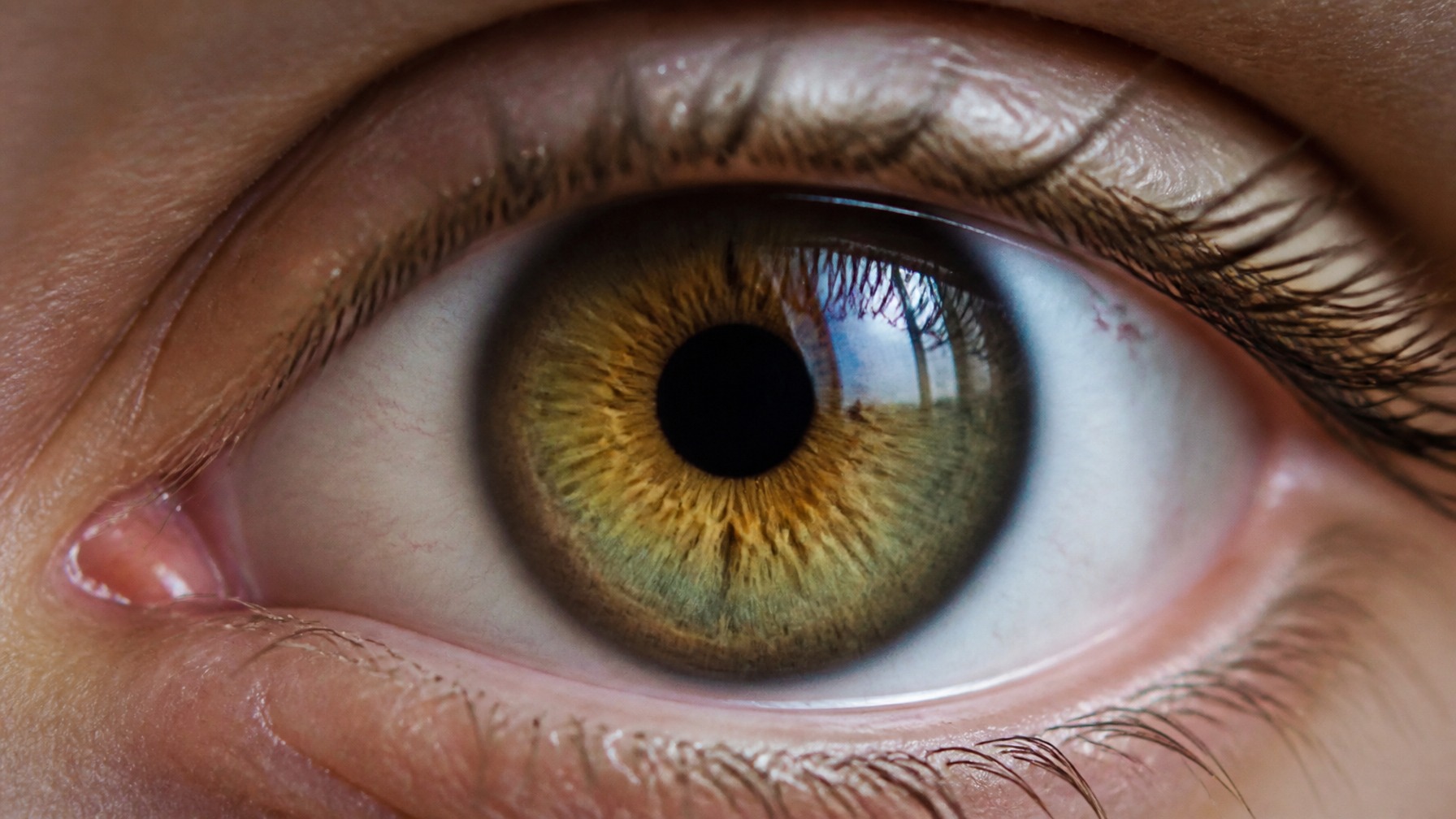
Watch a dog for long enough and you’ll notice it can follow your gaze remarkably well, glancing wherever you look. Watch a chimpanzee try to do the same thing with another chimpanzee, and it’s a genuinely harder task, in part because chimpanzee eyes don’t give away nearly as much information at a glance. A chimp’s iris sits against sclera that’s often darkly pigmented, sometimes nearly matching the iris itself, making the exact direction of its gaze surprisingly hard to read from a distance. Human eyes work almost the opposite way, and that difference has become the center of one of evolutionary biology’s more interesting, and more contested, debates.
The Eye Feature That Sets Humans Apart From Every Other Primate
The sclera is the tough, protective outer layer that makes up most of the visible surface of the eyeball, surrounding the colored iris and the pupil at its center. In the vast majority of primates, including our closest relatives like chimpanzees and gorillas, the sclera carries at least some pigmentation, ranging from lightly tinted to fully dark, and it’s often only a thin, hard-to-spot sliver around the iris even when it is visible. Humans are a genuine outlier. Our sclera is typically depigmented to a uniform white and exposed across a wide, elongated portion of the eye, making it easy to spot at a glance from a meaningful distance.
Why a Dark Iris on a White Background Works Like a Compass Needle
The practical effect of this anatomical difference is straightforward: a dark iris sitting on bright white sclera creates strong visual contrast, making the direction someone is looking almost instantly readable, the same way a compass needle stands out sharply against a plain white dial. A dark iris against equally dark sclera offers far less of that contrast, making gaze direction considerably harder to detect without looking closely. Researchers have proposed that this simple anatomical difference might be the physical foundation for an entire category of uniquely human communication: reading someone’s attention and intention purely through where their eyes are pointed, without a single word being spoken.
The Experiment That Launched the Cooperative Eye Hypothesis
This idea was formalized into what’s now called the cooperative eye hypothesis, most prominently developed by researcher Michael Tomasello and colleagues at the Max Planck Institute for Evolutionary Anthropology. The hypothesis proposes that human sclera evolved its distinctive, highly visible whiteness specifically to make gaze direction easier for others to read, which in turn would have supported the kind of close, wordless coordination that underlies distinctly human cooperative behaviors, from communal childcare to complex group projects.
What the Landmark Study Seemed to Show
To test this, Tomasello’s team ran a now well-known 2007 experiment comparing how reliably human infants versus great apes followed another individual’s gaze toward a target, based only on where that individual’s eyes, rather than their whole head, were pointed. The results appeared to show a genuine difference in favor of human infants, which researchers interpreted as evidence that our uniquely visible eyes might make gaze-following easier and more automatic for humans than for other primates, supporting the idea that this anatomical feature carries real communicative weight.

A Possible Peace Signal Written Into the Eye
Later research pushed the idea further by looking across species rather than just at humans and apes. A 2022 study published in Scientific Reports analyzed scleral pigmentation across 108 primate species and compared it against measures of cooperative behavior, social tolerance, and rates of lethal aggression between members of the same species. The pattern that emerged was striking: primates with brighter, more visible sclera, including some chimpanzees and bonobos, tended to show more cooperative behavior, while species with darker sclera showed both less cooperation and higher rates of violence within their own groups. Taken at face value, this suggested that visible sclera might function as a kind of built-in signal of trustworthiness or nonaggression, readable at a glance across an entire social group.
Why Some Researchers Aren’t Convinced
Not everyone in the field is on board with this explanation, and the pushback has gotten more pointed in recent years. Critics have raised real concerns about the methodology of the original 2007 infant-versus-ape study, pointing to differences in testing environments and how familiar each set of subjects was with the experimental setup, both of which could have skewed the results independent of any genuine biological difference in gaze-following ability. Follow-up studies have also shown that, under the right conditions, chimpanzees can follow gaze just as accurately as humans, and that darkening a human sclera artificially only slows gaze interpretation slightly without meaningfully reducing its accuracy.
The Messier, More Honest Picture Emerging Now
Researchers have also pointed out that human sclera isn’t actually uniform white across every population. Some people, including individuals from parts of South Asia, Africa, and Australia, naturally have somewhat more pigmented sclera, directly complicating any claim that fully depigmented white sclera is a universal, defining feature of our species. Combined with evidence that a handful of other great apes also show meaningfully visible sclera under the right conditions, the tidy story of humans as the sole cooperative-eyed primate looking out at a world of dark-eyed, more secretive apes has gotten considerably more complicated than the original hypothesis suggested. Most researchers still agree that human sclera tends to be unusually visible and consistently pale as a general pattern. What’s increasingly in question is whether that pattern evolved specifically as a cooperation signal, or whether it’s a real anatomical trend that later got wrapped in a more definitive evolutionary story than the evidence fully supports.
What the Debate Itself Reveals
Even with the uncertainty, there’s something worth sitting with in this whole line of research. The basic observation, that human eyes are unusually easy to read at a glance compared to most other primates, still holds up reasonably well across the data. What’s being contested isn’t whether that difference exists, but why it exists, and how central it really was to the emergence of humanity’s uniquely cooperative social behavior. That’s a genuinely healthy scientific argument to be having, and it’s a good reminder that even a feature as simple and universally overlooked as the whites of your eyes can turn out to sit at the center of a real, ongoing debate about what makes human communication so different from everything else in the animal kingdom.

Frequently Asked Questions
Why do humans have white sclera while other primates don’t?
The leading explanation, called the cooperative eye hypothesis, proposes that human sclera evolved to be highly visible and uniformly white to make gaze direction easier for others to read, supporting close, nonverbal cooperation. This explanation remains actively debated among researchers.
What is the cooperative eye hypothesis?
The cooperative eye hypothesis, developed by researcher Michael Tomasello and colleagues, suggests that the high visibility of human sclera evolved specifically to make gaze direction easy for others to detect, supporting the kind of nonverbal coordination central to human cooperation.
Is the cooperative eye hypothesis widely accepted?
It remains debated. While many researchers agree that human sclera is unusually visible compared to most other primates, some studies have challenged the original experimental evidence and pointed out that scleral pigmentation varies across human populations and that some other great apes also show visible sclera under certain conditions.
Do other animals have white sclera like humans?
Some other primates, including certain chimpanzees and bonobos, show more visible sclera than was previously assumed, and a 2022 study found that primate species with brighter sclera tended to show more cooperative behavior overall, though humans still show the trait most consistently.