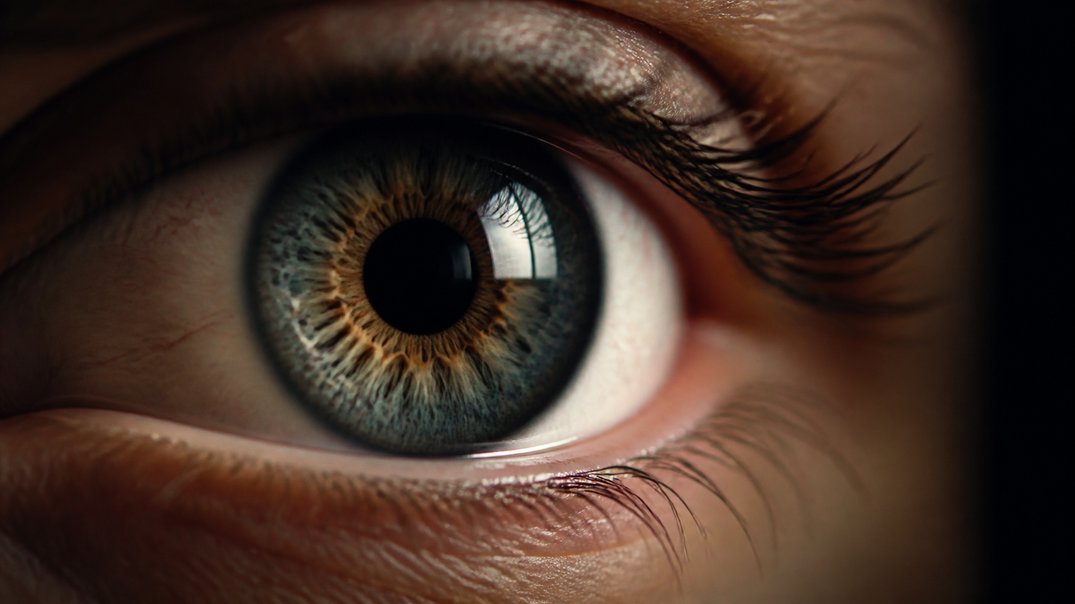
You blink somewhere around fifteen to twenty times a minute, and each blink briefly cuts off essentially all light reaching your retina for a fraction of a second. Multiply that across a waking day and the eyes spend a genuinely significant chunk of total time, by some estimates around three or four percent of waking hours, physically closed. And yet the visual world never appears to flicker, dim, or interrupt in any way most people consciously notice. Researchers have spent decades investigating exactly how the brain manages this, and the answer turns out to involve more than one distinct mechanism working together.
The First Piece: Active Suppression During the Blink Itself
The most basic part of the explanation involves the visual system actively reducing its own sensitivity right around the moment of a blink, a process similar to a related and better known phenomenon called saccadic suppression, which reduces visual sensitivity during the rapid eye movements called saccades that occur constantly as the eyes scan a scene. Researchers using a clever technique, shining light onto the retina from behind the closed eyelid using a fiber optic source, were able to directly measure visual sensitivity during a blink and found a genuine, measurable drop, roughly half a log unit, meaning vision becomes considerably less sensitive to light right around the time of blinking, independent of the eyelid physically blocking incoming light.
Why This Suppression Starts Before the Eyelid Even Closes
Notably, this drop in sensitivity begins slightly before the eyelid physically starts closing and continues for a short period after the eye reopens, which tells researchers this is not simply a mechanical consequence of the eyelid blocking light. Instead, it reflects an active neural signal that anticipates and accompanies the blink, deliberately dialing down how strongly the visual system responds to the abrupt light-to-dark-to-light transition that a blink would otherwise produce. Studies recording directly from neurons in visual processing areas have found that this suppression is specific to blinks themselves. The same neurons respond differently to an external light being switched off briefly compared with a blink producing a nearly identical pattern of reduced retinal input, suggesting the brain can distinguish self-generated visual interruptions from external ones and treats them differently from the earliest stages of processing.
Why Suppression Alone Does Not Fully Explain Continuity
Reduced sensitivity during a blink helps explain why the brief darkness is not perceived as jarring or particularly bright and dark, but researchers studying this question closely have pointed out that suppression by itself does not fully explain why the visual world feels continuous across the gap. A period of external darkness lasting as long as a typical blink is clearly visible and noticeable when it comes from an outside source, like someone briefly switching off a light. Blinks, despite involving a comparably brief interruption to retinal input, do not produce this same noticeable dark flash under ordinary conditions, which means something beyond simply reducing sensitivity to the interruption must also be involved in stitching the visual experience together seamlessly.

The Second Piece: The Brain Actively Bridges Before and After
More recent research has pointed toward a second, complementary mechanism located further along in the brain’s processing pathway, involving regions well beyond the earliest visual areas. Researchers studying patients with electrodes implanted for epilepsy monitoring, which allowed extremely precise recording of brain activity, identified a region in the prefrontal cortex, an area typically associated with higher-level cognitive functions like decision-making and short-term memory, that appears to actively calibrate the visual scene perceived just after a blink with the visual scene that was being perceived just before it.
Evidence From a Patient With Brain Damage
Supporting the idea that this brain region plays a genuinely necessary, rather than merely correlated, role in maintaining visual continuity across blinks, researchers studying a patient with damage specifically affecting this area of the prefrontal cortex found that this individual showed measurably impaired ability to perceive visual continuity across interruptions, compared with people without this specific damage. This kind of evidence, drawn from a naturally occurring brain lesion rather than only from healthy participants, offers a stronger case that the region is actively doing something functionally important for stitching visual experience together, rather than simply showing activity that happens to correlate with the process without actually driving it.
Blinking’s Effect on Perceived Time
An intriguing related finding is that blinking does not just get smoothed over perceptually, it also appears to distort the brain’s sense of how much time has actually passed. Research measuring how people judge the duration of a visual event has found that when a spontaneous blink occurs during that event, people tend to underestimate how long the event lasted, and the size of this underestimation correlates with how long the individual blink itself lasted. Notably, this effect was specific to visual duration judgments and did not appear when people judged the duration of an equivalent auditory event, suggesting the effect is tied specifically to the visual system’s handling of the interruption rather than a broader, general disruption to the brain’s sense of time.
How Blinking Differs From Watching an External Light Turn Off
Taken together, this research points to blinks being treated by the brain as a fundamentally different category of event than an external interruption to vision, even when the actual pattern of light reaching the retina is nearly identical in both cases. A brief external darkening is registered as a real, noteworthy change in the environment worth perceiving clearly. A blink, despite involving a comparable break in visual input, gets actively suppressed at an early stage and then further smoothed over by higher-level brain regions that stitch the visual scene together across the gap, treating it not as an event in the world but as routine biological housekeeping unworthy of disrupting the ongoing, continuous experience of seeing.
Why This Matters Beyond Explaining a Curious Everyday Fact
Understanding how the brain manages blink-related interruptions connects to broader questions in neuroscience about how the brain constructs a stable, continuous sense of the visual world at all, given that the raw sensory input it receives is genuinely far choppier and more interrupted than conscious experience ever suggests, involving not just blinks but constant rapid eye movements and shifts in attention throughout every waking moment. The mechanisms uncovered through blink research offer a specific, well studied example of a much broader principle: perceived reality is substantially the product of active construction and prediction by the brain, not a direct, unfiltered readout of whatever signal happens to be arriving at the retina moment to moment.