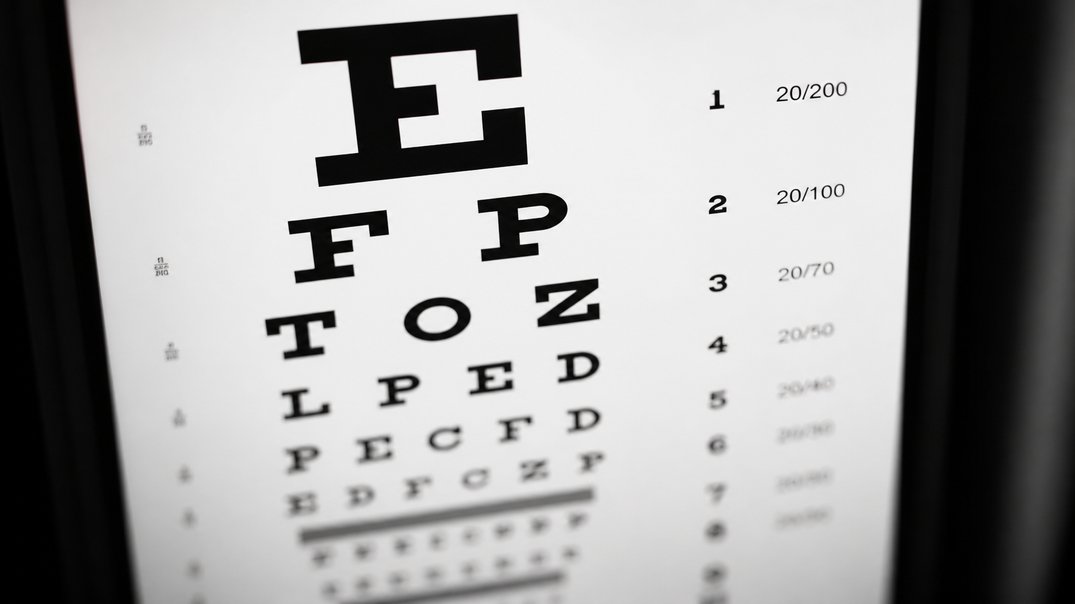
Every eye has a small region where vision simply does not exist, a genuine gap in visual sensitivity roughly the size of a pinhead held at arm’s length. Most people go their entire lives without noticing it, and even after learning about it and finding it with a simple demonstration, the blind spot vanishes back into invisibility the moment ordinary looking resumes. The explanation involves both a straightforward anatomical fact and one of the more remarkable things the visual system does without any conscious effort at all.
The Anatomical Reason the Blind Spot Exists
The retina, the light-sensitive tissue lining the back of the eye, is covered almost entirely with photoreceptors, the rod and cone cells that detect light and begin the process of vision. At one specific location, however, the optic nerve gathers all the signal-carrying fibers from across the retina and exits the eye as a single bundle, and this exit point, called the optic disc, has no room for photoreceptors at all. Light that lands on this small patch of retina is never converted into a visual signal in the first place, producing a genuine, physical absence of vision at that exact spot, formally called a physiological scotoma.
Why Each Eye’s Blind Spot Sits Where It Does
The optic disc sits slightly toward the nose side of each retina, which means the resulting blind spot in your visual field appears off to the side, toward your temple, on the same side as the eye it belongs to. Because each eye’s blind spot occupies a different position in space, roughly 15 degrees out from the center of vision and spanning several degrees across, the two blind spots do not overlap when both eyes are open and working together, which turns out to be the first and simplest reason the gap goes unnoticed in normal daily life.
How Two Eyes Cover for Each Other
With both eyes open, whatever falls into the blind spot of one eye almost always lands on functioning retina in the other eye, since the two blind spots sit in different locations relative to each eye’s own line of sight. The brain combines input from both eyes into a single, unified visual experience, and because the second eye is supplying real information for the region the first eye cannot see, the combined picture has no gap in it at all. This binocular coverage explains a great deal of why the blind spot stays hidden, but it does not explain the entire phenomenon, since the blind spot remains just as unnoticeable when only one eye is open and looking around normally, a situation where this simple explanation runs out.

Perceptual Filling-In: The Brain Actively Completes the Picture
Even with one eye closed, the region corresponding to the blind spot does not appear as an obvious dark hole or gap in vision. Instead, the visual system actively extends the pattern, color, texture, and even motion of the surrounding area across the blind spot itself, a phenomenon researchers call perceptual filling-in. If you are looking at a uniformly colored wall, the brain fills the blind spot with that same color. If you are looking at a patterned surface, elements of that pattern get extended across the gap as well, provided the pattern is relatively simple and continuous rather than intricate or containing sharp, unrelated features right at the blind spot’s edges.
What Filling-In Reveals About the Brain, Not Just the Eye
Filling-in is not simply the absence of a sensation registering as nothing; it is an active construction the visual system builds using the information available around the gap. Researchers studying this process have found that neurons in the brain’s visual cortex, in the region that would normally represent the blind spot, show measurable activity patterns consistent with this completed, filled-in perception, suggesting the brain is genuinely generating a best guess at what belongs there rather than simply failing to notice something is missing. One influential framework for understanding this process describes it as a form of predictive processing, in which the visual system continuously generates expectations about what should be present based on surrounding context, and the blind spot region gets filled with exactly this kind of prediction rather than actual incoming light data.
Why You Can Demonstrate the Blind Spot on Purpose
Despite how effectively the blind spot normally stays hidden, it can be reliably demonstrated with a simple exercise: closing one eye, fixating steadily on a specific point, and moving a second object through the peripheral field at the right distance and angle until it disappears entirely. This works because the demonstration deliberately isolates a single, small, distinct object against a background that does not continue seamlessly through the blind spot’s location, denying the visual system the continuous surrounding pattern it needs to convincingly fill in that specific missing object. Complex, isolated details like a small shape or a word tend to vanish rather than get accurately reconstructed, since filling-in works well for extending simple, uniform, continuous surroundings but does not fabricate specific, detailed content that was never actually seen.
Why This Matters Beyond a Curious Party Trick
Understanding perceptual filling-in has genuine clinical relevance beyond satisfying curiosity about the ordinary blind spot. The same mechanism appears to be involved in how people compensate, to varying degrees, for larger areas of vision loss caused by retinal disease or damage to the visual pathways in the brain, sometimes called a pathological scotoma. Researchers studying visual rehabilitation and recovery after conditions like macular degeneration or certain brain injuries are specifically interested in how and when this filling-in process helps patients function despite gaps in their visual field, and when it might instead mask a problem a patient is not consciously aware of, since a filled-in gap feels indistinguishable from actually seeing that part of the scene.
What Filling-In Can and Cannot Reconstruct
Research into the limits of perceptual filling-in has found that it works reliably for simple, uniform, or repetitive visual content, a solid color, a consistent texture, a regularly repeating pattern, but performs far worse or fails entirely when the missing region would need to contain specific, unpredictable detail. A field of grass, a plain colored wall, or evenly spaced stripes tend to fill in convincingly across the blind spot, while a specific word, a small isolated object, or a complex, irregular pattern typically does not get accurately reconstructed and instead simply disappears from awareness within that region. This distinction matters because it tells researchers that filling-in is not a general-purpose image reconstruction system capable of hallucinating arbitrary detail. It is a more constrained process that extrapolates from genuinely available surrounding information, which is also why the blind spot demonstration exercises used in science museums and classrooms specifically rely on isolated shapes or letters rather than patterned backgrounds, since those isolated details are exactly the kind of content the visual system cannot convincingly fabricate.