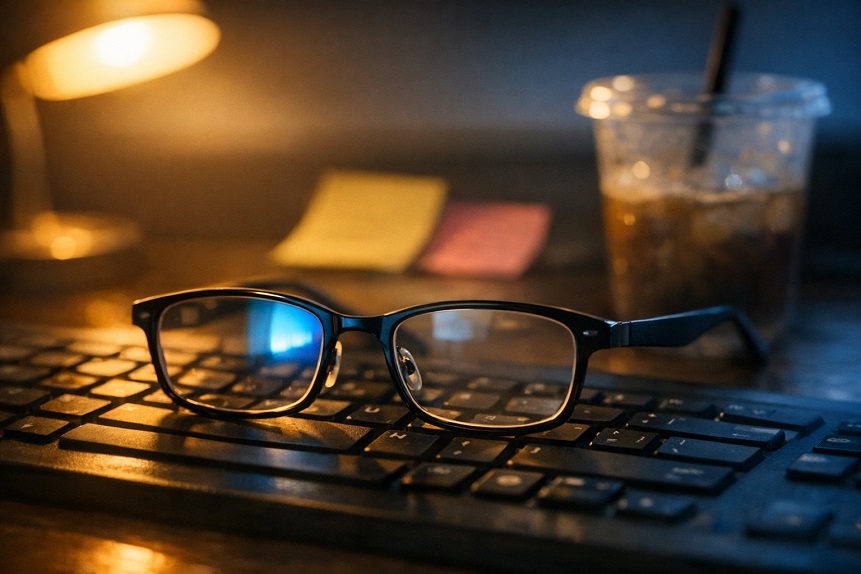
Blue light glasses have become one of the more remarkable success stories in consumer eyewear. In the span of a few years, they went from a niche product with limited awareness to a mainstream item stocked at every optician, sold on every major online retailer, and endorsed by influencers, employers, and wellness brands with equal enthusiasm. The market is now valued in the billions. The glasses look good, feel reasonable to wear, and are accompanied by confident claims about protecting eyes from screen-related damage and improving sleep.
The problem, and it is a genuine problem worth being honest about, is that the scientific evidence behind those claims has not kept pace with the marketing. Several high-quality studies and systematic reviews in recent years have produced findings that are considerably less supportive of blue light glasses than the industry would prefer you to believe. That does not mean the glasses are useless or harmful. It means that understanding what they actually do and do not do is more useful than accepting the standard pitch at face value.
Here is an honest account of what the research shows, what remains genuinely uncertain, and where the most defensible uses of blue light filtering actually lie.
What Blue Light Glasses Are Designed to Do
Blue light filtering lenses work by absorbing or reflecting a portion of short-wavelength blue light before it reaches the eye. The degree of filtering varies widely between products. Clear lenses with a blue light coating typically filter somewhere between 10 and 30 percent of blue light. Lenses with a yellow or amber tint filter significantly more, sometimes 50 to 90 percent, but with the trade-off of color distortion that makes them impractical for color-sensitive work.
The Three Claims Most Commonly Made
The marketing case for blue light glasses typically rests on three claims: that they reduce digital eye strain, that they protect against long-term retinal damage from screen exposure, and that they improve sleep by reducing evening blue light exposure. These are distinct claims, and the evidence behind each is very different in quality and consistency. Treating them as a package deal, as most product marketing does, obscures the fact that some of these claims are better supported than others.
How the Filtering Actually Works
The lens coatings or tints used in blue light glasses work primarily through absorption, converting incoming blue light energy to a small amount of heat before it passes through the lens. Higher-quality coatings also use reflection, bouncing some blue light away from the lens surface. The visible result of this filtering is the faint blue or purple sheen visible on the lens surface when blue light glasses are held at an angle. Products without this visible coating are often applying minimal filtering, and some products marketed as blue light glasses provide negligible actual filtering despite the label.
Blue Light Glasses for Eye Strain: What the Evidence Shows
This is the claim with the weakest research support, and it is also the claim most prominently made in blue light glasses marketing. The disconnect between the confidence of the claims and the quality of the evidence is notable.
The Cochrane Review Findings
In 2021, the Cochrane Collaboration, which produces the most rigorous systematic reviews of clinical evidence, published a review specifically examining whether blue-light-filtering lenses reduce symptoms of eye strain compared to standard lenses. The conclusion was that blue-light-filtering lenses probably make little or no difference to eye strain. The review analyzed the available clinical trials and found the evidence insufficient to support the claim that blue light is a significant driver of screen-related eye fatigue, or that filtering it meaningfully reduces symptoms.
The American Academy of Ophthalmology, one of the most authoritative professional bodies in eye care, has similarly stated that it does not recommend blue-light-blocking glasses for reducing digital eye strain, noting the lack of scientific evidence to support this use. These are not fringe opinions. They represent the mainstream scientific and clinical consensus as of the most recent evidence reviews. As we covered in our article on what the science says about blue light, the drivers of screen eye strain are primarily mechanical and environmental rather than spectral.
Why People Feel Better Wearing Them Anyway
This is a reasonable question and deserves a straightforward answer. Several factors can produce genuine subjective improvement in eye comfort when wearing blue light glasses that have nothing to do with blue light filtering. Many blue light glasses have an anti-reflective coating that reduces surface reflections and glare, which does help with screen comfort. Some have a mild magnification that reduces accommodative effort for near work. And for some people, the act of putting on the glasses signals a change in behavior, including sitting slightly farther from the screen, blinking more consciously, and taking the visual environment more seriously. Placebo effects in comfort outcomes are real and not trivial. None of this makes blue light glasses bad to wear. It just means the comfort benefit may not be coming from the mechanism being advertised.
Blue Light Glasses for Retinal Protection: An Open Question
The long-term retinal protection claim is more difficult to assess because it operates over decades rather than in a controlled short-term study. Laboratory evidence shows that concentrated blue light can damage retinal cells through oxidative stress. The question is whether the level of blue light from ordinary screen use, filtered or unfiltered, is sufficient to cause this damage over a human lifetime of use.
What the Laboratory Evidence Shows and Does Not Show
Cell culture and animal model studies have demonstrated blue-light-induced retinal damage at intensities well above what screens produce. Extrapolating from these findings to everyday human screen use is a significant leap that requires more epidemiological evidence than currently exists. No large-scale human study has yet demonstrated that screen-based blue light exposure without filtering is associated with increased rates of macular degeneration or other retinal pathology compared to otherwise matched populations without screen exposure. This absence of evidence is not the same as evidence of absence, particularly given that the mass adoption of high-screen-time lifestyles is recent enough that long-term data is not yet available.
The precautionary case for some degree of blue light management is not unreasonable. But the most evidence-supported way to protect the retina from blue-light-related oxidative stress is not a lens coating. It is building and maintaining a dense macular pigment through consistent lutein and zeaxanthin intake, which provides continuous, internally located blue light filtering at the retinal level itself. This approach is covered in depth in our article on macular pigment and why it matters.
Blue Light Glasses for Sleep: The Strongest Case
Of the three main claims made for blue light glasses, the sleep benefit has the most consistent and mechanistically credible research support. This is where the glasses are most defensibly useful, and it is also where the specific type of lens matters most.
Evening Use and Melatonin
The eye contains specialized photoreceptors called intrinsically photosensitive retinal ganglion cells that are particularly sensitive to blue wavelengths around 480 nanometers. These cells feed into the brain’s circadian clock and suppress melatonin production in response to blue light. Evening screen exposure genuinely delays melatonin onset, making it harder to fall asleep and reducing sleep quality. Several studies have found that blue-light-blocking glasses worn in the evening, particularly the amber-tinted variety that filter a high proportion of blue light, can reduce this suppression and improve sleep onset timing.
The effect is not consistent across all studies, and the magnitude varies between individuals. But the mechanism is well understood, the evidence is more favorable than for eye strain, and the practical downside of wearing amber glasses in the evening while watching television or reading is minor compared to the potential sleep benefit. For people who are sensitive to evening screen exposure and have difficulty falling asleep after evening screen use, amber blue-blocking glasses in the hour or two before bed are a reasonable experiment. Our article on sleep and eye health covers the full picture of how screen use affects nighttime eye and body recovery.
Clear Versus Amber Lenses for Sleep
Most blue light glasses marketed for daytime computer use have clear lenses that filter a modest amount of blue light, typically 10 to 30 percent. This level of filtering is unlikely to produce meaningful effects on melatonin suppression. Amber or orange-tinted lenses, which filter 50 percent or more of blue light, are the type used in the better sleep studies. If sleep improvement is the goal, clear blue light glasses sold for daytime use are probably not the right product. Dedicated evening amber lenses, or simply dimming screens and enabling night mode, are more appropriate and more evidence-based approaches.
A Calibrated Verdict on Blue Light Glasses
Blue light glasses are not a scam, but they are not the complete screen eye health solution their marketing presents them as. For daytime eye strain, the evidence does not support them as a meaningful intervention, and the more impactful changes involve screen brightness, glare management, break habits, and workspace lighting. For long-term retinal protection, internal macular pigment nutrition is more evidence-grounded than external lens filtering. For evening sleep quality, amber-tinted glasses worn before bed have a reasonable evidence base, even if the effect varies between individuals.
If you already own blue light glasses and find them comfortable, there is no reason to stop wearing them. If you are considering buying them primarily to address daytime eye strain, the evidence suggests your money and attention are better directed toward the workspace and nutritional adjustments covered elsewhere in this section.