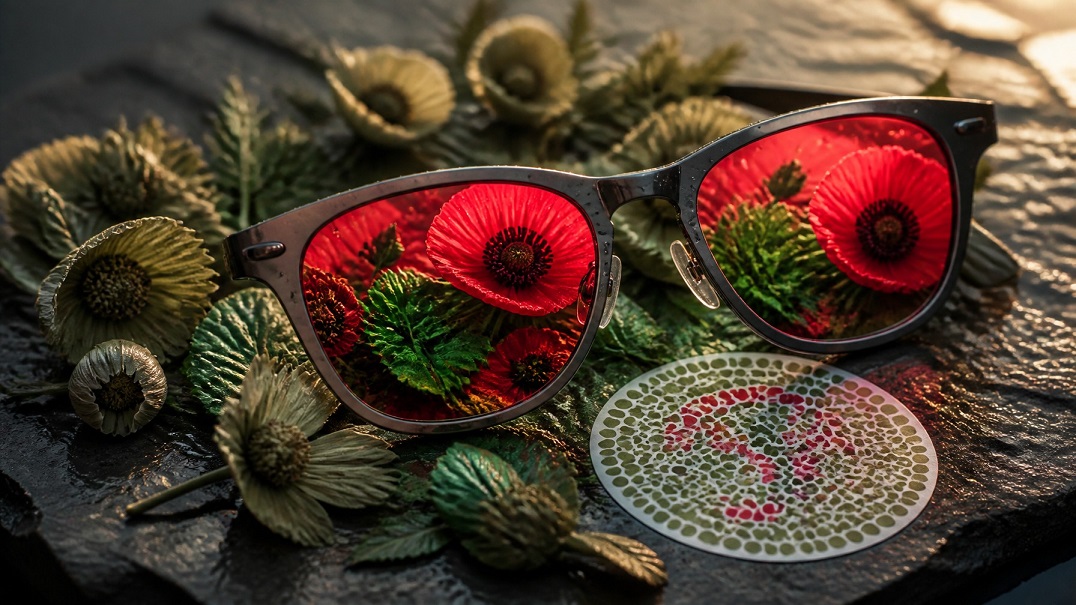
Sometimes, in limited ways. Special notch-filter glasses, such as EnChroma, may make colors look more vivid or help separate certain colors for some people with red-green color vision deficiency. They do not cure color blindness or restore typical color vision, and studies disagree on how much they help. An eye doctor can tell you your type before you spend money.
What Color Blindness Glasses Actually Do
The National Eye Institute says there is no cure for inherited color vision deficiency, but special glasses and contact lenses may help people tell colors apart by increasing the contrast between them. The best-known versions use spectral notch filters. A 2020 study reported by NEI describes the filters as designed to increase the separation between color channels, so colors look more vibrant, clear, and distinct.
Who the Glasses Are Designed For
The 2020 University of California, Davis study focused on the most common types of red-green color vision deficiency, called anomalous trichromacy. The maker says on its research page that its glasses are designed for partial red-green deficiency. It also says results vary and that the glasses are an assistive device, not a cure, as a University of Granada news release noted.
Most research has tested red-green deficiency, so do not assume the glasses help other types.
The Studies Reporting Benefits
The NEI-reported study followed people over two weeks of use and found enhanced color vision. It also reported that the expanded color ability showed up when participants were not wearing the glasses.
A small Latvian study of ten men with anomalous trichromacy found that the filters reduced color confusion along the red-green axis after chromatic adaptation. It also saw noticeable changes on the blue-yellow axis while the filters were worn, which hints at trade-offs.
The Studies Finding Little Benefit
Researchers at the University of Granada tested a pair of the glasses on about 48 color blind volunteers and found no improvement on diagnostic color tests. In a related study of other filter glasses, they concluded that such filters may help some tasks while confusing others, according to a Granada summary.
A 2022 study in Optics Express tested 86 people with color vision deficiency and 24 controls on two clinical tests. It found no overall improvement, with better discrimination for some colors and worse for others, and concluded that the results do not support using notch filters to improve color discrimination. A computer model of ideal observers matched their behavioral findings.
Why the Results Look Mixed
Several things can explain the split. The 2022 authors noted that earlier reports were inconclusive mainly because of small samples. Studies also measure different things. The manufacturer says that clinical screening tests, such as the Ishihara plates, are not something the lenses are designed to change.
That leaves a gap between how vivid colors feel to a wearer and how someone scores on a test. Both can be real, and neither proves the lenses restore normal color vision.
What Glasses Will Not Do
They will not cure color blindness, and they will not turn red-green deficiency into typical color vision. Because the manufacturer says the lenses are not designed to change clinical test scores, do not count on them for workplace color screening, which our post on jobs that still test for colorblindness explains.
If your color vision has changed recently, glasses are the wrong first step. An exam comes first, because acquired color loss can signal eye disease.
Other Ways to Cope
NEI lists apps that let you tap part of a photo to learn its color, and notes that adults may need accommodations in color-dependent jobs. It also says gene therapies look promising for a severe type of color vision deficiency, though that research is still developing. NEI also notes that most people with color vision deficiency do not have problems with everyday activities, so many never need any aid.
Photographers and designers may want to read photography and color vision.
Before You Buy
Start with a proper color vision test so you know whether you have a red-green type, and how strong it is. Ask about trial periods or return policies, since individual results vary. Keep expectations modest: a pleasant boost in vividness is plausible, but a cure is not.
Parents should ask the child’s eye doctor before buying. NEI notes that children with color vision deficiency may try to hide it, so get a child tested if they have trouble learning colors or reading from a chalkboard. Adults should mention any new color change at their next visit.