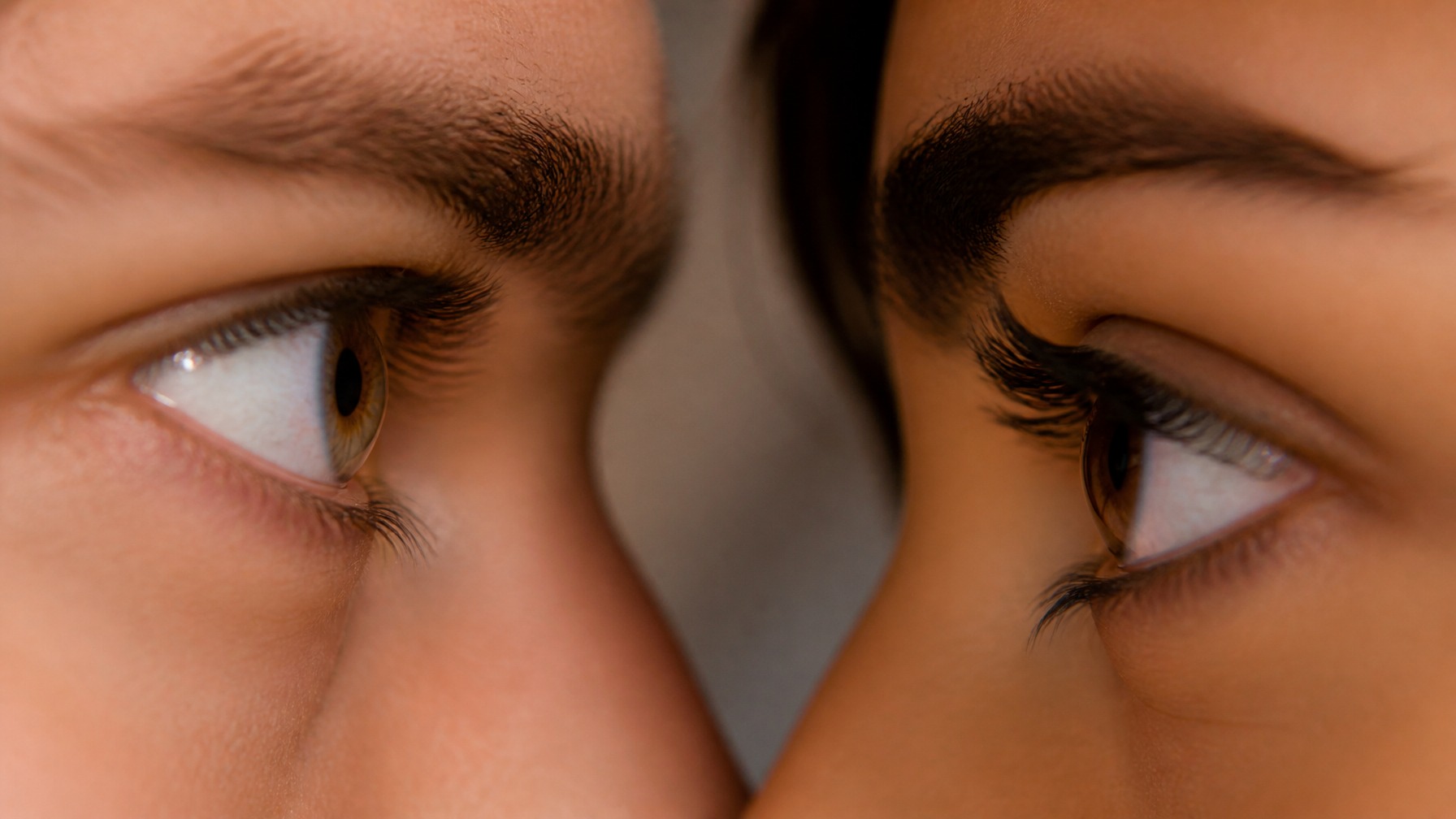
Two people lock eyes, neither one willing to look away first, both silently daring the other to blink. It feels like a contest of nerve, focus, maybe even dominance, the kind of thing you’d win through sheer stubbornness. In reality, a staring contest has very little to do with willpower and almost everything to do with a reflex your nervous system runs largely without your permission. Winning isn’t really about beating your opponent. It’s about temporarily overriding one of the most automatic, hardwired behaviors your body performs, and that turns out to be a lot harder than simply wanting to win badly enough.
Blinking Is a Reflex, Not a Choice
The average adult blinks somewhere between 15 and 20 times per minute, and the vast majority of those blinks happen without any conscious decision at all. This spontaneous blinking exists to keep the surface of the eye properly lubricated, spreading tear film evenly across the cornea and clearing away dust or other small irritants before they can cause damage. The cornea, the clear dome at the front of the eye, happens to be one of the most nerve-dense, sensitive tissues in the entire human body, and it’s wired directly into a reflex arc that triggers a blink the moment it senses dryness or irritation.
What Happens When You Try to Override It
During a staring contest, you’re not just resisting an urge, you’re actively fighting a reflex loop your nervous system runs on a timer independent of conscious thought. As your open eyes go longer without blinking, the tear film starts to thin and evaporate, and the exposed cornea becomes progressively drier and more irritated. That irritation feeds directly back into the same nerve pathway responsible for triggering a blink in the first place, meaning the urge to blink actually intensifies the longer you resist it rather than fading away. You’re not simply choosing not to blink. You’re overriding an escalating physiological alarm that gets louder, not quieter, the longer the contest goes on.
Why Screen Time Makes This Even Harder for Some People
Interestingly, plenty of people are already unknowingly training themselves in exactly the opposite direction of what a staring contest requires. Research has found that staring at a computer screen for extended periods can cut a person’s normal blink rate roughly in half, largely because visual concentration naturally suppresses the spontaneous blink reflex, leading to dry, irritated eyes by the end of a long workday. In a strange way, this means chronic screen use and a staring contest rely on the exact same underlying suppression of the blink reflex, just with very different levels of comfort and very different goals attached to it.

The Real People Who Trained Their Eyes to Beat This Reflex
Some people have taken deliberate, sustained training seriously enough to set genuine records. A Chinese naval serviceman reportedly went 57 minutes and 24 seconds without blinking in 2015, a feat he built up to gradually by practicing staring directly into wind and sunlight over an extended period of time to condition his eyes to tolerate the irritation. A separate record of one hour, five minutes, and eleven seconds without blinking has also been documented. Guinness World Records itself has stated it doesn’t maintain an official category for this particular feat, but the underlying achievement is the same either way: a slow, deliberate desensitization of one of the most persistent reflexes in the human body.
The Strange Advantage Nerve Damage Would Actually Give You
There’s a genuinely odd footnote buried in the medical literature on this topic. Certain nerve conditions, including damage to specific cranial nerves involved in the blink reflex, or facial nerve dysfunction like Bell’s palsy, can reduce or even eliminate someone’s ability to blink normally, sometimes leaving the eye unable to close completely. Medically, this is a real and often uncomfortable condition rather than a superpower, frequently requiring treatment to protect the eye from the very dryness and damage blinking normally prevents. But from a purely mechanical standpoint, it would hand someone an undeniable, if entirely unwanted, edge in a staring contest.
The Surprising Reason a Newborn Baby Would Quietly Demolish You
If you’re looking for the single most lopsided staring contest matchup imaginable, skip the trained adults entirely and consider a newborn baby. Infants blink remarkably rarely, often only two to three times per minute compared to an adult’s 15 to 20, with some studies documenting babies blinking as infrequently as once a minute. This isn’t because babies are unusually determined. Spontaneous blinking appears to be closely tied to activity in the brain’s dopamine system, and that system is still actively developing in the first months and years of life. As children age, their spontaneous blink rate climbs steadily, reaching adult levels by their early teenage years, tracking almost exactly with ongoing brain maturation.
What Blink Rate Actually Reveals About the Brain
This connection between blinking and dopamine isn’t just a curiosity about babies. Researchers have found that conditions involving unusually low dopamine activity, such as Parkinson’s disease, are associated with a reduced blink rate, while conditions involving elevated dopamine activity have sometimes been associated with faster blinking. Because of this relationship, some researchers have proposed spontaneous blink rate as a simple, noninvasive window into dopamine system activity, useful in contexts ranging from studying infant brain development to monitoring certain neurological and psychiatric conditions in adults. A behavior most people associate purely with keeping their eyes moist turns out to double as a subtle, continuously running readout of deep brain chemistry.
What a Silly Childhood Game Actually Reveals About the Eye
A staring contest looks, on the surface, like a simple test of nerve between two people trying to out-stubborn each other. Underneath that, it’s really a live demonstration of how much of your own body operates outside your direct control, governed by a nerve-dense, hypersensitive tissue that insists on protecting itself whether you want it to or not. The people who manage to win these contests aren’t beating their opponent through pure willpower so much as slowly, deliberately teaching a reflex arc to tolerate discomfort it was specifically built to prevent. It’s a strange amount of neuroscience hiding inside a game most people last played in elementary school.

Frequently Asked Questions
Why is it so hard to win a staring contest?
Blinking is largely an involuntary reflex triggered by nerves in the cornea detecting dryness or irritation. During a staring contest, the eyes dry out the longer they stay open, which intensifies the urge to blink rather than reducing it, making the reflex progressively harder to override.
Do babies really blink less than adults?
Yes. Infants typically blink only two to three times per minute, compared to 15 to 20 times per minute in adults. Researchers believe this is linked to the ongoing development of the brain’s dopamine system, since spontaneous blink rate rises steadily throughout childhood as the brain matures.
Can training actually help you blink less?
To some degree, yes. Some individuals have gradually trained themselves to tolerate longer periods without blinking, with documented examples exceeding 55 minutes without a blink, though this involves deliberately overriding a natural protective reflex rather than eliminating the underlying urge.
Is there a medical link between blinking and brain chemistry?
Yes. Spontaneous blink rate is associated with activity in the brain’s dopamine system. Conditions involving low dopamine activity, such as Parkinson’s disease, are linked to reduced blinking, while some conditions involving elevated dopamine activity have been associated with increased blink rates.