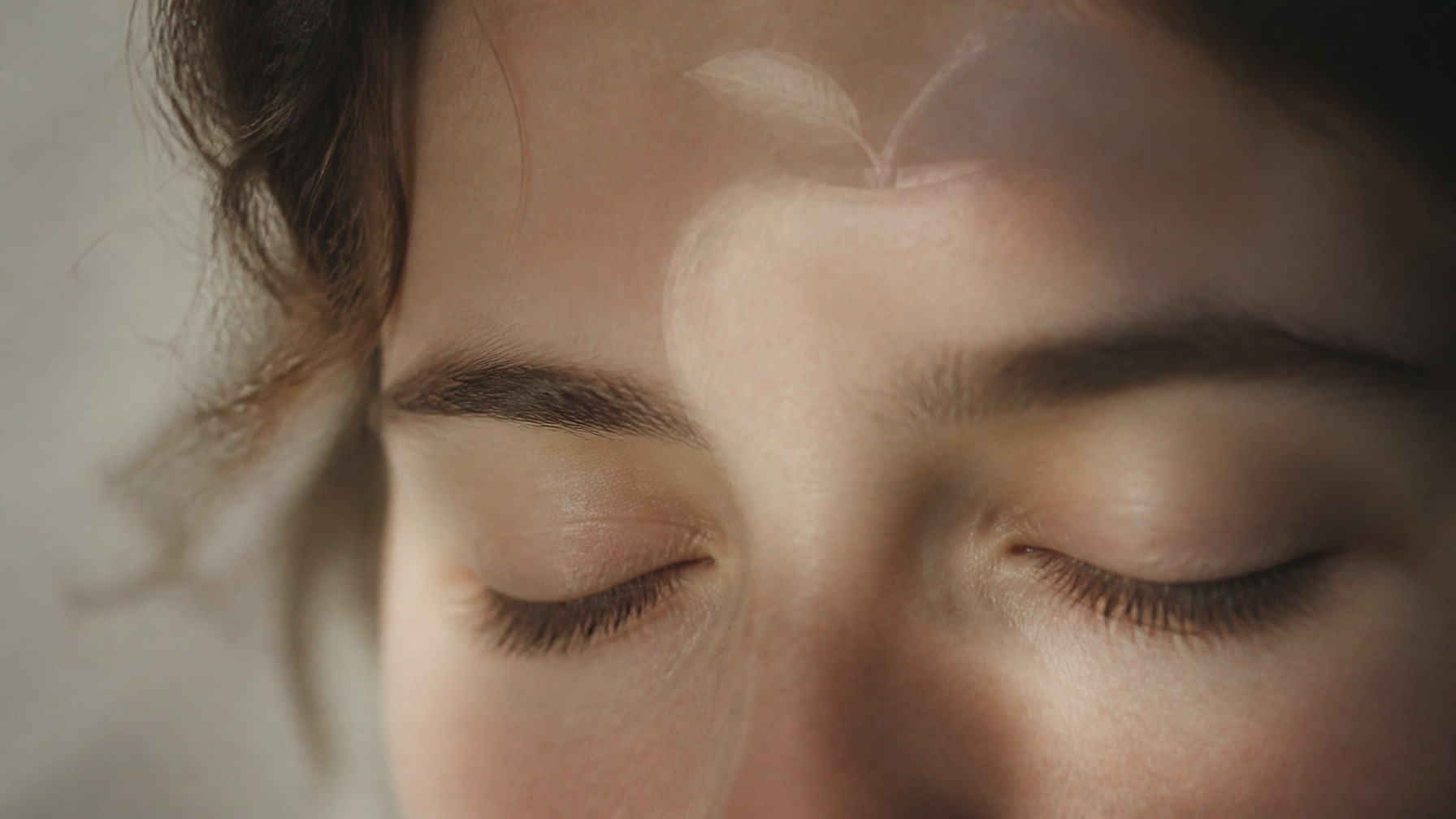
Close your eyes for a moment and picture an apple. For most people, something appears, maybe faint and fleeting, maybe sharp enough to notice the exact shade of red and a small bruise near the stem. Now consider that a meaningful share of people, when asked to do the exact same thing, see nothing at all. No image, no color, no shape hovering behind their closed eyelids. They know what an apple looks like in the sense that they can describe it perfectly well, but the actual experience of picturing it, visually, in the mind, simply doesn’t happen for them. This is aphantasia, and it’s a genuinely strange case of a normal human variation that science almost completely overlooked for more than a century.
The Study That Named a Blind Spot Science Almost Missed
The first documented hint of this came in 1880, when the British scientist Francis Galton surveyed roughly 100 men, asking them to describe their breakfast table in as much visual detail as possible, including its lighting, sharpness, and color. Galton expected a fairly uniform range of responses. Instead, he was startled to find that a number of his subjects had no idea what he was even asking for. They had assumed, up to that point, that phrases like “mental imagery” were just a figure of speech, not a literal description of something other people actually experienced. Galton had stumbled onto a real and measurable difference in human cognition, and then, for more than 130 years, almost nobody followed up on it.
The Patient Who Restarted the Investigation
Modern interest in the phenomenon didn’t pick back up until 2005, when a retired building surveyor known in the research literature as MX reported to neurologist Adam Zeman that he had lost his ability to visualize anything at all following a minor cardiac procedure. Zeman’s team studied MX’s case in detail, publishing their findings in 2010, and the case caught enough public and scientific attention that Zeman went on to hear from thousands of people who described a similar experience, except that many of them had never had any visualization ability to lose in the first place. In 2015, Zeman and his colleagues coined a formal name for this lifelong absence of visual mental imagery, adapting it from Aristotle’s ancient Greek term for the mind’s eye: aphantasia.
What Aphantasia Actually Feels Like From the Inside
One of the trickiest parts of understanding aphantasia is that it doesn’t impair someone’s knowledge of what things look like. Someone with aphantasia can tell you an apple is round and red without any trouble. What’s missing is the specific subjective experience of seeing that apple projected in their mind while they think about it. Many describe their thinking in this domain as purely conceptual or factual, built entirely out of knowledge and language rather than pictures, which is part of why so many people with aphantasia don’t realize their experience is unusual until surprisingly late in life.
Why So Many People Don’t Realize They Have It
Because visualization happens entirely inside someone’s own head, there’s no obvious external clue that would tip a person off that their experience differs from everyone else’s. Plenty of people with aphantasia simply assumed for years that phrases like “picture it in your mind” were poetic exaggeration rather than a literal instruction, much like Galton’s original survey subjects in 1880. It’s only when the topic comes up directly, often through a viral article or a casual conversation that goes strangely specific, that many people first discover their experience of “picturing” something has never involved an actual picture at all.

Aphantasia’s Surprising Companions: Memory and Faces
Researchers have found that aphantasia doesn’t travel alone. People with lifelong aphantasia report a higher rate of difficulty with autobiographical memory, meaning the vivid, image-based recall of personal past experiences that many people rely on when reminiscing. Some also report a higher incidence of prosopagnosia, or difficulty recognizing faces, suggesting that the same neural circuitry involved in generating visual imagery may also play a supporting role in certain kinds of memory and facial recognition. Researchers stress that these links are variable rather than universal. Plenty of people with aphantasia have perfectly typical memory and no trouble recognizing faces at all, but the association shows up often enough across studies to suggest a real, shared underlying mechanism rather than coincidence.
The Curious Case of Still Dreaming in Pictures
Perhaps the most counterintuitive finding is that a majority of people with aphantasia, over half in Zeman’s research, still report dreaming in visual imagery, despite being completely unable to voluntarily conjure a mental picture while awake. That split suggests the brain systems responsible for generating imagery during sleep aren’t entirely the same as the ones involved in deliberate, conscious visualization, and that aphantasia may specifically affect the voluntary, waking side of that system rather than the brain’s visual imagination as a whole.
The Opposite End of the Spectrum: Hyperphantasia
If aphantasia sits at one extreme of visual imagination, researchers have also identified the opposite end, which they call hyperphantasia, describing mental imagery so vivid it can feel indistinguishable from actually seeing something. People with hyperphantasia also show a higher rate of synesthesia, a related phenomenon in which one sense triggers an involuntary experience in another, such as perceiving specific letters or numbers as having an inherent color. Between these two extremes sits the vast majority of people, experiencing mental imagery somewhere in the ordinary middle range most researchers had simply assumed was universal until aphantasia forced a much closer look.
Why This Isn’t a Disorder, Just a Different Setting
It’s worth being clear that aphantasia isn’t classified as a disorder or a deficit in any functional sense. It doesn’t stop people from succeeding in fields that seem, on the surface, to depend heavily on visualization. Interestingly, Galton’s original 1880 data hinted at exactly this kind of variation by profession, finding that people in scientific fields tended to report fainter mental imagery on average than people in other lines of work, a pattern researchers have continued to explore in modern studies. Several public figures, including a well-known browser developer and an award-winning animator, have openly described having aphantasia themselves while working in fields that would seem to require constant visualization. Whatever aphantasia changes about the internal experience of thought, it clearly doesn’t prevent the kind of creative and technical work most people would assume requires a fully functioning mind’s eye.
Frequently Asked Questions
What is aphantasia?
Aphantasia is the inability to voluntarily create visual mental imagery. People with aphantasia can still know and describe what something looks like, but they do not experience an actual mental picture when they try to visualize it.
Who first discovered aphantasia?
British scientist Francis Galton first documented significant variation in mental imagery ability in 1880 through a survey about visualizing a breakfast table. The phenomenon received little further study until neurologist Adam Zeman coined the term “aphantasia” in 2015 following his research into a patient who lost his visualization ability after a medical procedure.
Does aphantasia affect memory or dreaming?
Research suggests aphantasia is associated with a higher rate of difficulty with autobiographical memory and face recognition, though this varies from person to person. Interestingly, more than half of people with aphantasia still report dreaming in visual imagery, despite being unable to voluntarily visualize while awake.
Is aphantasia a disorder?
No, aphantasia is not classified as a disorder. It represents one end of a normal range of variation in human mental imagery, alongside hyperphantasia, an unusually vivid form of visualization at the opposite extreme. People with aphantasia work successfully in a wide range of fields, including creative and technical professions.