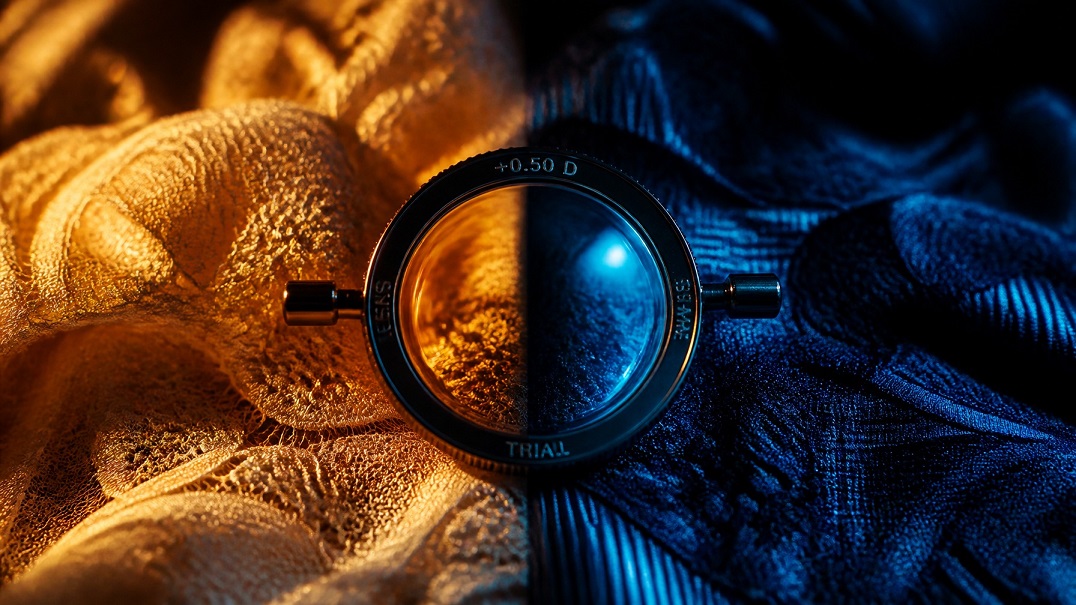
People disagree about the dress because the photo is ambiguous about its lighting, and each brain quietly makes a guess. If yours assumes shade or bluish daylight, you tend to see white and gold. If it assumes warm artificial light, you tend to see blue and black. Research supports this lighting-assumption idea, but it does not fully explain every individual’s view.
A Photo That Hides Its Lighting
In the original image, the dress’s pixels are brown and blue, according to a 2015 study in Current Biology. Neuroscientist Pascal Wallisch says, per a university press release, that the photo was overexposed, which left the light source uncertain. The actual dress was blue and black, Live Science reports.
When lighting is unclear, your brain still has to decide, and it does so without telling you.
Color Constancy at Work
Your brain constantly subtracts the color of the light to judge an object’s true color. Wallisch describes this as a basic cognitive function that happens continuously. The Current Biology team proposed that some people favor a cool illuminant such as blue sky, discount short wavelengths, and see white and gold. Others favor a warm illuminant such as incandescent light, discount long wavelengths, and see blue and black.
For another example of color you did not expect, see afterimages.
What the Big Surveys Found
In a free-response survey of 1,401 people, 57% described the dress as blue and black, 30% as white and gold, and 11% as blue and brown. Some respondents had never seen the image before. White and gold reports were higher among older people and women.
Medical News Today, covering three Current Biology studies, reported that about half of participants saw the blue stripes as blue and half saw them as white, and that the researchers framed the real question as light blue versus dark blue.
Wallisch later surveyed more than 13,000 people. In two runs, roughly 56% to 59% saw white and gold, and roughly 27% to 31% saw blue and black. The splits differ from study to study, so treat the percentages as results from those samples, not population facts.
Shadow or Artificial Light
Wallisch asked people whether they thought the dress sat in shadow. Those who did were far more likely to see white and gold, about four out of five according to Live Science. Those who assumed artificial light were more likely to see blue and black. The press release describes the logic: shadows are bluish, so the brain removes blue, leaving gold and white.
Larks, Owls, and Daylight
Wallisch also asked whether people were morning types (larks) or evening types (owls). Per Live Science, owls were more likely to see blue and black than white and gold, and larks the reverse. His interpretation is that the light you typically live in shapes your assumptions. The Current Biology authors made a similar suggestion, proposing that night owls may assume warmer artificial light.
That is an association based on self-reported habits, not proof that bedtime changes what you see.
Can Your View Flip?
For some people, yes. A follow-up study in the Journal of Vision notes that data from the initial report suggested some observers experience perceptual reversals, so the dress may behave like other ambiguous images. Popular accounts had suggested people get locked into one view after a first look, which is why the researchers tested it. Wallisch has also told Live Science that people who see both versions on different days may not be strongly lark or owl types.
What the Dress Teaches Us
Wallisch concluded that the color I see may not be the color you see when the lighting is unclear, because your assumptions about the light will matter, and those may reflect lifestyle. That is not a flaw, just how vision works. Your brain resolves ambiguity quietly, and it rarely tells you it was guessing.
Does It Say Anything About Your Eyes
Not in any diagnostic sense. The researchers frame the split as a difference in assumptions about light, and nothing in this research treats it as a sign of eye disease. The National Eye Institute notes that everyone sees color a little differently. If you struggle with colors in daily life, ask an eye doctor for a color vision test.
Room lighting affects comfort and color judgments too. See our posts on ambient lighting color temperature and photography and color vision. And for more strange color effects, read about impossible colors.