
Your eyes put in long hours. Screens at work, headlights on the drive home, bright sun on the weekend. It makes sense that more people are looking for nutrition that supports everyday eye health, and two formulas often land on the same shortlist: Performance Lab Vision and Life Extension MacuGuard Ocular Support with Saffron & Astaxanthin.
Neither one is an AREDS2 formula. Both are built for everyday eye support rather than for people managing a diagnosed eye condition. This guide walks through what is in each bottle, how the labels differ, and which one suits your routine.
Performance Lab Vision vs MacuGuard at a Glance
| Feature | Performance Lab Vision | Life Extension MacuGuard |
|---|---|---|
| Lutein | 10 mg | 10 mg |
| Zeaxanthin | 2 mg | 4 mg (meso-zeaxanthin and zeaxanthin combined) |
| Astaxanthin | 4 mg | 6 mg |
| Saffron | 10 mg | 20 mg |
| Bilberry extract | 25 mg | None listed |
| Blackcurrant | 300 mg freeze-dried fruit plus 25 mg extract | C3G from blackcurrant extract on some label versions |
| Capsule type | Vegan pullulan capsule | Gelatin softgel |
| Label style | Every ingredient and dose listed individually | Carotenoids grouped in a proprietary blend |
| Daily serving | 1 capsule with food | 1 softgel with food |
| Count per bottle | 30 | 60 |
What Is in Performance Lab Vision
Vision packs six research-backed ingredients into one daily capsule. Here is what each serving contains:
- Lutein, 10 mg, and zeaxanthin, 2 mg, from marigold flower extract
- Astaxanthin, 4 mg, from Haematococcus pluvialis algae
- European bilberry extract, 25 mg, standardized to 25% anthocyanosides
- European blackcurrant, 300 mg freeze-dried fruit plus 25 mg extract (25% anthocyanins)
- Saffron, 10 mg, standardized to 0.3% safranal
The capsule itself is a plant-based pullulan shell made from fermented tapioca. Performance Lab lists the product as non-GMO, free of soy, gluten, and common allergens, and third-party tested for purity and potency.
What Is in Life Extension MacuGuard Ocular Support
MacuGuard takes a carotenoid-first approach. Each softgel contains marigold extract providing 10 mg of lutein and 4 mg of meso-zeaxanthin and zeaxanthin, plus phospholipids and mixed carotenoids (1.24 mg of alpha-carotene). Those pieces sit inside a “MacuGuard proprietary blend.” Alongside the blend you get 20 mg of saffron extract and 6 mg of natural astaxanthin. Some label versions also list 2.2 mg of C3G from European blackcurrant extract.
The softgel shell is made with gelatin, and the other ingredients include palm oil, beeswax, and annatto color.
Both products lean on the same two nutrients, and for good reason. Lutein and zeaxanthin are the pigments that collect in the macula, the part of your retina responsible for sharp central vision. There they absorb blue light, which is why researchers call them macular carotenoids.
A six-month, placebo-controlled trial of 48 healthy adults with at least six hours of daily screen time found that supplementing with these carotenoids raised macular pigment density and improved eye strain, eye fatigue, and headache frequency, according to a summary from the American Optometric Association. To keep expectations realistic, that trial used 24 mg a day of macular carotenoids, which is more than either of these products supplies. Think of it as a strong reason to take eye nutrition seriously, not a promise about any single bottle.
On the foundation, the two formulas are close. Both give you 10 mg of lutein. MacuGuard supplies more zeaxanthin forms. The real separation happens in everything built on top.
Bilberry and Blackcurrant: A Berry Advantage for Vision
Vision is the more berry-forward formula. It includes bilberry extract, an ingredient MacuGuard does not list at all. It also pairs 300 mg of whole freeze-dried European blackcurrant with a standardized blackcurrant extract, so you get the fruit and a concentrated anthocyanin source in the same capsule.
If you like the idea of a formula that covers carotenoids, berry anthocyanins, saffron, and astaxanthin in a single daily dose, Vision is the one that checks all of those boxes with distinct, individually listed ingredients.
Saffron and Astaxanthin Doses Compared
Here is the straightforward numbers check. MacuGuard lists 20 mg of saffron and 6 mg of astaxanthin. Vision lists 10 mg of saffron and 4 mg of astaxanthin.
Bigger numbers on a label do not automatically mean a better experience. What matters is the whole formula, how consistently you take it, and how well it fits your daily habits. Vision’s approach is breadth: six ingredients working together at moderate doses, rather than a carotenoid base with a couple of add-ons. If you want your eye supplement to cover more categories of nutrition, that breadth is the point.
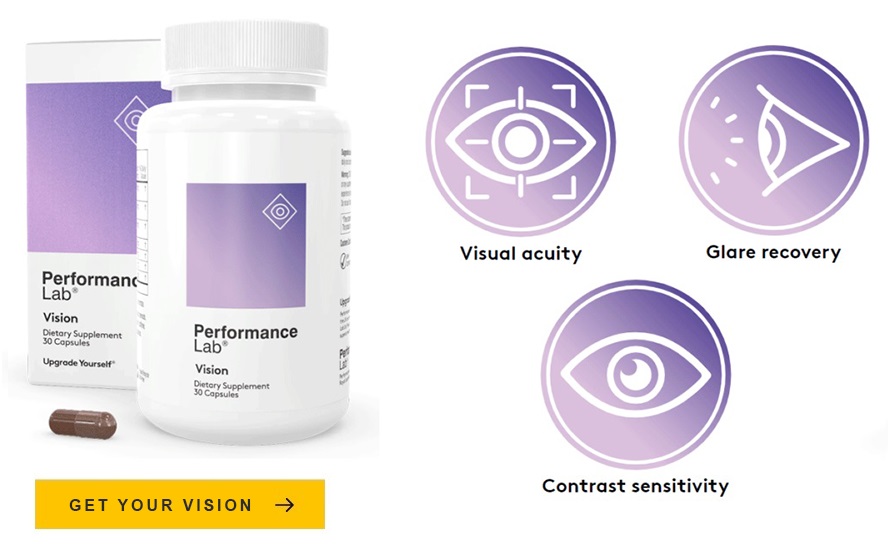
Label Transparency: Clear Doses vs a Proprietary Blend
This is one of the easiest differences to spot when you read the two labels side by side. Vision shows every ingredient with its own dose and uses no proprietary blends. You know exactly what is in each capsule.
MacuGuard groups its marigold extract, phospholipids, and mixed carotenoids under a single blend. The label does tell you the lutein and zeaxanthin amounts in brackets, but the phospholipid and mixed carotenoid portions are bundled together. If you like knowing precisely what you are swallowing, Vision’s label makes that simple.
Vegan Capsules vs Gelatin Softgels
Vision uses NutriCaps, a prebiotic pullulan capsule made from fermented tapioca. It is suitable for vegans and vegetarians, and Performance Lab’s product page lists it as free of soy, gluten, synthetic additives, artificial colors, and preservatives.
MacuGuard uses a gelatin softgel, which comes from animal sources, and its other ingredients include beeswax. That means it is not vegan or plant-based. If you follow a plant-based diet, or you simply prefer a cleaner ingredient list, Vision fits without any compromise.
Price Per Day: What You Pay for Each Eye Supplement
MacuGuard is the lower-priced option. At some retailers it sells for about $18 for 60 softgels, which works out to roughly 30 cents a day. Prices vary by store, so check the current listing.
Vision lists at $49 for a 30-capsule bottle, about $1.63 a day as a one-time purchase. With the smart subscription (four bottles every four months), the price drops to $36.75 a bottle, around $1.23 a day, with free shipping, and you can update or cancel anytime. Performance Lab also advertises a 30-day money-back guarantee, so you can try it with very little risk.
What the extra cost buys is a different kind of product: a broader formula with bilberry and whole blackcurrant, fully disclosed doses, and a vegan capsule. If those things matter to you, the difference is easy to justify.
Who Should Choose Performance Lab Vision
Vision is a strong fit if you:
- Follow a vegan or plant-based diet, or avoid gelatin and animal-derived ingredients
- Want bilberry, blackcurrant, saffron, astaxanthin, lutein, and zeaxanthin together in one formula
- Prefer a label that shows every dose with no proprietary blend
- Spend long hours on screens, drive often, or play sports and want daily nutrition aimed at everyday visual performance
- Like the confidence of a money-back guarantee and subscription savings
If your top priority is the lowest possible cost per day, and you are comfortable with a gelatin softgel and a blended label, MacuGuard is the one that serves that goal.
Final Verdict on Vision vs MacuGuard
Both supplements start with the same 10 mg of lutein. After that, Vision gives you a wider and more transparent formula: bilberry, whole blackcurrant, saffron, and astaxanthin, all with individually listed doses, in a vegan capsule that is third-party tested. MacuGuard offers higher saffron and astaxanthin numbers and a lower price, but with a proprietary blend and a gelatin shell.
For most people who want a complete, clean-label eye formula to take every day, Performance Lab Vision is the better fit. You can see the full Performance Lab Vision formula and current pricing here.
Frequently Asked Questions About Vision and MacuGuard
Is Performance Lab Vision or Life Extension MacuGuard an AREDS2 Formula?
No. Vision is designed for everyday eye health and nutrition. MacuGuard is not an AREDS2 formula either. If you have been diagnosed with a macular condition, talk with your eye doctor before choosing any eye supplement.
Which Has More Saffron and Astaxanthin, Vision or MacuGuard?
MacuGuard lists 20 mg of saffron and 6 mg of astaxanthin. Vision lists 10 mg of saffron and 4 mg of astaxanthin, along with bilberry and blackcurrant, which MacuGuard does not match.
Is Performance Lab Vision Vegan?
Yes. Vision uses a plant-based pullulan capsule and is free of soy, gluten, and common allergens. MacuGuard uses a gelatin softgel and contains beeswax, so it is not vegan.
How Long Should I Take an Eye Supplement Before Judging It?
Give it consistent daily use over several months. The screen-time trial discussed above ran for six months. Performance Lab recommends taking one Vision capsule per day with food.
Can I Take Vision With Other Supplements?
Many people combine eye nutrition with a multivitamin or omega-3. Check with your doctor or pharmacist first, especially if you take medication, are pregnant, or are nursing.
Does Performance Lab Vision Come With a Guarantee?
Performance Lab advertises a 30-day money-back guarantee across its products, along with subscription savings of up to 25%.
These statements have not been evaluated by the Food and Drug Administration. Vision and MacuGuard are not intended to diagnose, treat, cure, or prevent any disease. This article is for information only and is not medical advice.