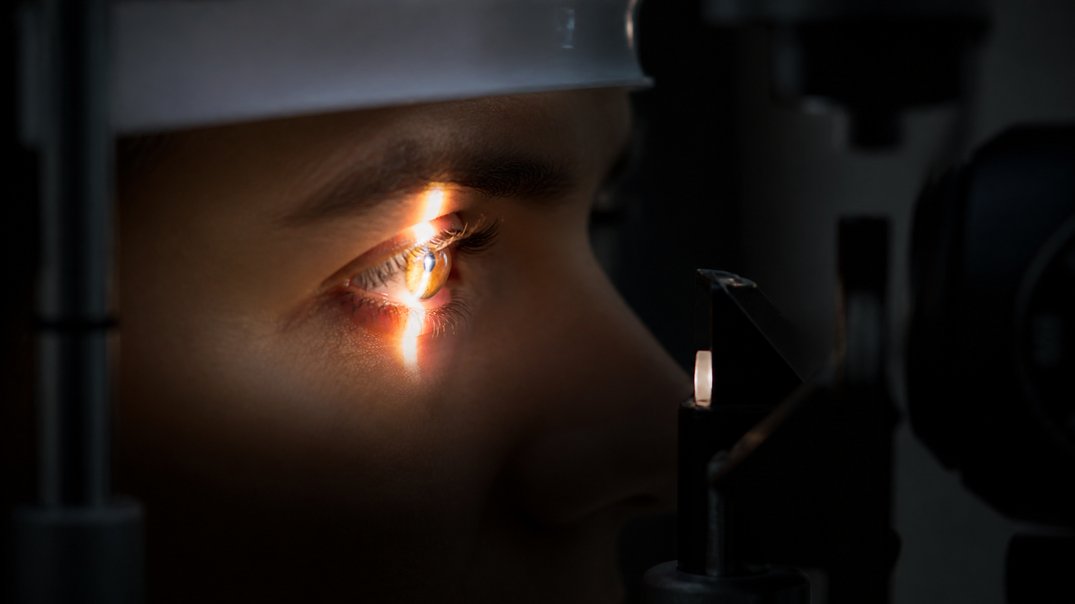
Dark mode has become the default assumption for eye comfort among a huge share of smartphone and computer users, marketed by device makers as gentler on the eyes and adopted widely on that premise. The research on the topic tells a more layered story than the marketing suggests. Dark mode genuinely helps in some situations and genuinely works against comfortable reading in others, and which one applies to you depends heavily on your surroundings and, in a meaningful number of cases, on a very common and often undiagnosed vision characteristic.
How Pupil Dilation Changes What You Are Looking At
The core mechanism separating dark mode from light mode is how each affects pupil size. A bright, light-colored background causes the pupil to constrict, since more light is entering the eye and less needs to be let in. A dark background with light text does the opposite, causing the pupil to dilate as the eye tries to gather more light from the comparatively dim overall screen. A constricted pupil generally produces a sharper retinal image with fewer optical aberrations, similar to how narrowing a camera aperture increases the depth of field and image sharpness. A dilated pupil lets more light in but does so at some cost to focusing precision.
Why This Matters More for Reading Small Text
This tradeoff is fairly minor for large text or simple graphic content, but it becomes more consequential for small, detailed text, exactly the kind of reading most people do for extended periods on phones, tablets, and laptops. Several controlled studies comparing reading performance between the two contrast polarities, dark text on light background versus light text on dark background, have found that positive polarity, meaning dark text on a light background, tends to produce faster reading speeds and fewer errors for sustained reading tasks.
The Astigmatism Factor Most People Have Never Heard Of
The single biggest reason dark mode causes noticeably more strain for some people than others comes down to a very common and often subtle vision characteristic: astigmatism, an irregular curvature of the cornea or lens that causes light to focus unevenly rather than at a single sharp point. Astigmatism affects a substantial share of the adult population, with commonly cited estimates placing it at somewhere between roughly a third and half of adults to some degree, many of whom have never been formally diagnosed because their astigmatism is mild enough not to require correction under normal reading conditions.
Why Astigmatism and Dark Mode Are a Poor Combination
In someone with astigmatism, a dilated pupil, the kind produced by looking at a dark background, allows light to pass through a wider portion of an already irregularly shaped cornea or lens, increasing the degree of uneven focusing that reaches the retina. The practical result is a phenomenon called halation, where bright text on a dark background appears to bleed, blur, or develop a faint glow around its edges, making the text measurably harder to resolve clearly than the same text would appear in the opposite polarity. People with even mild, uncorrected astigmatism often notice this effect without necessarily understanding why dark mode feels harder to read than they expected it to.
What Controlled Studies Have Found About Overall Fatigue
Despite dark mode’s reputation as the more eye-friendly default, controlled research comparing overall visual fatigue between the two modes has generally found no significant difference in total fatigue between light and dark mode under typical screen brightness and ambient lighting conditions. Some studies have found dark mode performs slightly better on specific measures, including modestly reduced dry eye symptoms during extended use and somewhat better results on a measure called critical flicker frequency, which reflects a different aspect of visual processing capacity. Other research examining cognitive performance during reading tasks has found people generally perform slightly better in light mode, though the difference appears to vary by the type of task and by individual factors including gender in some studies, an area still being actively researched rather than settled.
Why Ambient Lighting Changes the Answer
The environment surrounding your screen turns out to matter as much as the screen mode itself. In a bright, well-lit room, a dark-mode screen creates a large brightness mismatch between the display and its surroundings, which can itself contribute to eye strain as the eye repeatedly readjusts between the two brightness levels. In this setting, light mode, whose brightness more closely matches a well-lit room, tends to be the more comfortable choice. In a dim room or at night, the relationship reverses. A bright, light-mode screen against dark surroundings creates the same kind of brightness mismatch in the other direction, and dark mode’s lower overall luminance tends to feel considerably more comfortable and is less disruptive to the eyes’ adaptation to the surrounding darkness.
The Practical Rule This Suggests
Rather than treating dark mode or light mode as a fixed, universally correct choice, matching the screen’s overall brightness to the ambient light in the room addresses much of what actually drives discomfort. Many devices now include automatic switching based on time of day or ambient light sensors, which is a reasonable default for most people, though it is worth remembering that this addresses brightness matching specifically and does not resolve the separate astigmatism-related halation issue for those affected by it.
What This Means for Sleep and Blue Light
It is worth separating the eye strain question from a related but distinct concern: the effect of screen light on sleep. Dark mode reduces the total amount of light emitted by a display, which can modestly reduce blue light exposure simply because less light overall is being emitted, but dark mode does not fundamentally change the spectral composition of the light that is emitted. A dedicated night mode or blue light filter, which shifts the color temperature of emitted light toward warmer tones, addresses this concern more directly than switching to dark mode alone, and the two features are not interchangeable even though they are frequently used together.
Choosing What Works for You
Given the mixed and context-dependent research, the most useful approach is a practical one rather than a categorical rule. If you have diagnosed or suspected astigmatism, particularly if you notice text looking blurry or glowing in dark mode, light mode for extended reading is very likely the more comfortable choice regardless of ambient lighting. If you do not have astigmatism, matching your screen mode to the brightness of your surroundings, light mode in bright rooms, dark mode in dim ones, is a reasonable, evidence-informed default, and beyond that, personal comfort during actual use is a perfectly legitimate way to decide, since the measured differences in fatigue between the two modes are fairly small for people without astigmatism to begin with.