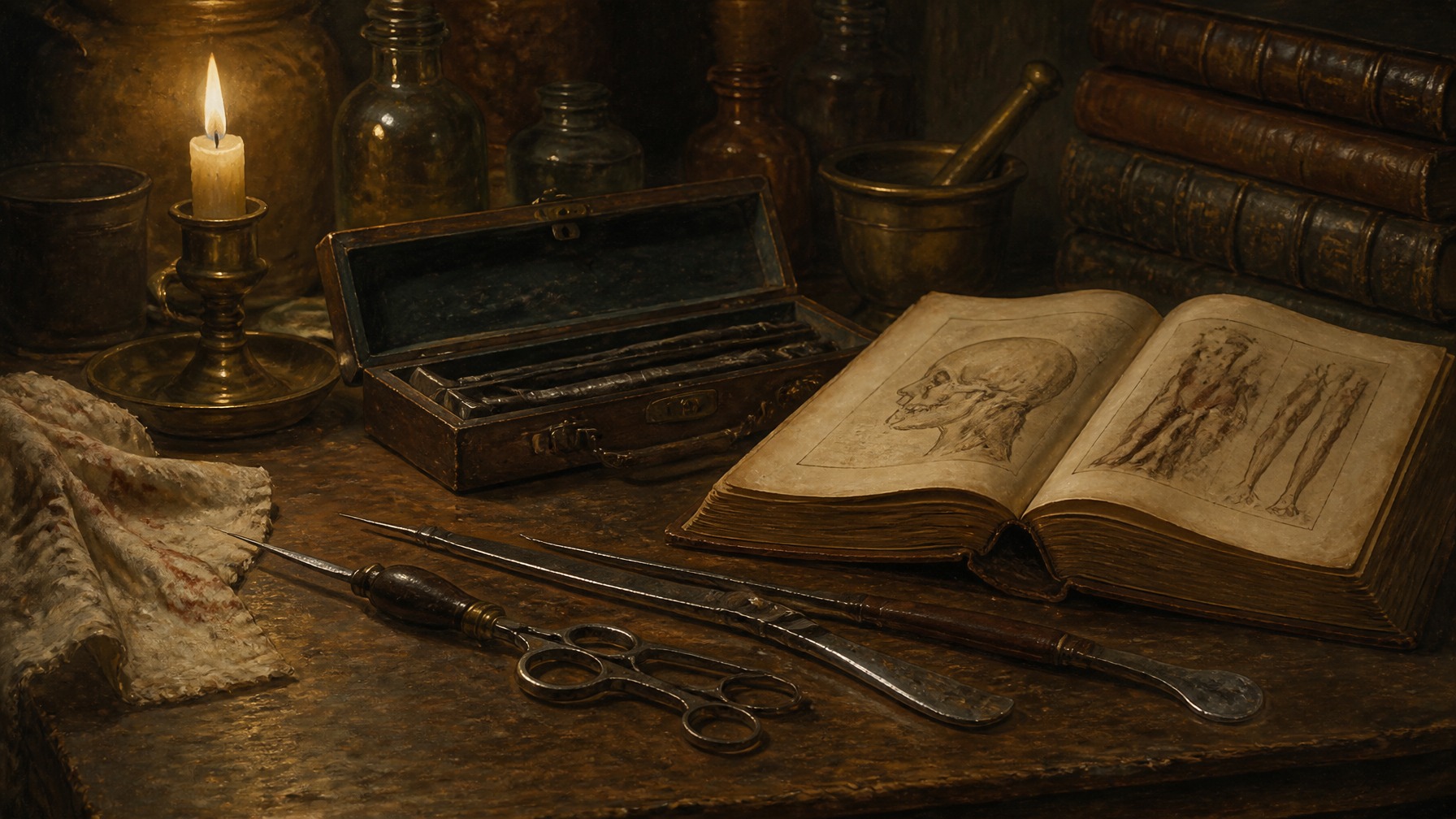
In March of 1750, a well-dressed Englishman rolled into Leipzig in a coach painted from top to bottom with giant eyeballs. A Latin motto ran along the side: qui dat videre dat vivere, or “to give sight is to give life.” His name was John Taylor, and he called himself an “ophthalmiater,” a title he invented himself because no existing word sounded impressive enough. He was in town to fix the failing eyesight of one of the most famous composers in Europe: Johann Sebastian Bach.
Bach never saw properly again. Within months he was dead. A few years later, Taylor would perform a strikingly similar operation on George Frideric Handel, with strikingly similar results. Two of the greatest musical minds in history, both left in darkness by the same traveling eye doctor.
The strange part is that Taylor wasn’t some back-alley con artist working outside the bounds of legitimate medicine. He was the standard of care. What he did to Bach and Handel was a real procedure, practiced for roughly two thousand years across multiple continents, taught in medical texts, and performed by respected specialists. It was called couching, and understanding it says a lot about how long the world went without a real fix for one of the most common causes of blindness.
A Surgery Almost as Old as Writing Itself
Cataracts have probably clouded human vision for as long as humans have lived long enough to get them. The lens of the eye is made of proteins that, over decades, can clump together and turn opaque, scattering light instead of letting it pass through cleanly. Someone, somewhere, eventually figured out that if you could physically dislodge that clouded lens from the line of sight, some vision would return. Exactly who figured this out first is lost to time, but the written record starts remarkably early.
An ancient Sanskrit surgical text called the Sushruta Samhita, likely compiled sometime around 200 BCE though possibly older, describes the procedure in detail. Around the same period, a nearly identical technique was apparently in use in Hellenistic Egypt. A few centuries later, the Roman writer Celsus documented it too. This wasn’t a one-off folk remedy that popped up in a single village. It was a genuine medical technique that different cultures, working independently or through trade and conquest, arrived at again and again.
How the Technique Traveled the World
From its early roots in India and the Mediterranean, couching spread outward along the same routes that carried spices, silk, and scholarship. Arabic medical texts from the medieval period describe the procedure in careful detail, and it was through translations of those Arabic works in Sicily and Spain that the technique made its way into Western Europe. It also traveled east, becoming widespread in China during the Sui and Tang dynasties, and it shows up independently in Tibetan medical practice, in parts of Africa, and among healers across the Americas. Some regions even developed variations using sharpened thorns instead of metal needles when metal instruments weren’t available.
By the time couching reached the British Isles, sometime around the 1560s, it had already been refined and re-refined by generations of practitioners on three or four continents. For most of its history, it wasn’t performed in hospitals by university-trained physicians. It was performed by itinerant specialists known as oculists, who often learned the trade within their own families and traveled from town to town, treating whoever needed them and moving on.
What Actually Happened During a Couching Procedure
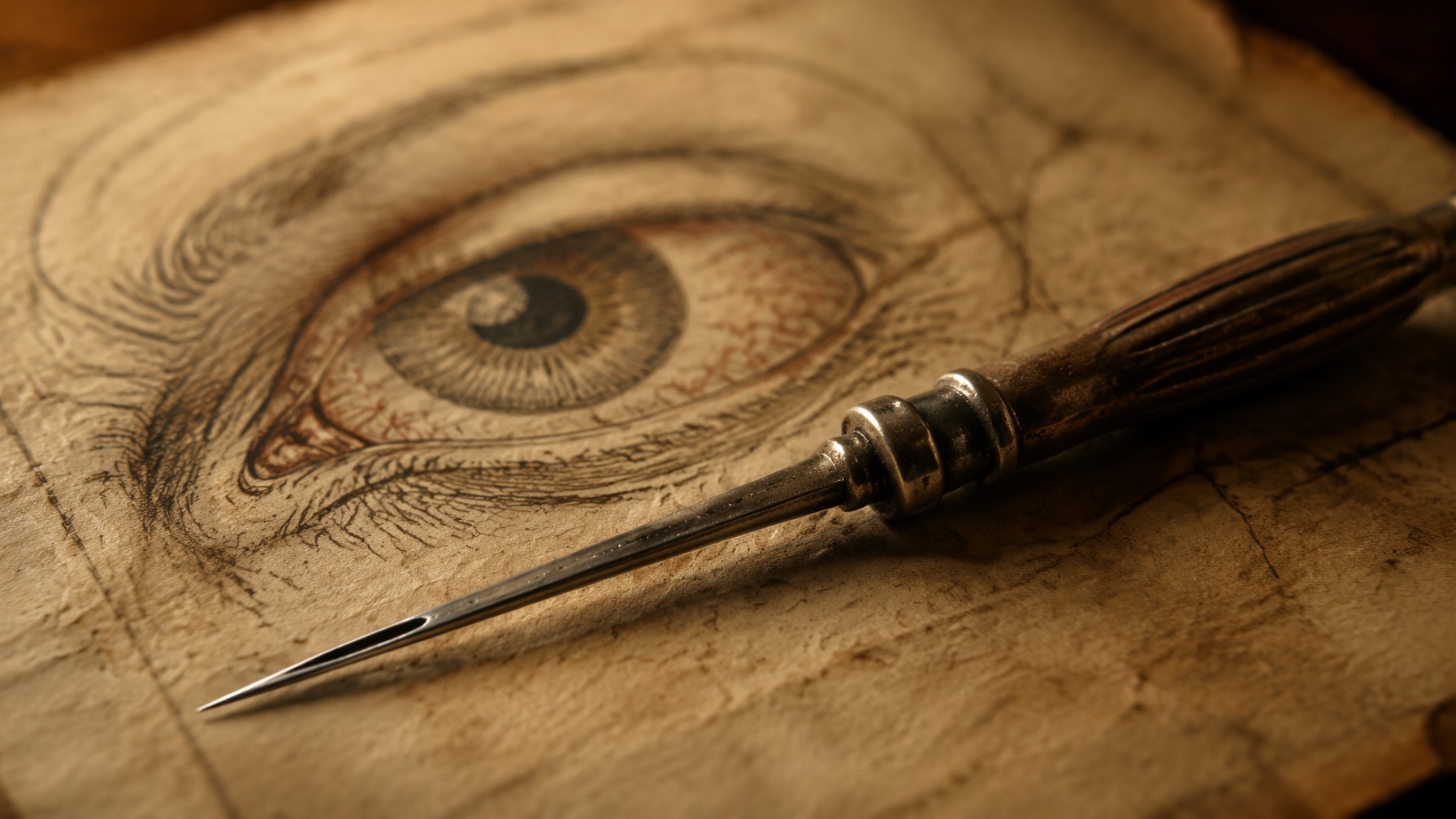
The mechanics of couching were simple enough to describe in a sentence, which is part of why the technique persisted for so long even though it required real skill to perform well. A practitioner would wait until a cataract was “ripe,” meaning fully clouded and firm enough to handle. Then, using a needle or a sharpened metal lance, they would puncture the eye near the edge of the cornea and push the clouded lens downward and backward, out of the direct path of light, into the lower chamber of the eye.
A Procedure Without Painkillers, Sterilization, or Guarantees
None of this was done with anesthesia in any modern sense. Patients were sometimes given alcohol, held down by an assistant, or simply told to endure it. There was no understanding of germ theory, so instruments weren’t sterilized in any meaningful way. If the lens didn’t stay put after being pushed aside, or if infection set in, or if the needle nicked something it shouldn’t have, the result could be partial vision, total blindness, or worse. Historical accounts, including John Taylor’s own writings, suggest that a meaningful share of couching patients ended up blind rather than cured. Taylor himself reportedly admitted, later in life, to having blinded hundreds of people over the course of his career.
Even when things went reasonably well, the results were nothing like modern vision correction. Pushing the lens aside let unfocused light reach the retina again, which could mean the difference between total darkness and being able to make out shapes, light, and movement. But without a replacement lens, patients typically remained severely farsighted and needed thick corrective glasses afterward, if they could get their hands on any.
The Ophthalmiater Who Blinded Two Musical Legends
John Taylor is worth lingering on because his career shows exactly how this system operated at its most theatrical. He had genuine medical training, having studied under a respected London surgeon named William Cheselden, but he built his fame on showmanship rather than surgical care. He toured constantly, treating royalty in Russia, the Persian court, and multiple European monarchies, and he wrote a two-volume autobiography that, by most modern accounts, reads as pure self-promotion.
A Pattern That Followed Him From City to City
Wherever his results were poor, Taylor tended to have already moved on to the next town by the time patients realized their vision wasn’t returning. This traveling model wasn’t unique to him. It was baked into how oculists of the era operated, and it made accountability nearly impossible. Bach’s case is a stark example: two operations in Leipzig within days of each other, followed by total blindness, a lingering fever, and death a few months later. Handel underwent a similar operation eight years later and experienced a comparable decline in health afterward. Whether Taylor’s surgery directly caused either composer’s death is still debated by historians, but neither man saw well again after treatment.
Why an Imperfect Technique Survived for Two Thousand Years
It’s tempting to look back at couching and wonder how anyone tolerated it for two millennia. The honest answer is that for most of human history, the alternative to couching wasn’t a better surgery. It was permanent, total blindness with no intervention at all. Even a technique with a high failure rate and a real risk of making things worse offered something that hadn’t existed before: a chance, however uncertain, at partial vision. For patients with nothing left to lose, that chance was enough to make the journey, and the pain, worth it.
It also helped that couching didn’t require expensive equipment or institutional infrastructure. A skilled practitioner needed a sharpened instrument and steady hands, which meant the procedure could travel to rural villages and remote regions that never saw a formally trained physician. In many parts of the world, this made couching the only realistic option for treating cataracts well into the 20th century, and it’s still occasionally practiced by traditional healers in a handful of regions today, generally discouraged by modern ophthalmology due to its high complication rate.
The Slow Arrival of a Genuine Alternative
The real turning point didn’t come until 1747, when a French surgeon named Jacques Daviel developed a fundamentally different approach. Rather than pushing the clouded lens out of the way and leaving it inside the eye, Daviel figured out how to make an incision and remove the lens entirely. This was a genuine extraction, not a displacement, and it dramatically improved outcomes compared to couching. It wasn’t painless and it wasn’t risk-free by modern standards, but it represented the first real conceptual leap in cataract treatment in roughly two thousand years.
From Daviel’s Incision to Today’s Outpatient Procedure
Daviel’s technique kicked off a slow, multi-generational refinement process. Anesthesia arrived in the 19th century. Antiseptic technique followed. Eventually, replacement lenses were developed to correct the severe farsightedness that lens removal alone had always caused. Modern cataract surgery, a quick outpatient procedure with an extremely low complication rate, is the end result of that centuries-long chain of small improvements, each one building on the last.
What This History Says About Modern Eye Care
It’s easy to take a same-day, numbing-drops-and-you’re-done cataract surgery for granted. But for the vast majority of the time humans have understood that clouded lenses cause blindness, the best available option involved a sharpened needle, no anesthesia, and genuine uncertainty about whether you’d come out seeing better or not seeing at all. The traveling oculists of the 18th century weren’t outliers or frauds practicing outside legitimate medicine. They were the medicine, for better and for worse, and their story is a reminder of just how recent the idea of safe, reliable eye surgery actually is.

Frequently Asked Questions
What is couching in eye surgery history?
Couching was a cataract treatment technique in which a practitioner used a needle or sharpened instrument to push the eye’s clouded lens out of the direct line of sight rather than removing it. It was practiced across multiple continents for roughly two thousand years before being replaced by true lens extraction techniques.
Did John Taylor really blind Bach and Handel?
John Taylor performed cataract operations on both composers, and both men experienced severe vision loss afterward. Historians continue to debate exactly how much of the damage was directly caused by his surgery versus underlying illness, but neither composer regained meaningful sight after being treated by him.
When did modern cataract surgery replace couching?
The key turning point was 1747, when French surgeon Jacques Daviel developed a technique to fully remove the clouded lens through an incision rather than simply pushing it aside. This laid the groundwork for the modern cataract extraction procedures refined over the following two centuries.
Is couching still practiced anywhere today?
Couching has largely been abandoned in modern medicine due to its high complication rate, but it is occasionally still practiced by traditional healers in a small number of regions. Modern ophthalmology strongly discourages it in favor of safe, low-risk surgical alternatives.