
Prime Acuity covers eye nutrition because the research on it is genuinely interesting and genuinely underappreciated. The site also, transparently, recommends one supplement. This review is the full case for that recommendation, made the way any recommendation worth making should be: by examining what is actually in the product, comparing each ingredient against the clinical evidence, identifying where the formula is strong and where it is limited, and being direct about who this product is best suited for and who it is not.
Performance Lab Vision is made by Performance Lab, a supplement company that also produces Mind Lab Pro, one of the most well-regarded nootropic supplements on the market. The company’s approach emphasizes clean formulations with no proprietary blends, full ingredient disclosure, and the use of premium ingredient forms. Whether those commitments are kept in Vision specifically is what this review examines.
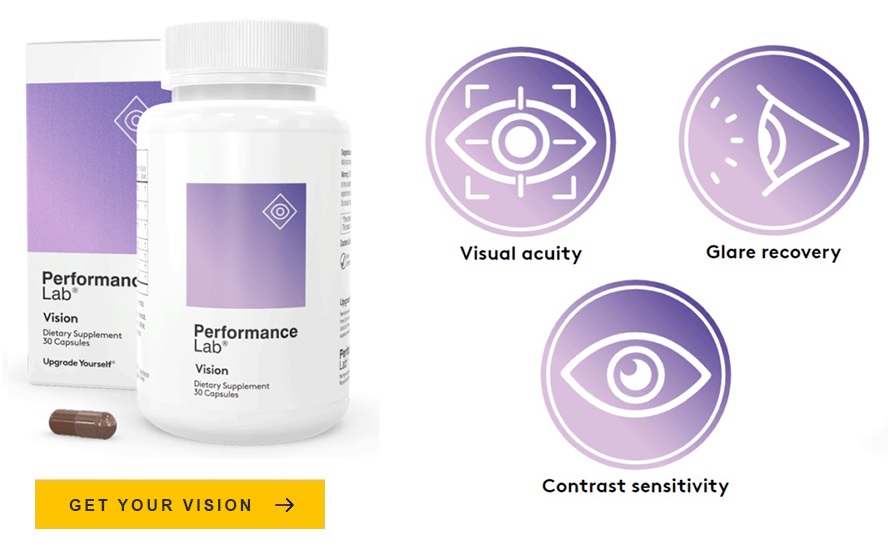
The short version is that Performance Lab Vision is a well-designed product that brings together six ingredients with genuine research support in forms and doses consistent with the clinical evidence, in a single daily capsule, without fillers or undisclosed blends. The longer version, which matters for making an informed decision, follows below.
Who Performance Lab Vision Is Designed For
Before examining the formula, it is worth being explicit about the target user for this product, because that clarity affects how the ingredients and doses should be evaluated.
The Primary Audience
Performance Lab Vision is not an AREDS2 formula and is not designed for people with diagnosed age-related macular degeneration who need the specific high-dose AMD management protocol. It is designed for the broader population of adults who want to support their visual performance, protect their eyes from the cumulative demands of screen use and light exposure, and build the nutritional infrastructure for long-term macular health before problems develop rather than after.
The product speaks most directly to screen-heavy workers and students experiencing eye fatigue, people in their 30s, 40s, and 50s who want proactive macular support, athletes and gamers interested in visual performance alongside protection, and anyone who already takes their nutritional health seriously and wants to extend that approach to their eyes specifically. It is not designed for people with existing eye disease who need clinical-grade intervention, and it would not substitute for professional eye care in that context.
The Performance Lab Brand Context
Performance Lab’s positioning as a performance nutrition brand rather than a general supplement company is relevant to how Vision is formulated. The product is oriented around both the protective and the performance dimensions of visual nutrition, which is why it includes ingredients like astaxanthin for accommodation support and saffron for retinal signaling, not just the baseline lutein and zeaxanthin that most eye supplements start and finish with. This orientation aligns well with the Prime Acuity reader who approaches eye health from a performance and optimization mindset rather than a purely disease-prevention one.
The Six Ingredients: Evidence-by-Evidence Assessment
Performance Lab Vision contains six active ingredients. All six are disclosed individually with specific amounts, which immediately passes the first test of label transparency. Here is what each ingredient does, what the research supports, and how the dose in this formula compares to the clinical evidence.
Lutein (10 mg from Marigold Flower Extract) and Zeaxanthin (2 mg from Marigold Flower Extract)
These two are the foundation of any credible eye supplement, and Performance Lab Vision delivers them at exactly the doses used in the AREDS2 trial and the majority of macular pigment clinical research: 10 mg lutein and 2 mg zeaxanthin. Both are derived from marigold flower extract (Tagetes erecta), which is the source used in the most extensively studied lutein and zeaxanthin preparations. The ratio of 5:1 reflects the AREDS2 formula directly.
At these doses, consistent daily supplementation produces measurable increases in macular pigment optical density over months, providing progressive blue light filtration and antioxidant protection in the fovea and surrounding macula. This is the core protective mechanism of the formula and it is properly addressed. For a complete understanding of what macular pigment does and why these doses are appropriate, our dedicated articles on lutein and zeaxanthin versus lutein cover the full research picture.
Astaxanthin (4 mg from Haematococcus Pluvialis Algal Extract)
The inclusion of astaxanthin at 4 mg is one of the features that distinguishes Vision from basic lutein-and-zeaxanthin eye supplements. At 4 mg, the dose is at the lower end of the range used in the Japanese eye fatigue trials (4 to 12 mg), where 6 mg was the most commonly studied amount showing significant improvements in ciliary muscle accommodation and subjective eye strain reduction. The 4 mg dose reflects a practical formulation decision in the context of a single-capsule daily formula, and it is a meaningful dose rather than a token amount.
The specification of Haematococcus pluvialis as the source confirms this is natural astaxanthin, which is the form used in all relevant human clinical trials and which has superior bioavailability compared to synthetic astaxanthin. For screen users whose primary near-term concern is eye fatigue from sustained focus work, this ingredient is doing something the lutein and zeaxanthin cannot: addressing the ciliary body oxidative stress that drives accommodation fatigue. The full mechanism is covered in our astaxanthin article.
European Bilberry Extract (25 mg, Standardized to 25% Anthocyanosides)
The bilberry extract is specified as European and standardized to 25 percent anthocyanosides, which matches the form used in clinical research on bilberry for visual function. At 25 mg of extract with 25 percent anthocyanosides, the formula delivers 6.25 mg of active anthocyanoside compounds per serving. This is a meaningful dose for contributing to the retinal vascular support and rhodopsin regeneration effects attributed to bilberry anthocyanins, though it is at the lower end of the range used in trials specifically examining night vision outcomes (which have used higher extract doses). For a product focused on daily maintenance of visual health rather than acute night vision enhancement, 25 mg of standardized extract is a practical and appropriate inclusion.
European Blackcurrant (325 mg Total: 25 mg Extract at 25% Anthocyanins with 2.2% C3G + 300 mg Freeze-Dried Powder)
The blackcurrant component is the most complex in the formula. Performance Lab Vision uses a dual approach: 25 mg of concentrated blackcurrant extract standardized to 25 percent anthocyanins and specifically including 2.2 percent cyanidin-3-glucoside (C3G), alongside 300 mg of freeze-dried blackcurrant powder providing a broader nutritional matrix from the whole fruit. The C3G specification is significant. As covered in our article on blackcurrant and C3G, this specific anthocyanin is the compound most directly studied for its interaction with rhodopsin regeneration and accommodative function. The dual format, concentrated extract plus whole fruit powder, reflects the logic of combining specific bioactive activity with the broader nutritional context of the whole berry.
The total blackcurrant inclusion at 325 mg is substantial relative to what many multi-ingredient eye formulas include, and the C3G specification demonstrates a formulation detail that distinguishes this product from those that include blackcurrant without specifying its active compound content.
Saffron Extract (10 mg, Standardized to 0.3% Safranal)
The saffron extract is specified at 10 mg standardized to 0.3 percent safranal, which is the active compound specification used in the clinical research preparations. The dose at 10 mg is half the 20 mg used in the most prominent Italian and Australian AMD trials, which is a genuine limitation worth acknowledging. At 10 mg of properly standardized extract, the safranal and crocin content is still meaningful, and the retinal antioxidant activity of these compounds is present at this dose. The product appears to have made a practical formulation decision about including saffron at a functional but cost-conscious level rather than at the full research dose within a one-capsule daily format. For the specific retinal function outcomes demonstrated in the AMD patient trials, the full 20 mg dose has the stronger evidence base. For a daily maintenance contribution to retinal antioxidant coverage in healthy eyes, 10 mg of standardized saffron extract is a very reasonable inclusion.
Formula Design: What the One-Capsule Format Means
Performance Lab Vision delivers all six ingredients in a single NutriCaps capsule per day. NutriCaps are made from pullulan, a fermented plant fiber, rather than gelatin or the more common HPMC (hydroxypropyl methylcellulose) used in most vegetarian capsules. This makes them suitable for vegans and vegetarians and aligns with the clean-label ethos of the Performance Lab brand.
The Trade-Off in Single-Capsule Formulation
Fitting six evidence-based ingredients into a single capsule requires formulation trade-offs. The astaxanthin at 4 mg rather than 6 mg and the saffron at 10 mg rather than 20 mg both reflect the practical constraints of what can be delivered in one capsule. This is worth being transparent about. If maximizing the astaxanthin dose for eye fatigue is your primary goal, a standalone astaxanthin supplement at 6 mg or 12 mg would provide a higher dose than Vision delivers. If you want the full AREDS2 protocol for diagnosed AMD, you need that specific formula at its validated doses.
For most of Vision‘s target audience, however, the one-capsule convenience meaningfully increases daily adherence, which is the most important practical variable in eye supplement effectiveness. A formula that is taken consistently at slightly below the maximum studied dose produces better real-world outcomes than a more complete formula taken inconsistently because the regimen is complicated. The single-capsule format is a practical strength, not a compromise.
Additional Formula Features
Vision uses Nu-FLOW rice concentrate as a flow agent rather than the magnesium stearate common in most capsule formulations. The formula is free of gluten, soy, dairy, artificial colors, and preservatives. It is certified vegan by the Vegetarian Society, non-GMO, and non-irradiated. These clean-label specifications matter in the context of a supplement intended for daily long-term use, where the accumulated exposure to any questionable additives over months and years is more relevant than it would be for occasional supplementation.
Price, Value, and the Practical Comparison
Performance Lab Vision retails at approximately $49 for a 30-day supply as a one-time purchase, with subscription options reducing this to $44.10 per month at 10 percent off, or $36.75 per month at 25 percent off on the quarterly smart subscription. These prices position it at the premium end of the eye supplement market.
Is the Price Justified?
Compared to combining separate high-quality supplements for each of the six ingredients, Performance Lab Vision is less expensive per total ingredient delivered. A standalone astaxanthin supplement from Haematococcus pluvialis at 6 to 12 mg, a separate lutein and zeaxanthin supplement at evidence-based doses, and separate bilberry and blackcurrant extracts would collectively cost more per month and require taking multiple products daily. The convenience of a single formula with full ingredient disclosure, standardized ingredient forms, and clean-label certification commands a reasonable premium over bargain-bin alternatives that use token doses and undisclosed blends.
The honest comparison point is not whether Vision is the cheapest eye supplement available but whether it delivers what it promises at a price that reflects the quality of what is included. On both counts, the answer is yes.
Limitations and Who Should Consider Alternatives
An honest review requires naming limitations alongside strengths. There are two contexts where Performance Lab Vision is not the optimal choice.
Diagnosed AMD Patients
People with intermediate or advanced AMD who have been advised by an ophthalmologist to take nutritional supplementation need the validated AREDS2 formula at its specific doses. Vision is not an AREDS2 product. The lutein and zeaxanthin doses match AREDS2, but the formula does not include the high-dose vitamin C, vitamin E, zinc, and copper that are part of the validated AMD management protocol. AMD patients should follow professional guidance on supplementation rather than treating Vision as a substitute for the clinically validated approach. Our article on the AREDS2 formula explains this distinction clearly.
Very Budget-Conscious Buyers
At approximately $49 per month at single-purchase pricing, Vision is not the most affordable eye supplement option. For people whose primary goal is simply ensuring adequate lutein and zeaxanthin intake and for whom the additional ingredients are less of a priority, a basic lutein-zeaxanthin supplement at 10 mg and 2 mg respectively from a quality manufacturer is available at a lower cost. Vision‘s additional value comes from the astaxanthin, bilberry, blackcurrant, and saffron components. If those ingredients are not relevant to your specific goals, a simpler product at a lower price is a reasonable alternative.
The Bottom Line
Performance Lab Vision is the supplement Prime Acuity recommends because it brings together the six ingredients with the strongest evidence for visual performance and macular health, in forms consistent with the clinical research, at doses that are meaningful rather than token, in a clean single-capsule daily formula with full ingredient disclosure. It is priced at a premium that reflects the quality of what is included rather than the markup of a widely marketed brand.
It is best suited for adults with regular screen exposure who want a comprehensive daily eye nutrition approach, people in their 30s to 50s taking a proactive stance on macular health, and anyone whose interest in eye health is oriented around performance and long-term protection rather than acute disease management. For that audience, it represents the most complete and transparent single-product option currently available in the eye supplement market.
Performance Lab Vision is available exclusively through the Performance Lab website. The subscription options represent meaningful savings for those committed to the consistent long-term use that eye nutrition requires to deliver its full benefits.