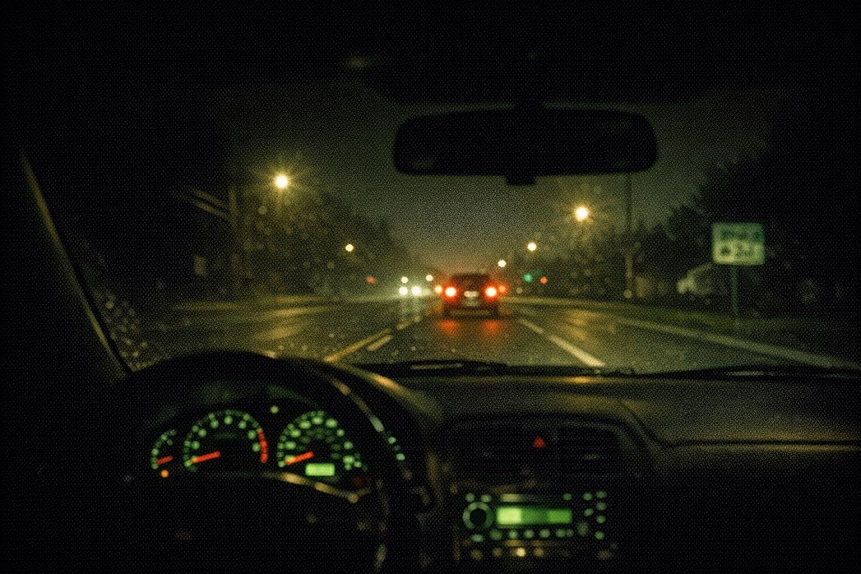
Night driving is the visual performance test that most people take without realizing it is a test. Unlike sport or gaming, where the stakes of reduced visual performance are competitive, night driving involves genuine safety consequences when visual function falls below what the task demands. And yet the visual demands of driving after dark are exactly the kind of task for which the standard eye chart provides the least useful information about your actual functional capability.
The visual challenges of night driving include low-contrast object detection, adaptation to variable light levels as street lighting and oncoming vehicles come and go, glare recovery after headlight exposure, and peripheral awareness in near-darkness. Each of these relies on visual functions that decline measurably with age, that vary between individuals of the same age, and that are influenced by the nutritional status of the visual system in ways that are increasingly well-documented.
Whether supplements can meaningfully improve night driving performance is a question that deserves a careful answer rather than a simple yes or no, because the honest answer depends on who is asking and what specific visual challenges they are experiencing.
The Visual Functions That Night Driving Actually Demands
Understanding which visual functions are most critical to night driving makes the supplement question more tractable, because it allows the research to be evaluated against specific rather than general outcomes.
Glare Recovery: The Most Safety-Relevant Function
When an oncoming vehicle’s headlights bleach the driver’s rhodopsin, a recovery period follows during which vision in the dark portions of the road is compromised. In a young driver, this recovery takes one to two seconds. In a driver in their 60s with slower rhodopsin regeneration, the recovery may take five to ten seconds. At highway speeds, ten seconds represents several hundred meters traveled with impaired vision of the road ahead. This is not a minor inconvenience. It is a measurable safety variable.
Glare recovery time is influenced by two main nutritional factors. Macular pigment density, built from consistent lutein and zeaxanthin intake, reduces the degree of bleaching from any given headlight exposure by filtering the blue-wavelength light that is most efficient at bleaching rhodopsin. Less bleaching means less recovery required and faster return to useful vision. Rhodopsin regeneration speed, supported by adequate vitamin A and zinc and potentially by the C3G anthocyanins in blackcurrant and bilberry anthocyanosides, determines how quickly the recovery occurs once bleaching has happened. Both factors are nutritionally modifiable, which gives the supplement question real purchase for this specific outcome.
Contrast Sensitivity in Low-Light Conditions
Detecting a pedestrian in dark clothing at the edge of the headlight beam, reading a pale road sign under sodium street lighting, or noticing the edge of the road in an unlit rural stretch are all contrast sensitivity tasks performed under low-light conditions. These demands are not captured by a standard eye chart, and a driver who passes an acuity test may still have reduced contrast sensitivity that meaningfully affects their low-light detection capability.
Research has found that macular pigment optical density is associated with better contrast sensitivity, partly through the optical mechanism of reduced intraocular light scatter from the blue-light-filtering effect of the macular pigment. This is the most direct nutritional influence on this specific visual function, and it operates continuously rather than requiring active attention or behavioral change. Building macular pigment through consistent lutein and zeaxanthin intake is the most evidence-grounded nutritional approach to supporting low-light contrast sensitivity. The full picture of contrast sensitivity and what affects it is covered in our contrast sensitivity article.
Dark Adaptation After Stopping in Bright Areas
Drivers who stop at a well-lit petrol station, a drive-through, or a brightly lit car park and then return to a dark road must dark-adapt each time they make this transition. The speed of this re-adaptation determines how quickly full visual sensitivity is restored. As covered in our article on dark adaptation, this process slows with age and is influenced by rhodopsin regeneration efficiency. The nutritional supports for rhodopsin regeneration, particularly vitamin A adequacy, zinc, and berry anthocyanins, are relevant here for the same reasons they are relevant to glare recovery.
What the Research on Supplements and Night Driving Shows
The most directly relevant clinical evidence for supplements and night driving comes from a small but substantive body of trials that have measured specific night vision outcomes in driving-relevant conditions rather than general visual acuity.
Blackcurrant Anthocyanins and Dark Adaptation
A human clinical trial specifically examining dark adaptation found that supplementation with blackcurrant anthocyanins improved dark adaptation speed compared to placebo. The mechanism involves the C3G component of blackcurrant facilitating rhodopsin regeneration. For drivers whose primary concern is slow recovery after glare exposure or slow adaptation when transitioning from lit to dark environments, this is the most specifically evidence-grounded nutritional intervention available. The dose used in the relevant Japanese research provided defined anthocyanin fractions including C3G from standardized blackcurrant extract. Our detailed article on blackcurrant and C3G covers the mechanism and research thoroughly.
Bilberry and Night Driving Metrics
Several older trials examined bilberry’s effects on night driving specific metrics, including night visual acuity and glare sensitivity. Results have been mixed, with some positive findings and some null results. A study published in the journal Optometry found that participants with early macular changes who supplemented with zeaxanthin showed improvements in night driving ability over a one-year period. While zeaxanthin is not a classical night vision supplement in the rhodopsin sense, this finding connects to the macular pigment and glare recovery story described above and suggests that the lutein-zeaxanthin approach to macular pigment building has specific night driving relevance.
The Honest Limitation of the Research
It is worth being direct about the research limitations in this area. The number of well-designed, adequately powered clinical trials specifically testing supplement effects on night driving outcomes is small. Most of the evidence is either from trials using surrogate endpoints (dark adaptation measurements rather than actual driving outcomes), from trials in populations with existing visual dysfunction rather than healthy drivers, or from the older literature with methodological limitations. The biological plausibility of the nutritional mechanisms involved is strong. The direct clinical evidence specifically for driving outcomes is thinner than one would ideally want. A responsible assessment acknowledges both.
Who Is Most Likely to Benefit From Nutritional Support for Night Driving
The benefit of nutritional support for night driving is not uniform across all drivers. It is most meaningful for specific groups where the modifiable nutritional factors are below their potential optimum.
Drivers in Their 40s and Beyond
The age-related changes that reduce night driving visual performance, slower rhodopsin regeneration, reduced maximum pupil dilation, and progressive lens yellowing, begin to become functionally significant from the mid-40s onward for many drivers. These structural changes are not nutritionally reversible, but the nutritional modifiers of the remaining functional capacity, macular pigment density and rhodopsin regeneration efficiency, can be optimized through supplementation. For older drivers who have noticed that night driving feels less comfortable than it once did but who still drive regularly, nutritional support represents a practical and evidence-grounded complement to the behavioral adaptations described below. Our article on why night vision gets worse with age covers the full picture of age-related changes and what is and is not modifiable.
People With Lower Dietary Carotenoid Intake
Drivers who consume diets low in dark leafy vegetables, eggs, and colorful produce are more likely to have suboptimal macular pigment optical density and lower anthocyanin intake. For these individuals, the gap between their current nutritional state and their potential optimum is larger, and the potential benefit from supplementation is correspondingly greater. This is not a niche population. Average lutein intake in Western dietary patterns is roughly one-fifth of the level associated with meaningful macular pigment development in clinical trials.
Practical Behavioral Strategies That Complement Nutritional Support
Supplements address the nutritional dimension of night driving visual performance. Behavioral and environmental strategies address other dimensions that are equally important and more immediately modifiable.
Managing Pre-Adaptation Before Night Driving
Spending a few minutes in moderate rather than bright lighting before beginning a night drive allows partial dark pre-adaptation that meaningfully reduces the initial adjustment time on the road. Avoiding prolonged exposure to very bright screens or lights in the 10 to 15 minutes before driving at night, or using a lower screen brightness setting during that period, reduces the amount of rhodopsin bleaching that needs to be reversed during the initial driving phase.
Headlight Management and Looking Habits
Deliberately avoiding direct gaze at oncoming headlights, using the right edge of the road as a visual reference instead, significantly reduces the degree of rhodopsin bleaching from each oncoming vehicle and therefore reduces both the severity and duration of each glare recovery episode. This is a habit change that costs nothing and addresses one of the most practically significant contributors to night driving visual difficulty. Ensuring that the vehicle’s own headlights are clean, properly aimed, and at full brightness is a physical vehicle maintenance point that also directly affects how much light is available for low-contrast object detection ahead.
A Considered Answer to the Original Question
Can supplements improve night driving? For most people below their nutritional potential, which includes the majority of adults on typical Western diets who have below-optimal macular pigment density and do not regularly consume the anthocyanin-rich berries with specific evidence for rhodopsin support, the honest answer is probably yes, modestly and over time rather than dramatically and overnight. The mechanisms are real, the relevant biological systems are nutritionally sensitive, and the ingredients with the best evidence are available in quality supplements at appropriate doses.
The supplementation story works best alongside the behavioral and environmental adaptations described here rather than as a substitute for them. If you want to understand how the specific ingredients with the most direct evidence for these outcomes are brought together in a single daily formula, our Performance Lab Vision review covers the relevant components, including bilberry and blackcurrant, in a complete ingredient assessment.