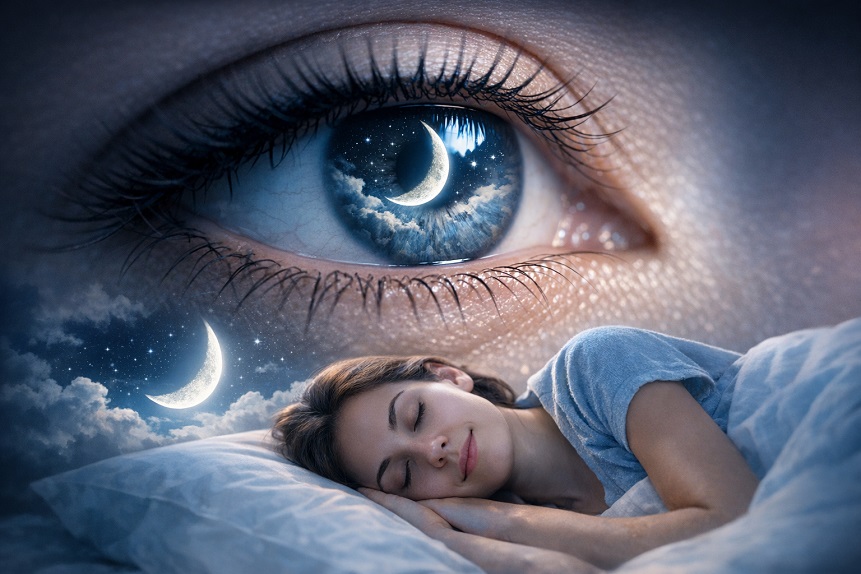
Sleep’s reputation in health circles is well established. It’s when the brain consolidates memory, when muscles repair, when hormones reset, when the immune system does some of its most productive work. What gets far less attention is what sleep does — and what sleep deprivation undoes — specifically for the eyes.
The eyes are not passive during sleep. They’re undergoing active repair, restoration, and waste clearance processes that simply cannot happen at the same rate during waking hours. The ocular surface recovers from a full day of exposure, tear film quality resets, and the intraocular pressure regulation cycle that matters enormously for glaucoma risk completes a phase that only happens in darkness and rest. Treating sleep as optional maintenance for eye health is a bit like treating an oil change as optional maintenance for an engine. The machine keeps running for a while. The costs accumulate invisibly.
The Ocular Surface Recovery Window
During waking hours, the ocular surface operates under continuous mechanical, environmental, and immunological stress. Every blink distributes the tear film but also subjects the corneal and conjunctival epithelium to friction. Every hour of screen use reduces blink rate and accelerates tear evaporation. Airborne particles, allergens, pathogens, and oxidative byproducts of light exposure all challenge the ocular surface throughout the day. The corneal epithelium — the outermost cellular layer of the cornea, which is replaced entirely roughly every seven to ten days — sustains microtrauma that requires nighttime repair.
Sleep provides the closed-eye environment that allows this repair to happen efficiently. With the eyelid closed, the corneal surface is protected from airborne exposure, evaporation is minimized, and the temperature and humidity beneath the closed lid create optimal conditions for epithelial cell migration and proliferation. The tear film itself — particularly the mucin layer secreted by conjunctival goblet cells, which allows the tear film to adhere to the corneal surface — undergoes restoration during sleep that partially compensates for daytime depletion.
Persistent sleep deprivation degrades this recovery cycle. Studies measuring corneal sensitivity and epithelial integrity in sleep-deprived subjects find measurable changes after even a few nights of restricted sleep. Contact lens wearers are particularly vulnerable: the epithelial microtrauma associated with daily lens wear requires the overnight recovery window, and insufficient sleep reduces the repair margin, increasing the risk of epithelial defects and infection over time.
Intraocular Pressure and the Nocturnal Cycle
Intraocular pressure is not static. It follows a circadian rhythm, with most people experiencing their highest IOP values in the early morning hours — typically between 1 and 5 AM — and lowest values in the late afternoon and evening. This cycle is driven by a combination of body position (IOP increases when lying flat, as venous drainage from the head is reduced), aqueous humor production patterns that follow circadian rhythms, and autonomic nervous system activity during different sleep stages.
This matters most for glaucoma patients and those with elevated intraocular pressure, because the nocturnal IOP peak is the period during which optic nerve pressure loading is highest. Clinical IOP measurements taken during standard daytime office hours may miss these nocturnal peaks entirely, potentially underestimating the true pressure burden on the optic nerve in patients with pressure spikes confined to the early morning hours.
Sleep position adds another variable. Sleeping on one side consistently — particularly for people who sleep predominantly in one lateral position — can produce asymmetric IOP exposure, with the dependent eye experiencing higher pressure from positional effects on venous drainage. Some research suggests this may contribute to asymmetric glaucomatous damage in people who already have elevated pressure risk. The clinical implications remain an area of active research, but for glaucoma patients, discussing sleep position with their ophthalmologist is a reasonable conversation.
Sleep apnea creates a more serious concern. Obstructive sleep apnea — which produces repeated episodes of hypoxia and hypercapnia during sleep — is independently associated with elevated intraocular pressure and is a recognized risk factor for normal-tension glaucoma. The mechanism involves repeated nocturnal IOP spikes driven by hypoxic and hypercapnic vascular responses, combined with reduced ocular perfusion pressure during apneic episodes. People with diagnosed or suspected sleep apnea who also have glaucoma risk factors should be screened for both conditions.
Tear Film Restoration During Sleep
The quality of the tear film on waking is partly determined by what happened overnight beneath the closed lid. The meibomian glands — which secrete the lipid layer of the tear film — continue their secretory activity during sleep, and the warmth of the closed-eye environment softens meibomian secretions and facilitates better expression of the gland orifices. For people with meibomian gland dysfunction, which drives the majority of dry eye disease, the overnight period provides the conditions under which warmth-facilitated gland expression can partially compensate for the reduced secretion quality that characterizes the condition.
People with moderate to severe dry eye often notice that symptoms are worst in the first few minutes after waking, before blinking redistributes the overnight tear film and environmental exposure resumes. This is clinically described as nocturnal lagophthalmos in its most extreme form — incomplete eyelid closure during sleep that allows the inferior corneal surface to desiccate overnight. For people who regularly wake with painful, gritty eyes or visibly red inferior conjunctiva, nocturnal lagophthalmos is worth evaluating. Treatment options include humidifying the sleeping environment, eyelid tape or moisture chamber goggles worn during sleep, and lubricating nighttime ointments.
The broader dry eye picture and the role of meibomian gland health are covered in the article on dry eyes as you age.
The Glymphatic System and Ocular Waste Clearance
One of the most compelling recent developments in sleep neuroscience is the characterization of the glymphatic system — a brain-wide waste clearance mechanism that operates predominantly during sleep. The glymphatic system uses cerebrospinal fluid flowing along perivascular channels to flush metabolic waste products from brain tissue, including proteins associated with neurodegenerative disease. This clearance is significantly more active during sleep than during waking.
The retina and optic nerve, as extensions of the central nervous system, appear to share a version of this waste clearance mechanism. Research published in the past decade suggests that the vitreous humor and the tissue spaces around retinal ganglion cells participate in a glymphatic-like clearance cycle that is also sleep-dependent. Proteins that accumulate during daytime metabolic activity in the retina — including forms of amyloid and tau that are hallmarks of neurodegenerative disease — are cleared more efficiently during sleep.
The implications for conditions like glaucoma and age-related macular degeneration are still being explored, but they’re significant. Retinal ganglion cell loss in glaucoma, and retinal pigment epithelium dysfunction in AMD, may both be accelerated by impaired nocturnal waste clearance. Consistently insufficient sleep may reduce the efficiency of this clearance cycle in ways that add to the cumulative burden of oxidative and metabolic debris that drives these conditions.
Sleep Deprivation and Visual Performance
The short-term visual performance effects of sleep deprivation are measurable and appear earlier in the sleep loss cycle than most people expect. After a single night of significantly reduced sleep, visual attention narrows, contrast sensitivity declines, and reaction times to visual stimuli lengthen. The visual cortex, which requires adequate sleep for synaptic maintenance, begins showing reduced response efficiency to visual inputs within 24 hours of sleep restriction.
Microsleeps — involuntary sleep episodes lasting a few seconds — begin occurring with meaningful frequency after 18 to 20 hours of wakefulness. During a microsleep, the visual system is effectively offline. A driver experiencing microsleeps is not processing visual information during these episodes despite appearing awake. This is one of the mechanisms behind drowsy driving crashes, and it begins at much lower levels of sleep deprivation than most people assume.
For athletes, surgeons, air traffic controllers, and anyone performing visually demanding tasks under pressure, the performance degradation from sleep deprivation touches every component of the visual performance chain — acuity, contrast sensitivity, reaction time, tracking accuracy, and attention breadth. Eye drops and caffeine can partially blunt some of these effects; neither addresses the underlying sleep debt accumulating in the visual system.
Screen Use Before Sleep: The Circadian Dimension
Blue-spectrum light from screens, LED lighting, and other artificial sources suppresses melatonin production by signaling to the suprachiasmatic nucleus — the brain’s circadian clock — that it’s daytime and inappropriate to initiate the sleep transition. The timing and magnitude of this melatonin suppression depends on the brightness and spectral composition of the light source and the duration of exposure.
Delayed sleep onset from evening screen use doesn’t just shorten total sleep time. It disrupts the proportional balance of sleep stages, typically reducing the slow-wave sleep that is most important for physical repair and the rapid eye movement sleep that is most important for memory consolidation and, potentially, for glymphatic clearance. The result is sleep that is shorter and less restorative than its duration alone suggests.
Practical mitigation: screen brightness reduction after sunset, blue light filter software settings in the evening, and avoiding screens for thirty to sixty minutes before intended sleep onset are all evidence-supported strategies that reduce circadian disruption without requiring complete electronic abstinence. The article on the 20-20-20 rule and screen management habits covers the daytime component of screen-related eye health management.
Note: If you regularly experience significant eye discomfort upon waking, notice changes in visual field, or experience symptoms consistent with sleep apnea alongside eye health concerns, speak with both your eye care professional and your primary care provider. The intersection of sleep disorders and eye conditions often benefits from coordinated evaluation.
Seven to Nine Hours Is Eye Health Advice
The sleep duration recommendation that appears in cardiovascular, metabolic, cognitive, and mental health literature — seven to nine hours for most adults — is equally applicable as eye health guidance. The ocular surface repair cycle, the nocturnal IOP cycle, the tear film restoration process, and the retinal waste clearance mechanism all operate on a roughly eight-hour timeline that corresponds to a full night of adequate sleep.
Consistently sleeping six hours or fewer interrupts all of these processes simultaneously, in ways that compound over time just as UV damage and dietary inadequacy compound over time. Sleep is not a luxury addendum to an eye health strategy. It’s a foundational biological requirement for maintaining the visual system in the state it needs to be in for the decades ahead. For those also building the nutritional side of their eye health foundation, the Performance Lab Vision review covers the dietary carotenoids and antioxidants that support daytime ocular defense — the complement to what sleep restores overnight.