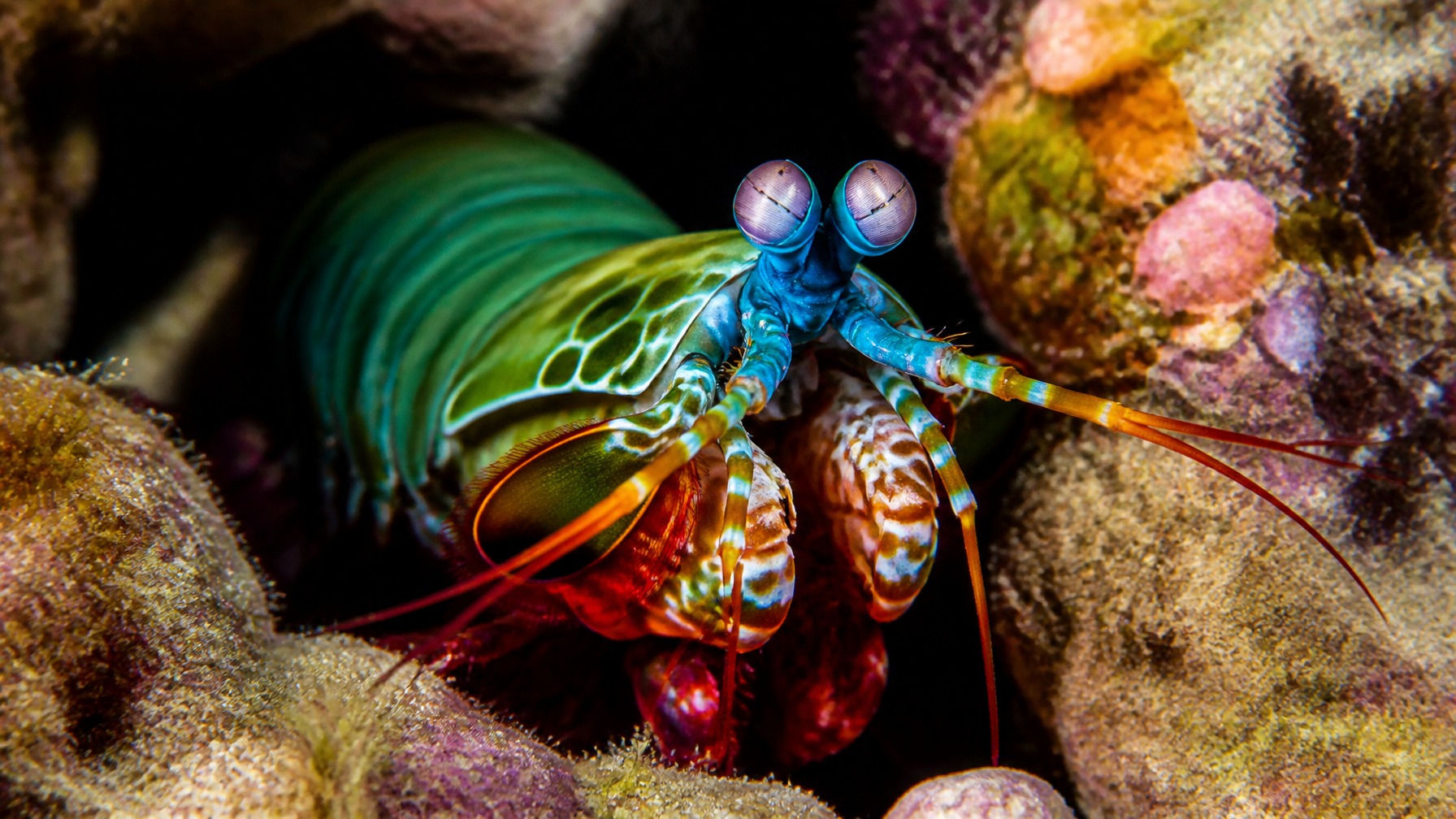
The human eye gets by on three types of color-sensing cone cells, tuned roughly to red, green, and blue light, and that modest setup is enough to distinguish somewhere around a million different shades. The mantis shrimp, a fist-sized crustacean living on coral reefs, has somewhere between 12 and 16 distinct types of color receptors, four or five times what humans have. By any straightforward logic, that should make mantis shrimp color vision almost incomprehensibly rich, capable of picking apart shades of color no human could ever hope to distinguish. When researchers actually tested it directly, they found something close to the opposite.
An Eye Built Like Nothing Else in the Animal Kingdom
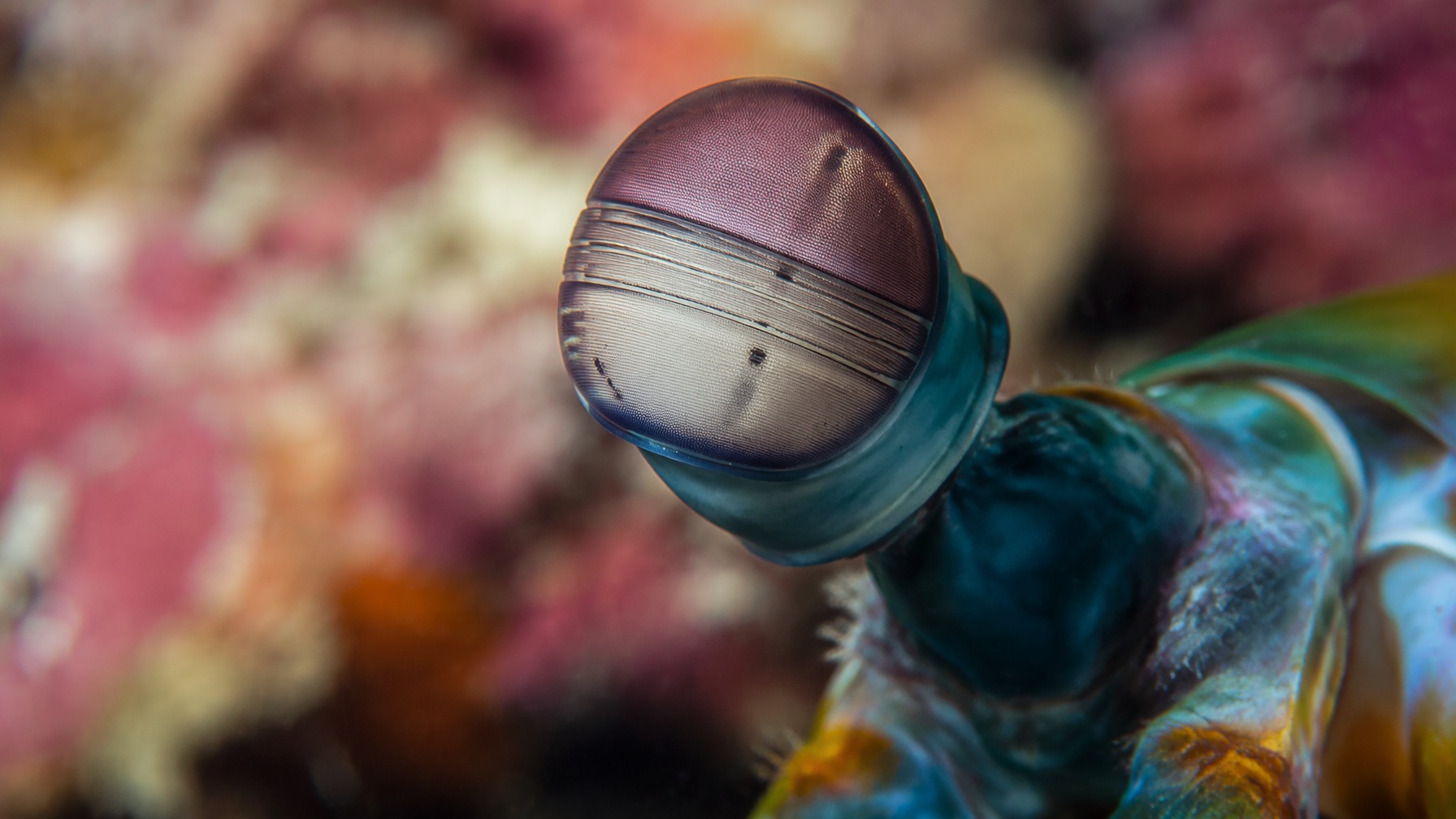
Mantis shrimp eyes are strange even before you get to the receptor count. Each eye sits on its own independently mobile stalk, capable of rotating in almost any direction, and each eye can judge depth entirely on its own without needing to compare notes with its partner. Running across the middle of each eye is a specialized band containing rows of light-sensing units, several of which are dedicated purely to color detection, spanning a range from deep ultraviolet light all the way to far red, well beyond what the human eye can register at either end. A separate set of rows in that same band is dedicated to detecting polarized light, including a rare ability to sense circularly polarized light, a trick barely found anywhere else in nature.
Why 12 to 16 Receptors Seemed Like an Obvious Superpower
When researchers first mapped out this receptor count in detail, it genuinely puzzled them. Most color vision models suggest that four or five well-placed receptor types are already more than sufficient to cover the visible spectrum with excellent precision, which is part of why the vast majority of animals that see color at all get by on somewhere between two and five receptor types. A mantis shrimp packing 12 to 16 receptor types looked, on paper, like serious evolutionary overkill, and the obvious assumption was that all that redundancy must translate into color discrimination on a level nothing else on the planet could match.
The Study That Turned the Assumption Upside Down
In 2014, researcher Hanne Thoen and colleagues, working with mantis shrimp expert Justin Marshall, published a study in the journal Science that put this assumption to a direct behavioral test. Rather than relying only on anatomy, the team trained mantis shrimp to associate specific colors with a food reward, then tested how finely the shrimp could actually distinguish between closely related hues. The results were genuinely surprising: mantis shrimp performed worse at telling similar colors apart than humans, honeybees, and even butterflies, several of which get by on far fewer receptor types. Where human observers can often distinguish colors separated by only a handful of nanometers in wavelength, the mantis shrimp in the study needed a gap of roughly 25 nanometers or more before it could reliably tell two colors apart.
Why More Receptors Didn’t Translate to Sharper Color Vision
The explanation comes down to how color information actually gets processed rather than how much of it gets collected in the first place. In humans and most other animals with color vision, the brain doesn’t just register the output of each receptor type in isolation. It actively compares the relative activity of different receptor types against each other, running a kind of ongoing subtraction between overlapping response curves. That comparison process is computationally demanding, but it’s also what allows a visual system with only three receptor types to tease apart extremely fine gradations in color. Mantis shrimp, by contrast, don’t appear to run this same kind of comparative processing. Instead, each of their many receptor types seems to operate largely on its own, sampling a narrow slice of the spectrum somewhat independently rather than feeding into a shared comparison system.
How Human Color Vision Is Cleverer Than It Looks
This is really the core surprise of the whole story: raw sensor count and actual discrimination ability aren’t the same thing, and the neural processing wrapped around a set of receptors can matter far more than how many receptor types exist in the first place. Human color vision achieves its fine-grained precision specifically because a relatively small number of receptor types are woven together through sophisticated comparative processing in the brain. Take that comparison step away, and even a system with far more raw receptor types can end up with a comparatively blunt sense of color.
The Shrimp’s Different Strategy: Skip the Math, Recognize Instead
Researchers now suspect mantis shrimp may be running a fundamentally different kind of color vision altogether, sometimes described as color recognition rather than color discrimination. Instead of computing fine differences between similar hues the way human vision does, a mantis shrimp’s many narrow-band receptors might let it identify a color almost immediately, in a single step, without needing to run any real-time neural comparison at all. It’s a system built less for nuance and more for speed, which lines up neatly with life on a coral reef, an environment full of fast-moving, brightly colored predators, rivals, and prey, where a split-second identification might matter far more than distinguishing two nearly identical shades of the exact same color.
The Other Superpower Hiding in the Same Eye
Color isn’t even the most unusual part of a mantis shrimp’s visual toolkit. That same specialized band of receptors also gives it the ability to detect circularly polarized light, an ability found almost nowhere else in the animal kingdom, believed to help mantis shrimp communicate with each other using signals invisible to most predators and prey. This capability has attracted real interest well beyond marine biology, inspiring engineers working on polarization-sensitive camera technology, including experimental approaches to detecting certain cancers by picking up on subtle polarization differences in tissue that the human eye and standard cameras simply can’t register.
What This Teaches About “Better” Senses
The mantis shrimp story is a genuinely useful correction to a very natural but flawed assumption: that more sensory hardware automatically means a richer, more capable experience of the world. What actually determines the quality of a sense is the entire system built around the raw hardware, including how that information gets processed, compared, and ultimately used to make decisions. A mantis shrimp’s eye isn’t a failed attempt at building something like human color vision with extra parts bolted on. It’s a different solution entirely, optimized for speed and immediate recognition rather than fine discrimination, and it’s a good reminder that nature doesn’t reliably converge on one single “best” way to see the world.
Frequently Asked Questions
Do mantis shrimp really see more colors than humans?
Despite having 12 to 16 types of color receptors compared to the human eye’s three, a 2014 study found that mantis shrimp are actually worse at distinguishing between similar colors than humans, honeybees, and butterflies.
Why don’t more color receptors mean better color vision?
Fine color discrimination depends heavily on neural processing that compares the relative activity of different receptor types, not just on how many receptor types an eye has. Mantis shrimp receptors appear to function largely independently rather than through this kind of comparative processing, which limits their ability to distinguish closely related colors.
What is mantis shrimp color vision actually good for, then?
Researchers believe mantis shrimp may use a strategy sometimes called color recognition, allowing them to quickly identify a color in a single step rather than finely discriminating between similar shades. This may prioritize speed over precision, which could be useful in a fast-moving coral reef environment.
What else is unusual about mantis shrimp vision besides color?
Mantis shrimp can detect circularly polarized light, an ability found almost nowhere else in the animal kingdom. This capability is believed to support communication between mantis shrimp and has inspired research into polarization-sensitive camera technology, including experimental medical imaging applications.