Eye supplements almost always list lutein and zeaxanthin together, in the same sentence, on the same label line, as if they were simply two names for the same thing. They are not. They are structurally related carotenoids that concentrate in different parts of the macula, serve overlapping but distinct biological functions, and are found in different dietary sources in different proportions. The habit of treating them as interchangeable may be good enough for marketing purposes, but it obscures something worth understanding if you are serious about eye nutrition.
The distinction matters more than it might initially seem. The central part of the macula, where the highest concentration of cone photoreceptors live and where the sharpest vision originates, is dominated by zeaxanthin rather than lutein. This is the zone most relevant to fine detail vision, color discrimination, and glare recovery. The peripheral macula, which handles a broader field of vision, contains more lutein. The eye is not treating these two nutrients as equivalent. It is concentrating them in specific zones for specific reasons.
Understanding what separates them, and what makes the combination superior to either alone, is the foundation for making intelligent choices about eye nutrition.
Structural Differences That Explain Different Biological Roles
Lutein and zeaxanthin are both xanthophyll carotenoids, meaning they are oxygenated carotenoids that appear yellow-orange in color and accumulate in the macular pigment. Their chemical structures are nearly identical, differing only in the position of one double bond in their molecular backbone. That small difference has significant consequences for how each molecule behaves in biological tissue.
How the Structural Difference Affects Antioxidant Activity
The positional difference in the double bond gives zeaxanthin a symmetrical structure and lutein an asymmetrical one. In practical terms, this means zeaxanthin has reactive ends on both sides of the molecule, while lutein has a reactive end on only one side. Zeaxanthin can therefore engage free radicals from either end of its molecular structure, giving it a somewhat broader antioxidant reactivity. This is not a categorical superiority of zeaxanthin over lutein but a difference in how each one functions within the antioxidant network of the macula. The two nutrients are genuinely complementary rather than redundant.
Where Each Concentrates in the Eye
This is the most functionally significant distinction between the two. In the fovea, the very center of the macula and the zone of highest visual acuity, zeaxanthin is the dominant carotenoid, outnumbering lutein by roughly 2:1. Moving outward from the fovea toward the peripheral macula, this ratio reverses and lutein becomes dominant. The entire macular pigment is composed of both, but the fovea, where the greatest photochemical stress occurs from concentrated incoming light and where the most metabolically active cone photoreceptors are concentrated, has preferentially accumulated zeaxanthin.
This distribution is not random. It appears to reflect the specific antioxidant demands of each zone. The fovea receives more concentrated light than any other retinal region, since the eye’s optical system focuses incoming light to a point directly on the fovea. The higher zeaxanthin concentration in this zone may reflect an evolutionary selection for the carotenoid with the slightly broader antioxidant reactivity in the region where oxidative stress is highest. Whatever the underlying reason, the implication for supplementation is clear: ensuring adequate zeaxanthin intake alongside lutein is necessary to support the specific protective requirements of the foveal zone.
Zeaxanthin and Visual Performance: What the Research Shows
Zeaxanthin has attracted specific research interest beyond its role in macular protection, particularly in relation to functional vision outcomes. Several studies have examined its effects on visual performance metrics rather than just macular pigment density.
Contrast Sensitivity and Visual Acuity
A study published in the journal Optometry found that participants with early age-related macular changes who consumed zeaxanthin supplementation for one year showed improvements in night driving ability and visual acuity averaging 1.5 lines on a standard eye chart. While this study involved participants with existing macular changes rather than healthy eyes, the finding points toward zeaxanthin’s functional relevance beyond purely protective effects. Multiple studies have found associations between higher macular pigment density, including zeaxanthin’s contribution to it, and better contrast sensitivity, the ability to distinguish objects from similarly colored or luminanced backgrounds. Contrast sensitivity is a visual performance metric that matters in driving, sport, gaming, and any context requiring reliable object detection in challenging visual conditions.
Glare Recovery and Photostress
Photostress recovery time, how quickly the eye regains normal vision after exposure to a bright light, is another functional outcome linked to macular pigment density. When the photoreceptors are bleached by intense light, the macular pigment’s role in filtering subsequent incoming light during recovery becomes particularly important. Higher macular pigment density is associated with faster photostress recovery. For screen users who experience prolonged sensitivity after looking at a bright screen, and for drivers who struggle with glare from headlights and street lights, this is a practical performance outcome connected to zeaxanthin’s contribution to the macular pigment. The relationship between night vision, glare, and macular nutrition is explored further in our article on nutrition for night vision.
Dietary Sources of Zeaxanthin and the Supplementation Gap
Lutein and zeaxanthin do not appear in identical ratios in the foods that contain them. Understanding the dietary distribution of each explains why zeaxanthin is the carotenoid most likely to be underrepresented in a typical diet and why targeted supplementation for zeaxanthin is often more necessary than for lutein.
Where Zeaxanthin Is Found in Food
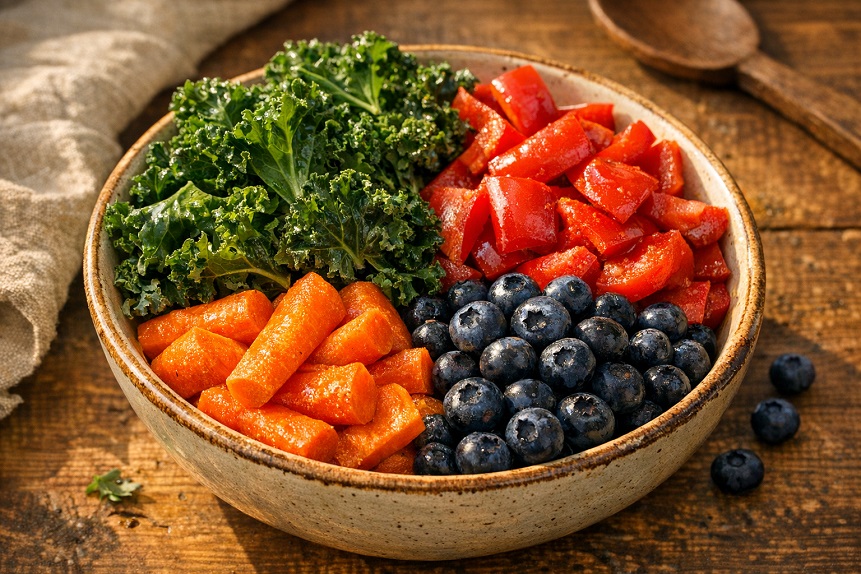
While lutein is concentrated most richly in dark green leafy vegetables, zeaxanthin is found in somewhat different sources. Orange and yellow peppers are among the richest zeaxanthin sources per gram. Corn, persimmons, goji berries, and egg yolks are also meaningful sources. Some dark greens that are high in lutein also contain zeaxanthin, but in lower proportions. The practical result is that diets high in lutein from green vegetables are not automatically high in zeaxanthin. Someone who eats plenty of kale and spinach may still have suboptimal zeaxanthin intake if their diet does not also include the specific sources where zeaxanthin concentrates.
Average Western dietary intake of zeaxanthin is estimated at roughly 0.2 to 0.4 mg per day, which is considerably lower than average lutein intake and dramatically below the levels associated with meaningful macular pigment support. This is partly a matter of the narrower range of common foods that are rich in zeaxanthin, and partly a matter of general awareness. Most people who have heard of lutein in the context of eye health have not heard of zeaxanthin, and are therefore not making specific dietary choices to include it.
The Ratio Question in Supplementation
The AREDS2 study used a supplement providing 10 mg of lutein and 2 mg of zeaxanthin, a 5:1 ratio that has become a widely referenced standard. However, some researchers and clinicians have argued that this ratio underweights zeaxanthin given its specific importance in the fovea. Products formulated with higher zeaxanthin content, including some specifically standardized to provide zeaxanthin as the primary carotenoid rather than as a minor addition to lutein, have been developed and studied. There is no definitive evidence that one ratio is categorically superior for all individuals. What is clear is that zero-zeaxanthin supplementation, providing lutein alone, leaves the foveal zone without its preferred protective carotenoid.
Meso-Zeaxanthin: The Third Macular Carotenoid
A complete discussion of zeaxanthin and macular health requires mentioning meso-zeaxanthin, a structural isomer of zeaxanthin that is found in the macular pigment but is largely absent from common dietary sources. This is an aspect of macular carotenoid biology that is less commonly discussed in mainstream eye health content but is genuinely relevant.
Where Meso-Zeaxanthin Comes From
Meso-zeaxanthin is not found in meaningful amounts in typical foods consumed in most countries, though it does appear in some fish and seafood. The primary source of meso-zeaxanthin in the macular pigment is believed to be conversion from lutein within the retinal tissue itself. The retina appears to convert some of the lutein it receives into meso-zeaxanthin, concentrating it specifically at the very center of the fovea. This conversion capacity varies between individuals, which may partly explain why some people maintain a healthy macular pigment more easily than others on similar diets.
Some premium eye supplements have begun including meso-zeaxanthin alongside lutein and standard zeaxanthin, with the rationale of providing the full trio of macular carotenoids directly rather than relying on the retina’s conversion of lutein. Research on meso-zeaxanthin supplementation has shown improvements in macular pigment density in people with low baseline levels, but this is a more specialized supplement territory than the mainstream lutein and zeaxanthin conversation. For most people, ensuring adequate lutein and zeaxanthin from a quality supplement is the practical starting point.
Why the Pair Outperforms Either Alone
The strongest argument for ensuring both lutein and zeaxanthin are present in any eye nutrition approach is not found in comparing their individual effects but in recognizing that the macular pigment is a team effort. The different zones of the macula have different carotenoid profiles for reasons that appear functionally meaningful. Supplementing for one and neglecting the other produces an incomplete version of the protection that the macular pigment is designed to provide.
If you are evaluating eye supplements with this in mind, our guide to reading an eye supplement label covers what to look for in terms of ingredient transparency, dosage disclosure, and the other nutrients that work alongside lutein and zeaxanthin in a well-designed formula. And for the broader ingredient picture, our detailed article on lutein and its evidence base provides the full research context for understanding where these two nutrients fit in the larger evidence landscape.