It is uncommon. Among people of Northern European ancestry, about 1 in 200 women have red-green color vision deficiency, compared with about 1 in 12 men. The gap exists because the genes involved sit on the X chromosome. Rarer blue-yellow types affect women and men equally, and other causes, such as eye disease, can affect anyone.
The Numbers in Women and Men
MedlinePlus Genetics puts red-green color vision deficiency at about 1 in 12 males and 1 in 200 females among populations with Northern European ancestry, and says it occurs less often in almost all other populations studied. The National Eye Institute likewise reports that about 1 in 12 men have color vision deficiency.
These figures come from a National Library of Medicine summary last updated in 2015, so treat them as reliable estimates, not exact counts. NEI also lists being white among the risk factors, which fits the ancestry note.
Why Men Are Affected More Often
The two genes behind red-green color vision sit on the X chromosome, and the common deficiencies are inherited in an X-linked recessive pattern. Males have one X chromosome, so a single genetic change in each cell is enough to cause the condition.
Females have two X chromosomes, so a change would have to occur on both copies to cause the disorder, according to MedlinePlus Genetics. That requirement is why women are affected far less often. The page adds that fathers cannot pass X-linked traits to their sons.
Carriers Are Far More Common
Many more women carry a variant than show a deficiency. The abstract of a 2010 Journal of Vision study says some 12% of women are carriers of mild X-linked forms called anomalous trichromacy. Because of random X chromosome inactivation, a carrier’s retina must contain four classes of cone rather than three.
A health system article from Henry Ford Health notes that carriers can pass the condition to their children but typically show no signs themselves. In that same study, 1 of 24 carriers tested behaved like a true tetrachromat, so a few carriers may even see color in unusual ways.

Types That Do Not Follow the Gap
Not every type favors men. MedlinePlus Genetics says blue-yellow color vision defects affect males and females equally and occur in fewer than 1 in 10,000 people worldwide. They are inherited in an autosomal dominant pattern, so one altered gene copy can cause them.
Blue cone monochromacy, a rarer and more severe form, affects about 1 in 100,000 people and, like the red-green types, affects males much more often than females.
Acquired Color Loss Can Affect Anyone
Color vision can also change after birth. HealthLink BC notes that acquired problems are caused by aging, disease, injury to the eye, optic nerve problems, or side effects of medicines. Inherited color blindness remains more common than acquired color blindness and affects males far more often. NEI adds that retinal detachment, laser eye injuries, some brain tumors, and radiation treatments can also lead to color vision deficiency.
If your color vision has changed, see the lens yellowing process and how medications affect vision for common explanations.
Why Women May Not Know
NEI says symptoms are often so mild that they are hard to notice, and people usually adjust, so many never realize they have a deficiency. Because it is rare in women, it may not occur to a woman or her doctor to check.
That last point is a reasonable inference, not a finding. NEI lists a family history, certain eye diseases, certain health problems, and some medicines as risk factors that apply to anyone. A color test is the only way to be sure.
What to Do If You Suspect It
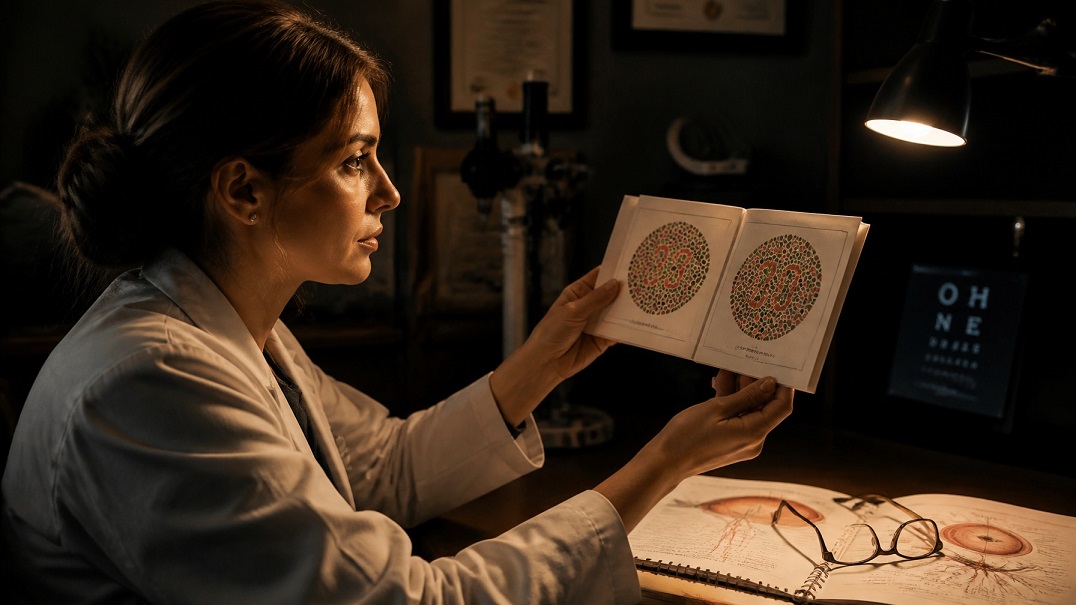
NEI says your eye doctor can usually test for color vision deficiency with a simple dot-pattern test. MedlinePlus says testing is usually part of a complete eye exam. There is no cure for the inherited kind, but most people adjust, and special glasses, contacts, and phone apps can help with some tasks.
Some careers screen for color vision, as covered in jobs that still test for colorblindness. For the history of that testing, read about the man who invented the colorblindness test.
The Bottom Line
Colorblindness in women is uncommon, but it is real, and most people who have it live without everyday problems, according to NEI. The rarity comes from X chromosome genetics, not from any protection against other causes. If colors look off to you, or a child is struggling with colors, a quick exam gives a clear answer.