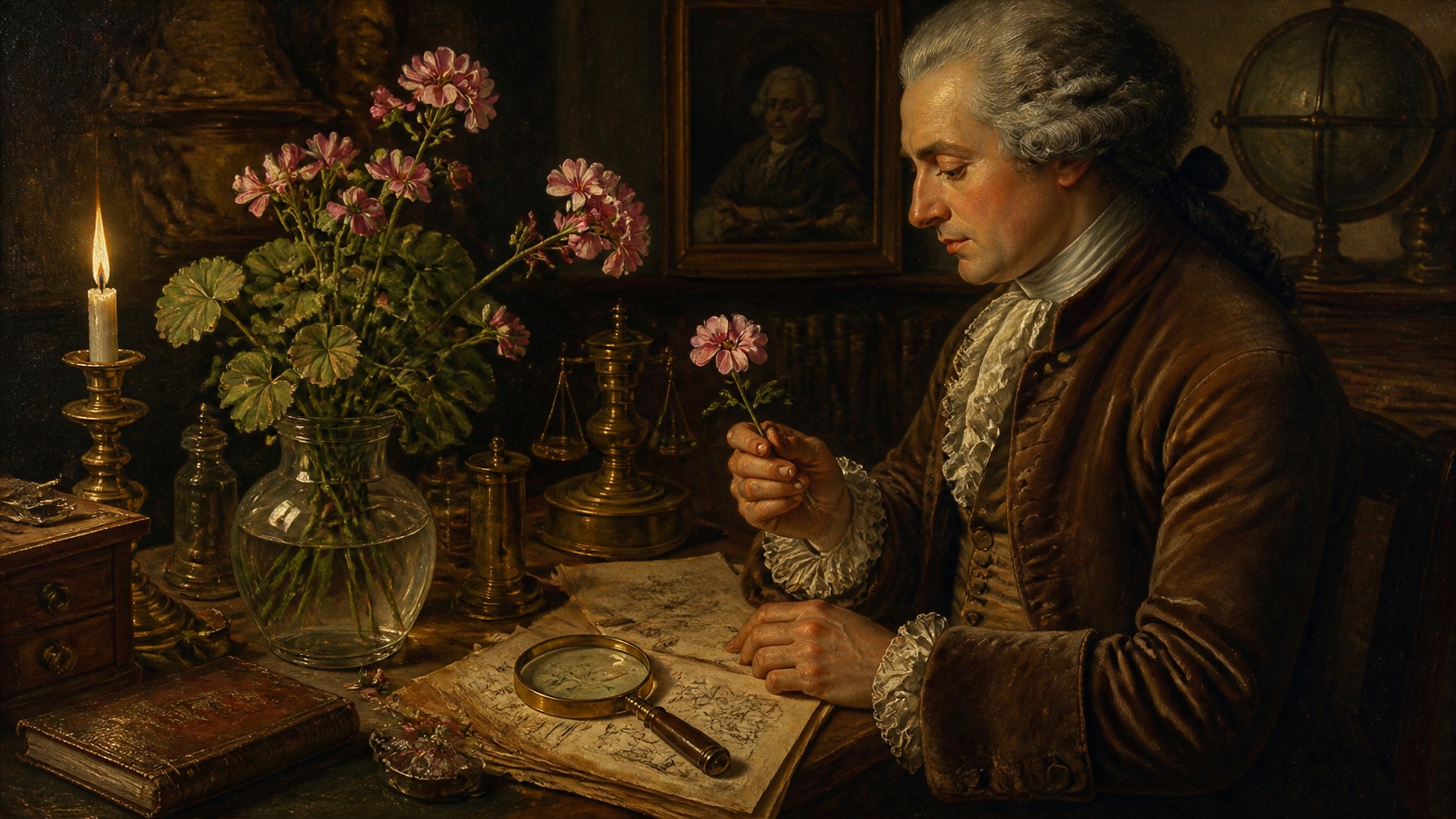
In 1794, a chemist in Manchester, England, noticed something odd about a pink geranium. Under candlelight, it looked blue to him. His friends insisted it looked the same shade of pink it always had. His brother, on the other hand, agreed with him completely. That small disagreement over a flower turned into one of the first serious scientific investigations of colorblindness, and it happened more than a hundred years before anyone built a standardized test for the condition.
The chemist was John Dalton, a name most people recognize from atomic theory rather than eye science. But Dalton’s curiosity about his own strange color perception set off a chain of events that stretched across continents and more than a century, involving a fatal railway collision, a Japanese army doctor, and eventually a set of colored dot patterns that has become one of the most recognizable medical tests in the world.
The Chemist Who Diagnosed Himself First
Dalton wasn’t content to simply note that he saw color differently and move on. He documented his perception methodically, comparing common objects like green woolen cloth and red sealing wax against how his peers described them, building what amounted to a personal color dictionary so he could communicate exactly how his vision diverged from everyone else’s. In 1798, he published his findings in a paper titled “Extraordinary Facts Relating to the Vision of Colours,” one of the earliest serious scientific descriptions of the condition. The term “Daltonism” is still used in several languages today as a synonym for red-green colorblindness, a nod to the man who took his own unusual eyesight seriously enough to study it.
A Theory He Was Confident Would Be Proven After His Death
Dalton had a specific theory about what caused his condition. He believed the vitreous humor, the clear gel that fills the back chamber of the eye, was tinted blue in his eyes, acting like an internal filter that absorbed certain wavelengths before they ever reached his retina. He was confident enough in this idea that he made an unusual request: after he died, he wanted his eyes removed and examined to confirm it.
He got his wish. The day after Dalton passed away in 1844, a colleague performed the dissection and found the vitreous humor to be, in his words, perfectly colorless. Dalton’s theory was wrong. What actually caused his colorblindness would remain a mystery for another 150 years, until researchers in 1995 extracted DNA from the preserved remains of his eye tissue and confirmed he had deuteranopia, a form of red-green colorblindness caused by a missing gene for one of the retina’s light-sensing pigments. Dalton had been right that something in his eyes was different. He simply had no way of knowing, in an era before anyone understood genetics, that the answer was written into his DNA rather than dissolved in eye fluid.
Why It Took Another Century for Anyone to Build a Real Test
For decades after Dalton’s paper, colorblindness remained a curiosity rather than a practical concern. It didn’t stop most people from working, farming, or living ordinary lives, so there was little urgency to screen for it on a large scale. That changed abruptly once industrial societies started depending on colored signals to keep people alive.
A Head-On Collision That Made Color Vision a Matter of Public Safety
On a November night in 1875, two trains collided head-on near Lagerlunda, Sweden, killing nine people. A Swedish physiologist named Frithiof Holmgren investigated the wreck and became convinced that the engineer or his assistant, both of whom died in the crash, had failed to distinguish a red stop signal from a green go signal because of undiagnosed colorblindness. Later historical analysis has cast real doubt on whether colorblindness actually caused the crash, since miscommunication between the stationmaster and the crew appears to have played the larger role. But at the time, Holmgren’s theory landed hard. He tested 266 railway employees using a method he had developed involving skeins of colored wool, and found that thirteen of them could not reliably sort the colors correctly. Sweden made color vision testing mandatory for railway and shipping workers that same year, and the practice spread to other countries soon after. A single, possibly overstated theory about one tragic accident had permanently changed how the world thought about screening eyesight for high-stakes jobs.

How a Japanese Army Doctor Built the Test Still Used Today
Holmgren’s wool test worked, but it required physically transporting skeins of yarn and relied on interpretation that could vary between examiners. The version of colorblindness testing most people would recognize today, a page of colored dots with a number hidden inside, came from a very different source: a military ophthalmologist working in Japan during the First World War.
The Simple Design That Made It Universal
Shinobu Ishihara trained as an army surgeon before shifting his focus to ophthalmology, eventually studying in Germany just before the war broke out in Europe. Once back in Japan, the army asked him to develop a reliable, easy-to-administer way of screening military recruits for color vision problems, since misreading a colored signal or map marking in the field carried obvious risks. Ishihara, working with a colorblind physician colleague who helped him verify the plates, hand-painted his first designs in watercolor. Interestingly, those earliest versions used Japanese hiragana characters rather than numbers, since they were built exclusively for use within the Japanese military. When Ishihara adapted the test for wider publication in 1917, he replaced the characters with numerals so people could read the plates regardless of what language they spoke.
The genius of the design was its simplicity. Each plate presents a circle made of colored dots in varying sizes and shades, arranged so that a number becomes visible against the background only if the viewer’s eyes can properly distinguish certain color combinations. Someone with typical color vision sees the number instantly. Someone with red-green colorblindness sees only a field of dots, or sometimes a different number entirely, hidden through the same design principle. It required no special equipment beyond a printed page and consistent lighting, and it worked the same way whether the person being tested spoke Japanese, English, or anything else. Twelve years after Ishihara published the test, the 13th International Congress of Ophthalmology formally adopted it as the international standard for color vision testing in 1929, a position it has held, largely unchanged, for nearly a century since.
From a Battlefield Screening Tool to a Global Standard
Once Ishihara’s plates became internationally recognized, testing for colorblindness stopped being something only railway workers or military recruits worried about. Aviation adopted it. Electrical trades adopted it, since misreading wire color coding carries obvious hazards. Various branches of the military expanded on Ishihara’s original purpose, applying similar screening well beyond the Japanese army that first commissioned it. What began as one doctor’s attempt to protect his own country’s soldiers turned into a piece of standard medical equipment found in eye clinics on every continent.
What This History Says About How We Test the Senses
It’s worth sitting with how strange the full timeline actually is. A chemist noticed a flower looked like the wrong color and had his eyes cut open after death to test a theory that turned out to be incorrect. A train crash in Sweden, possibly misattributed to colorblindness in the first place, made color vision testing a matter of law. And the test that eventually stuck came not from a lab studying vision in the abstract, but from a military doctor trying to solve a very specific, practical problem during wartime. Colorblindness testing didn’t arrive because someone set out to build the perfect diagnostic tool. It arrived in fits and starts, driven by curiosity, tragedy, and necessity, which is a pretty accurate description of how a lot of medical history actually unfolds.

Frequently Asked Questions
Who invented the colorblindness test used today?
The dot-pattern test most commonly used today was developed by Shinobu Ishihara, a Japanese army ophthalmologist, who published it in 1917 after being asked by the Japanese military to create a reliable way to screen recruits for color vision deficiency.
Why is colorblindness sometimes called Daltonism?
The term comes from the chemist John Dalton, who published one of the first detailed scientific descriptions of his own red-green colorblindness in 1798. His name became permanently attached to the condition in several languages.
What event made colorblindness testing mandatory?
A fatal train collision near Lagerlunda, Sweden, in 1875 is widely credited with prompting mandatory color vision testing for railway workers, after a physiologist theorized that colorblindness contributed to the crash. Sweden began mandatory testing that same year, and other countries followed.
How does the Ishihara test actually work?
Each plate displays a pattern of colored dots arranged so that a number is visible to people with typical color vision but difficult or impossible to see for people with certain forms of red-green colorblindness. The test requires no language translation, which helped it become an international standard.