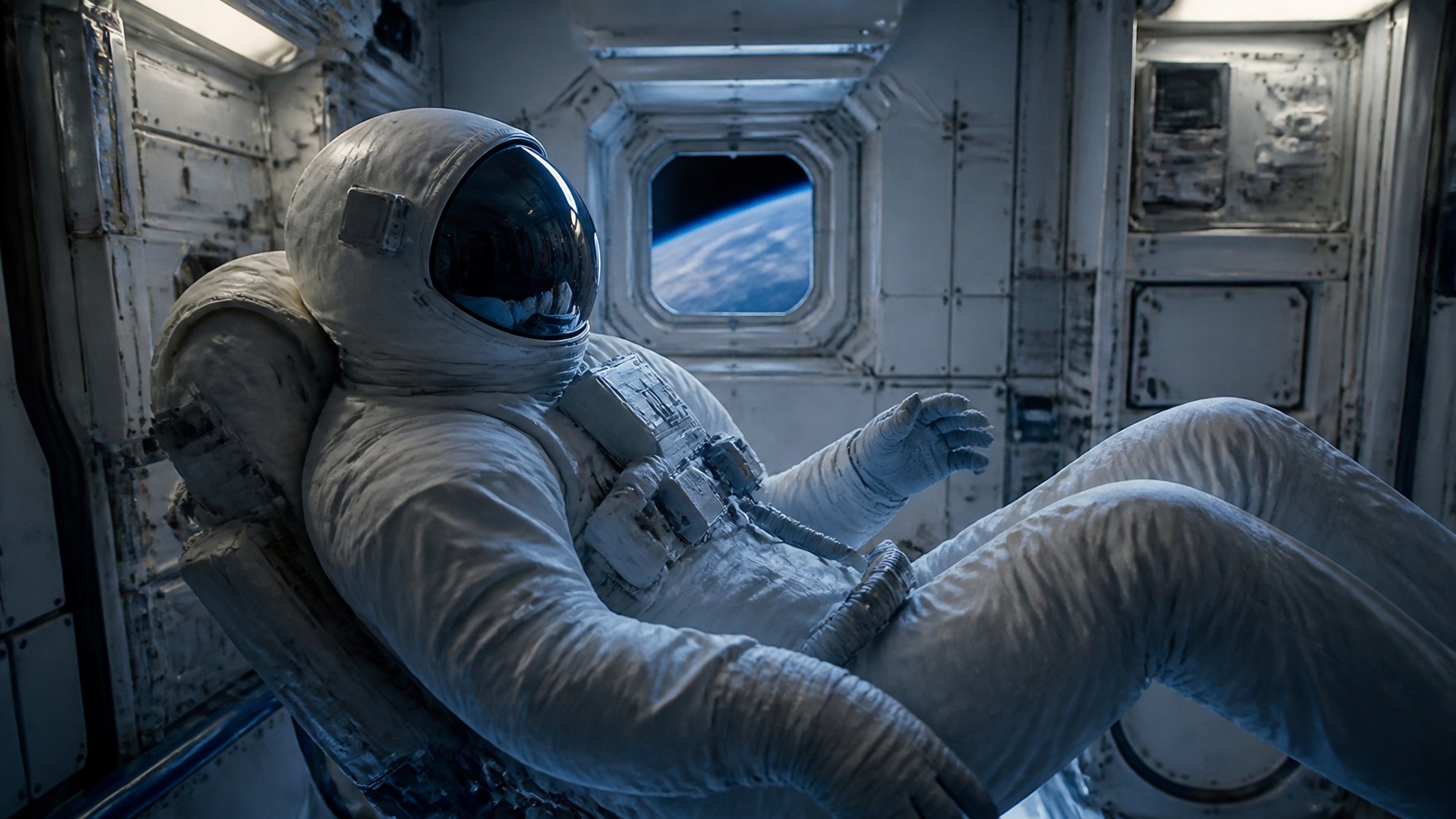
Somewhere in the first weeks of a long-duration mission aboard the International Space Station, an astronaut’s eyes begin to physically change shape. Not metaphorically. The back of the eyeball gradually flattens, the optic nerve can start to swell, and many astronauts return to Earth needing a stronger reading prescription than the one they left with. This isn’t a rare complication affecting a handful of unlucky crew members. It happens, to some degree, in a majority of astronauts on long missions, and it has become one of NASA’s most closely studied medical priorities as the agency plans for missions that will keep people in space far longer than a stay on the International Space Station ever has.
The Fluid Shift That Reshapes the Eye From the Inside
The underlying cause traces back to something most people never think about: gravity’s constant, quiet influence on where fluid sits in the body. On Earth, gravity keeps blood and other fluids pulled toward the lower body when you’re upright, and your cardiovascular system is built around managing that daily pull. In microgravity, that pull disappears, and fluid that would normally stay lower in the body instead shifts upward, toward the head and chest. Astronauts often notice this within the first day or two of spaceflight as a puffy face, congested sinuses, and a persistent feeling of head fullness, and the effect doesn’t fully reverse for as long as the mission continues.
What Actually Happens to the Back of the Eye
That upward fluid shift raises pressure in the veins around the eye and skull, and researchers believe this altered pressure environment is a central driver of a condition NASA now calls Spaceflight Associated Neuro-ocular Syndrome, or SANS. The changes it produces are visible on retinal imaging and include swelling of the optic disc where the optic nerve meets the retina, folds forming in the tissue at the back of the eye, and a flattening of the normally round back wall of the eyeball itself. That flattening can physically shorten the eye just enough to push it toward farsightedness, which is why some astronauts come home from long missions needing new glasses. In a portion of cases, doctors have also observed small areas of localized retinal damage called cotton wool spots, a finding also seen in certain conditions here on Earth involving disrupted blood flow to the retina.
How Common This Actually Is, and How Serious
The numbers here are more striking than most people expect. Studies of astronauts following long-duration missions have found measurable signs of SANS in a large majority of crew members, with research placing the earliest indicators at around two-thirds of long-duration astronauts, and refractive or structural eye changes documented in roughly 29 percent of astronauts after shorter missions and somewhere between 60 and 69 percent after longer ones. For most astronauts, the effects are manageable and at least partially reversible, with post-flight recovery generally taking somewhere between one and three months. But the swelling of the optic nerve itself, in more severe cases, carries a real risk to long-term vision, which is exactly why NASA treats this as more than a cosmetic inconvenience.
Why This Condition Took Years to Even Get a Proper Name
For a while, researchers referred to this cluster of symptoms as Vision Impairment and Intracranial Pressure syndrome, based on an early hypothesis that rising pressure inside the skull was the sole cause. Later research complicated that picture considerably. Studies measuring cerebrospinal fluid production in astronauts found that the body actually seems to reduce fluid production in response to the upward shift, and other factors, including localized pressure changes specific to the eye and optic nerve, venous congestion, genetic variation in certain metabolic pathways, and possibly radiation exposure, all appear to play a role as well. That more complicated, still not fully understood picture is why the name eventually changed to Spaceflight Associated Neuro-ocular Syndrome, a broader and more accurate label for what researchers now recognize as a condition with multiple contributing causes rather than one single mechanism.
Why This Is One of NASA’s Top Priorities for Reaching Mars
SANS matters enormously for missions to the International Space Station, but it becomes a genuinely different kind of problem once you start talking about a multi-year round trip to Mars. A crew heading to Mars won’t have the option of an emergency return flight if someone’s vision starts deteriorating in a mission-critical way partway through the journey, and a message to Earth and back can take up to roughly 20 minutes each way, ruling out real-time medical guidance from the ground during any kind of acute event. NASA has explicitly identified SANS as one of the highest-priority human health risks standing in the way of long-duration missions beyond low Earth orbit, precisely because a treatable, well-understood issue on a six-month space station rotation could become a serious, isolated medical emergency on a mission that lasts years and can’t simply be cut short.
The Strange Fixes Being Tested to Keep Fluid Out of Astronauts’ Heads
Researchers have spent the last decade testing a genuinely unusual lineup of countermeasures aimed at tricking the body into behaving more like it does under Earth’s gravity. Lower body negative pressure devices work by creating a vacuum-like environment around the lower half of the body, pulling fluid back down toward the legs the way gravity normally would. Venous constrictive thigh cuffs take a simpler mechanical approach, gently restricting blood flow at the thighs so fluid stays trapped in the lower body rather than migrating upward. Russian cosmonauts have used both approaches operationally for years. Other research directions under investigation include specialized pressurized goggles designed to counteract pressure changes directly at the eye, and even short bouts of artificial gravity generated through centrifugation.
The One Countermeasure Already Proven to Work
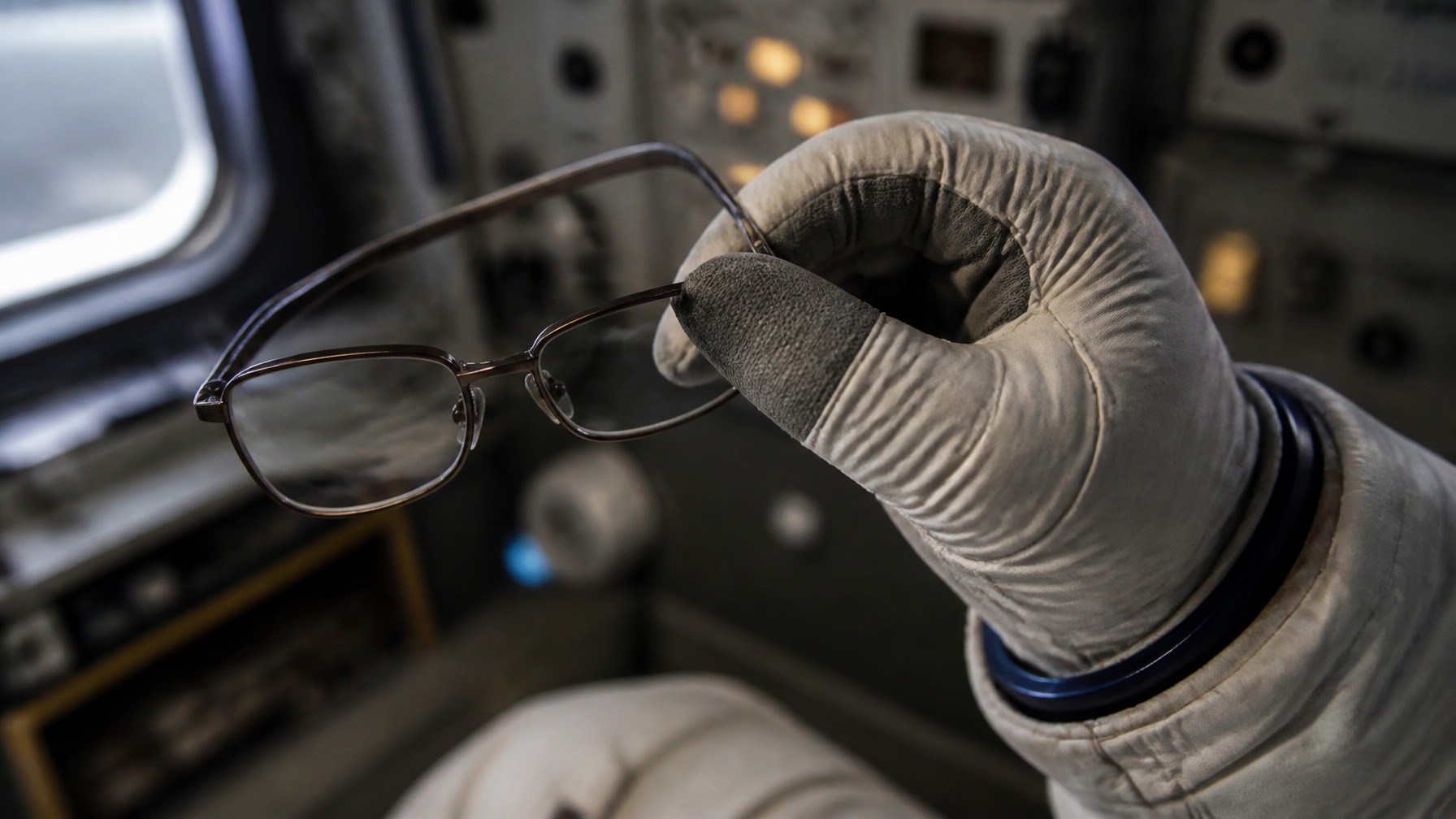
Despite all this research, there’s currently only one SANS-related countermeasure NASA considers fully proven and reliable: prescription eyewear. Since the hyperopic shift caused by globe flattening is a fairly predictable, correctable refractive change, astronauts are simply provided with what are sometimes called space anticipation glasses, essentially a stronger prescription anticipating the shift before it fully develops, along with backup pairs available on board. It’s a strikingly low-tech solution sitting right next to a research program involving vacuum chambers and artificial gravity, but it’s the one piece of this puzzle doctors can currently promise will actually work.
What Studying Astronaut Eyes Is Teaching Us Back on Earth
One of the more valuable side effects of SANS research has been how much it’s clarifying about pressure-related eye conditions that have nothing to do with space at all. The optic disc swelling seen in astronauts closely resembles patterns doctors see in certain terrestrial conditions involving elevated pressure around the brain and optic nerve, and understanding how the eye responds to sustained pressure changes in a genuinely controlled, well-monitored population like astronauts has given researchers a rare, detailed window into mechanisms that are much harder to study in typical patients on Earth. In a field of medicine that rarely gets a clean natural experiment, six-month missions in orbit have quietly become one of the most useful ongoing studies in neuro-ophthalmology, astronauts included.
Frequently Asked Questions
What is Spaceflight Associated Neuro-ocular Syndrome?
Spaceflight Associated Neuro-ocular Syndrome, or SANS, is a condition affecting astronauts during long-duration spaceflight, caused largely by an upward shift of body fluid in microgravity. It can produce optic disc swelling, flattening of the back of the eyeball, and a shift toward farsightedness.
How common is SANS among astronauts?
Research has found some of the earliest indicators of SANS in roughly two-thirds of astronauts after long-duration missions, with structural or refractive eye changes documented in about 29 percent of astronauts after shorter missions and 60 to 69 percent after longer ones.
Why is NASA especially concerned about SANS for Mars missions?
A mission to Mars would take years and would not allow for an emergency return flight or real-time medical guidance from Earth due to significant communication delays. A vision problem that’s manageable on a space station rotation could become a serious, isolated medical issue on a mission that can’t be cut short.
Are there proven treatments for SANS?
Currently, prescription eyewear that anticipates the farsighted shift caused by SANS is the only fully proven and reliable countermeasure. Other approaches, including lower body negative pressure devices and venous thigh cuffs, are still being researched and refined for future long-duration missions.