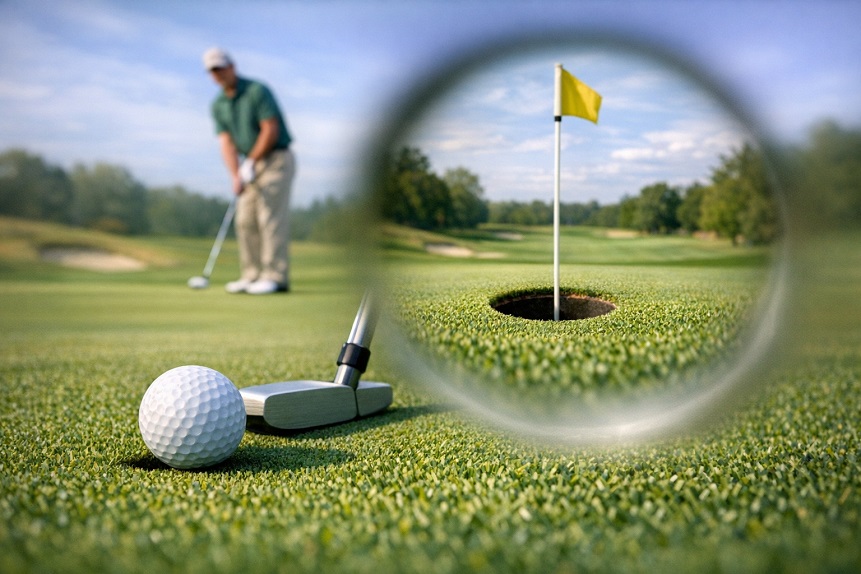
Golf has a reputation for being a patience game, a mental game, a game of inches. What it rarely gets credit for is being a vision game. But spend any time on a course with a serious golfer and you start to notice: they’re not just reading breaks and judging distances. They’re constructing a visual picture of a shot before a single muscle moves.
That pre-shot image matters more than most players realize. And the quality of what you see — the sharpness, the depth, the contrast between the ball and the rough, the way the grain of the green catches the light — shapes every decision you make from tee to cup.
What “Seeing the Putt” Actually Means
Tour players talk about visualization constantly, but visualization isn’t just imagination. It’s rooted in accurate visual input. Before a player crouches behind a putt and traces the line with their eyes, their visual system is doing serious work: estimating slope, reading grain, calculating the subtle color differences between uphill and downhill breaks.
This is where visual acuity matters in ways most golfers overlook. Acuity isn’t just about whether you can read the bottom line of an eye chart. On the green, it’s about resolving fine texture in the grass, catching the shimmer that tells you which way the grain runs, noticing the slight depression a foot off your intended line. These are all detail-level perceptions, and they degrade faster than most people expect — with age, with fatigue, and with insufficient light.
Reading putts from 15 feet away requires surprisingly precise visual resolution. The difference between a 1-degree and a 3-degree slope is visible if your contrast sensitivity is sharp and nearly invisible if it isn’t. That’s not a mental mistake. That’s optics.
Depth Perception Off the Tee and Into Greens
Distance judgment is a different visual task entirely. On approach shots, golfers constantly triangulate between themselves, the flag, hazards, and elevation changes. This relies on stereoscopic depth perception — the brain’s ability to merge the slightly different views from each eye into a three-dimensional picture.
When depth perception is good, distance estimation is almost intuitive. When it’s degraded — through eye dominance imbalances, fatigue, or reduced contrast sensitivity — distances become guesses. A pin that looks 155 yards might play 162. A bunker that seems comfortably short of your landing zone catches your ball anyway.
Interestingly, eye dominance also affects alignment. Golfers who set up with poor awareness of their dominant eye often push or pull shots without understanding why. The fundamentals look right from the outside, but the internal visual geometry is skewed. Some coaches now include basic dominant-eye checks in setup work for this reason.
For a broader look at how depth perception and dynamic vision factor into athletic performance generally, the article on vision and athletic performance covers the underlying mechanics in detail.
Contrast Sensitivity on the Course
Green reading depends heavily on contrast sensitivity — the ability to distinguish subtle differences in luminance and color between adjacent surfaces. Grass isn’t a single color. It’s a patchwork of shading variations that encode slope, moisture, and grain direction. A player with excellent contrast sensitivity reads this like a map. A player with diminished contrast sensitivity sees a uniform surface.
Morning rounds with soft, low-angle light punish poor contrast sensitivity. The visual cues that disappear under flat lighting are exactly the ones you need to read a breaking putt with any confidence. This is why some golfers who play well in bright afternoon sun struggle significantly in early morning tee times, even when the conditions seem otherwise ideal.
Glare is the inverse problem. Afternoon rounds in summer, especially on courses without significant tree cover, generate significant glare off fairways and water features. Glare reduces effective contrast by flooding the visual system with diffuse light, washing out the subtle gradients that give a course its visual texture. Polarized lenses help here, but the underlying sensitivity of the visual system determines how much recovery happens when the glare eases.
Fatigue and the Back Nine Problem
Ask any competitive amateur where their round falls apart and the answer is usually the same: somewhere between holes 13 and 16. There are obvious physical and mental fatigue factors at work. But visual fatigue plays a role that gets almost no attention.
After four-plus hours outdoors in variable light, tracking a small white ball against shifting backgrounds of sky, trees, and rough, the visual system accumulates real strain. Macular pigment — the protective layer of lutein and zeaxanthin that filters high-energy blue light and supports central visual function — gets progressively taxed as the round wears on.
The symptoms are subtle: slightly slower target acquisition, marginally reduced contrast on short putts, a faint sense that reading greens requires more mental effort than it did on the front nine. None of it is dramatic enough to blame directly, but the aggregate effect on decision quality over four or five holes is real.
Supporting macular pigment density through consistent nutrition is one of the more evidence-backed approaches to sustaining visual performance over long outdoor activities. The relationship between dietary carotenoids and macular function is covered in depth in the article on macular pigment and how it protects your eyes.

Ball Tracking in the Air
Losing a ball in flight is a frustrating and common experience. It’s typically blamed on sun angle or inattention, but visual processing speed plays a significant role. A well-struck iron shot peaks at significant height in under two seconds. Tracking it against a bright sky, through peripheral-to-central handoffs, while simultaneously processing where it’s likely to land, requires fast and accurate visual computation.
Players who track the ball well through its full flight are better at club selection on subsequent shots because their distance information is more accurate. Players who lose it mid-flight are estimating from where they think it landed, not where they saw it land. That’s a data quality problem dressed up as a strategy problem.
Reaction time and dynamic visual acuity training have shown benefits in other sports. The principles explored in the article on visual reaction time and how to train it apply directly to the ball-tracking challenge in golf.
What You Can Actually Do About It
Some of this is equipment. Proper prescription correction, high-quality polarized eyewear matched to light conditions, and attention to lens tint (amber or brown tints typically improve contrast on grass) all make a measurable difference.
Some of it is training. Putting drills that deliberately involve low-light conditions, or green reading practice that focuses on grain rather than slope, build the visual habits that pay off on the course. A few tour players have worked with sports vision specialists specifically on contrast discrimination for green reading.
And some of it is nutritional. The carotenoids that build macular pigment density — lutein and zeaxanthin in particular — have a direct and documented role in contrast sensitivity and glare recovery. These aren’t compounds the body makes on its own; they come from diet or supplementation. If you’re playing serious golf and neglecting this side of visual maintenance, you’re leaving a performance variable on the table that costs nothing to address.
If you’re interested in what a well-formulated eye supplement looks like and how the ingredient research stacks up, the Performance Lab Vision review walks through the evidence in detail.
Note: If you’re experiencing unexplained changes in vision quality during outdoor activity, have them evaluated by an eye care professional. Some visual symptoms can indicate conditions that warrant examination beyond nutritional or optical adjustments.
The Overlooked Edge
Golf instruction has never been more sophisticated. Swing mechanics, launch monitors, course management strategy, mental performance coaching — all of it has been refined to a remarkable degree. Visual performance, somehow, remains an afterthought for most amateur golfers.
The players who take it seriously tend to notice quickly how much information was always there on the course, waiting for a sharper visual system to pick it up. The putt you see before you make it isn’t a metaphor. It’s a skill — and like most skills in golf, you can develop it.