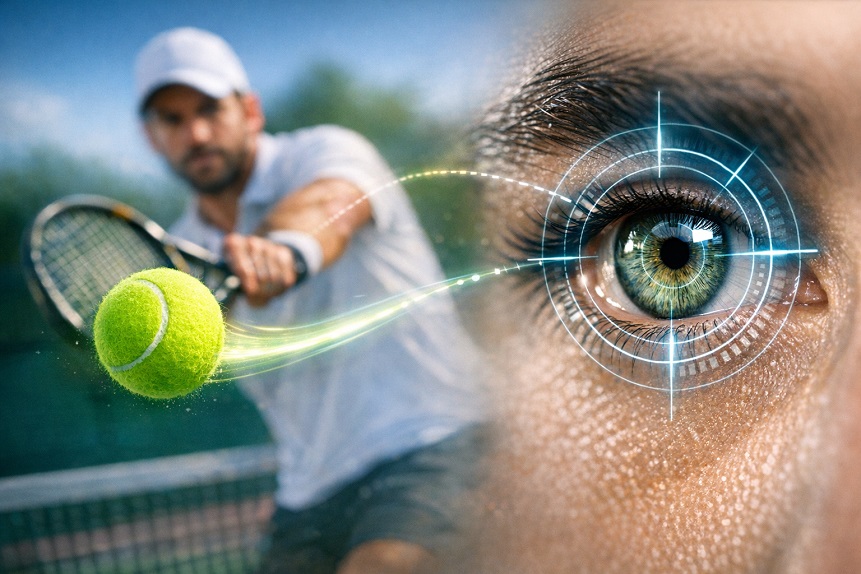
A tennis ball traveling at 120 miles per hour takes roughly 400 milliseconds to cross the net. Your brain needs somewhere between 150 and 200 milliseconds just to process the visual input and initiate a motor response. The math is uncomfortable: by the time you consciously decide to swing, the ball has already covered most of the court.
Tennis, at any serious level, is not a sport where you watch the ball and react to it. It’s a sport where you predict it. The visual system doesn’t wait for complete information. It processes early cues — the server’s ball toss, the angle of the racket face, the contact point — and generates a forward projection. Good tennis players, in a very real sense, are watching a ball that hasn’t arrived yet.
The Visual Chain From Serve to Return
Break down a return of serve and you find a sequence of visual tasks stacked on top of each other. The player watches the toss to anticipate serve direction. They track the racket through contact to estimate pace and spin. They pick up ball flight trajectory in the first few frames after the hit. They shift gaze ahead to the expected bounce point. Then they move.
Each step in that chain has a visual component that can be trained, degraded by fatigue, or impaired by nutritional deficiencies the player probably doesn’t know they have. A breakdown at any point cascades forward. Miss the early racket cue and you’re a quarter-second behind before the ball is even in the air.
Contrast sensitivity is critical throughout this chain. A green ball on a green court, tracked against alternating light and shadow, requires the visual system to work hard to maintain a clean object boundary. Players with excellent contrast sensitivity process these visual inputs faster and with less effort than players whose sensitivity is average or below. At 120 miles per hour, even small processing delays compound quickly.
Saccades, Gaze, and What Elite Players Actually Do
Researchers who study gaze behavior in tennis have found that elite players use fewer and more precise eye movements than novices. While a developing player’s eyes follow the ball in something close to continuous tracking, an expert’s eyes move in predictive jumps — saccades that leap to the anticipated location of the ball before it arrives there.
This isn’t just more efficient. It’s a fundamentally different visual strategy. The expert’s visual system is running a predictive model updated by incoming data. The novice’s visual system is running a tracking model that can’t keep pace with the ball at high speed. The gap between these two strategies grows larger as ball speed increases, which is why the difference between a beginner and an experienced player is most obvious on hard serves and flat groundstrokes.
Dynamic visual acuity — the ability to resolve detail on a moving object — sits underneath all of this. A player who can clearly see spin on an incoming ball extracts information that changes everything: a heavy topspin ball will kick higher than a flat ball, and the player who sees the spin early can position their body before the bounce rather than reacting after it.
The full breakdown of dynamic visual acuity and how it applies across sports is covered in the article on motion detection and sport, which is worth reading alongside this one.
Peripheral Vision and Court Awareness
Tennis players are tracking the ball, but they’re also tracking the court. Where is the opponent? Are they moving left? Is there an open angle to the ad side? These are peripheral awareness tasks happening simultaneously with the central ball-tracking task.
The visual cortex divides this labor between foveal and peripheral processing. The fovea handles the high-resolution central detail — the ball, the spin, the contact point. The periphery handles the larger spatial picture — opponent position, court geometry, open space. Players who integrate both channels seamlessly have a significant advantage. They see the whole board, not just the piece they’re currently moving.
Peripheral awareness training has found its way into tennis coaching, particularly at the junior development level. Drills that require a player to return a ball while simultaneously calling out a number shown on a paddle at the net corner force dual-channel visual processing. It’s uncomfortable at first and measurably effective with practice.
Fatigue and the Third Set Effect
Anyone who has played a long competitive match knows the third set is a different animal. Physical exhaustion is the obvious culprit, but visual fatigue contributes in ways that rarely get acknowledged.
After two sets of sustained ball tracking — often in bright sunlight with constant glare and rapid light-to-shadow transitions — the macular region of the retina has been working hard. Macular pigment acts as a natural optical filter, reducing glare and sharpening contrast, but it gets progressively taxed under sustained high-luminance conditions. The result in a third set can be slightly slower object acquisition, marginally reduced contrast on low-contrast ball trajectories, and an increased tendency to lose the ball briefly against bright backgrounds.
None of these effects is obvious or dramatic in isolation. In aggregate, over a set of tennis, they translate to slightly more unforced errors and slightly slower reads on short balls. That’s the match, right there.
The nutritional foundations of macular pigment — predominantly lutein and zeaxanthin from diet — are discussed in detail in the article on lutein for eye health. These aren’t exotic compounds, but most people eating a typical Western diet get far less than what research links to optimal macular pigment density.

Light Conditions and Their Role in Ball Visibility
Outdoor tennis is played in a wide range of light conditions, and indoor tennis is frequently played under lighting that tennis players rarely think critically about. Both environments present specific visual challenges.
Outdoor play in direct afternoon sun creates glare, particularly when serving or returning into sun. The visual system manages glare partly through squinting — which reduces acuity — and partly through neural adaptation. Players with high macular pigment density handle sun glare better because the pigment acts as a natural short-wavelength filter, reducing the most penetrating component of glare.
Indoor play under fluorescent or LED lighting creates a different problem. Artificial light sources often flicker at rates too fast for conscious detection but not too fast for the visual system to respond to. Subtle flicker can reduce contrast sensitivity and increase visual fatigue over long matches. Players who feel more tired after indoor matches than outdoor matches of equivalent duration sometimes attribute this to the environment without identifying visual fatigue from artificial lighting as a contributing factor.
What the Research Says About Training Vision in Racket Sports
Sports vision training has accumulated a reasonable evidence base in racket sports specifically. Studies in tennis and squash have demonstrated improvements in serve return accuracy, reaction time, and ball-tracking precision following structured visual training programs. The effects are modest but consistent across studies.
The training approaches that show the best results combine stroboscopic vision training — using special glasses that intermittently block vision to force predictive processing — with sport-specific drills that emphasize early cue pickup. Neither approach works in isolation as well as both together, which suggests the transfer from generic visual training to sport-specific performance requires context to stick.
The underlying science of reaction time and how it applies to sport is explored in the article on visual reaction time and how to train it.
The Competitive Edge That Lives in the Visual System
Tennis players spend thousands of hours perfecting technique, footwork, fitness, and strategy. The visual system — which initiates every one of those well-trained responses — typically receives almost no dedicated attention. That’s a gap worth closing.
The good news is that visual performance responds to training and to nutritional support. Neither is complicated. Both have real returns for serious players. The eye that wins the point is the one that sees the ball clearly, reads spin quickly, and sustains that quality through a long, demanding match.
If you want to understand how a well-formulated eye supplement addresses the nutritional side of this equation, the Performance Lab Vision review covers the ingredient evidence in full.
Note: Persistent changes in visual clarity or difficulty tracking moving objects should be evaluated by an eye care professional, as they can occasionally reflect underlying conditions requiring medical attention.