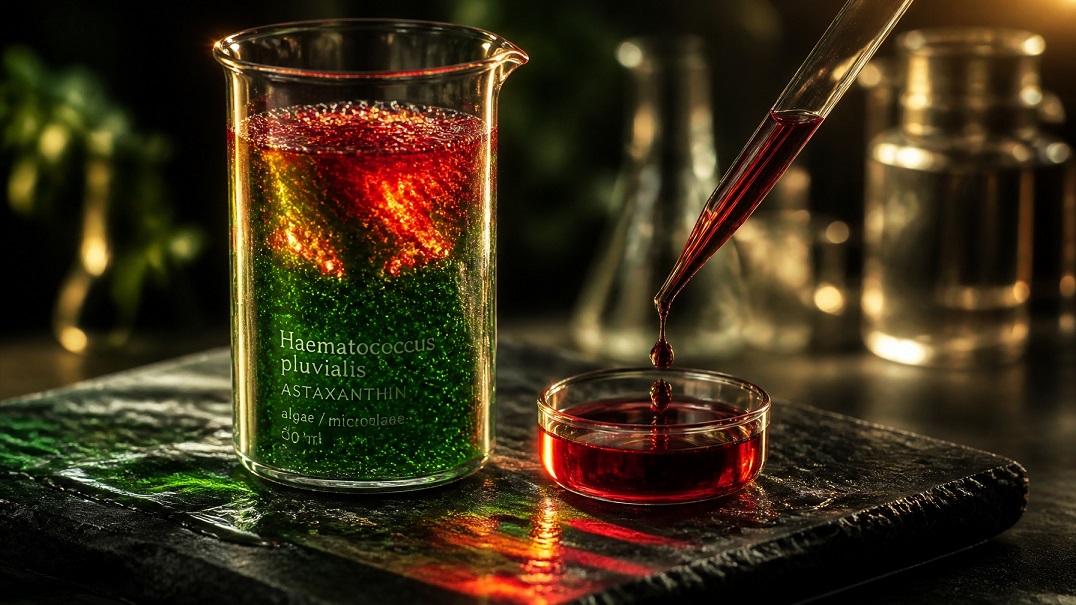
Astaxanthin comes from three main places: a freshwater microalga called Haematococcus pluvialis, a type of yeast, and chemical synthesis. The source does appear to matter. Algae-derived astaxanthin is the form used in most human eye studies, and lab research suggests it has a different structure and stronger antioxidant activity than synthetic versions. Human trials comparing sources are still missing.
The Natural Origin Story
Astaxanthin is the red pigment that gives salmon and shrimp their color. They do not make it themselves. They get it from the algae in their food chain. Haematococcus pluvialis hyperaccumulates astaxanthin under environmental stress as a survival mechanism, which is why it became the main natural commercial source.
A review in Marine Drugs on PubMed Central lists algae, yeast, salmon, krill, and shrimp as natural sources, and says commercial astaxanthin comes mainly from Phaffia yeast, Haematococcus, and chemical synthesis. It describes Haematococcus as one of the best natural sources.
Three Sources, Three Chemical Signatures
Astaxanthin exists in different mirror-image shapes, called stereoisomers. The same review explains that Haematococcus makes the (3S, 3′S) form, while yeast produces a different one, the (3R, 3′R) form. Synthetic astaxanthin is typically a mixture of several forms.
Another difference is that algal astaxanthin is mostly attached to fatty acids, a form called esterified. Synthetic and yeast versions are generally not. Whether esterified or free forms work better is still debated, which is a good reminder that this field has open questions.
Does the Source Change How Well It Works?
Laboratory comparisons suggest it might. A review of head-to-head antioxidant studies reported that algal astaxanthin showed much stronger antioxidant activity than synthetic astaxanthin, though those tests were done in test tubes and animals. The review’s authors recommend algal astaxanthin until clinical trials exist on the other forms, a point covered in trade coverage of the review.
An independent paper makes a similar point. It reports that synthetic astaxanthin shows weaker antioxidant activity than the natural form, partly because of its different isomer mix, and that about 40% of the astaxanthin on the market is synthetic, according to Lodz University of Technology researchers.
Does Natural Always Mean Better?
Not necessarily, and the trade-offs are worth knowing. The Lodz researchers note that natural astaxanthin faces challenges including lower stability, variability in pigment composition, and a high price. Those drawbacks explain why so much of the market is synthetic.
On safety, the European Food Safety Authority has set the same acceptable daily intake, 0.2 mg per kilogram of body weight, for both natural and synthetic astaxanthin, per the same paper. So the debate is mostly about effectiveness and quality, not about one form being dangerous.
What the Eye Studies Used
The more practical question is which form was tested in people. In a trial of 60 adults who did regular screen work, researchers specifically tested Haematococcus-derived astaxanthin and found a protective effect on visual acuity after screen work in participants aged 40 and older, as reported in the published study on PubMed Central.
So the human evidence for eye health leans heavily on algal astaxanthin. We have little published human data on synthetic astaxanthin for vision, which is one more reason to prefer the form that was actually studied. Our guide to astaxanthin for eyes covers those studies.
Why Source Matters for Vegans and for Quality
Algae-based astaxanthin has a practical advantage: it is plant-like in origin, so it suits people avoiding animal products. Fish-based and krill sources exist too, but they come with seafood considerations.
Quality varies within any source. Check how much astaxanthin, not just algal biomass, is in each serving, and look for third-party testing. Our guide to reading an eye supplement label shows how to do that.
How to Read the Label
Look for the species name, Haematococcus pluvialis, and a stated milligram amount of astaxanthin per serving. Vague phrases like “astaxanthin complex” tell you less. If a product does not name its source, ask the company.
Remember that astaxanthin is fat-soluble, so taking it with a meal containing some fat is a sensible habit.
Where Performance Lab Vision Fits In
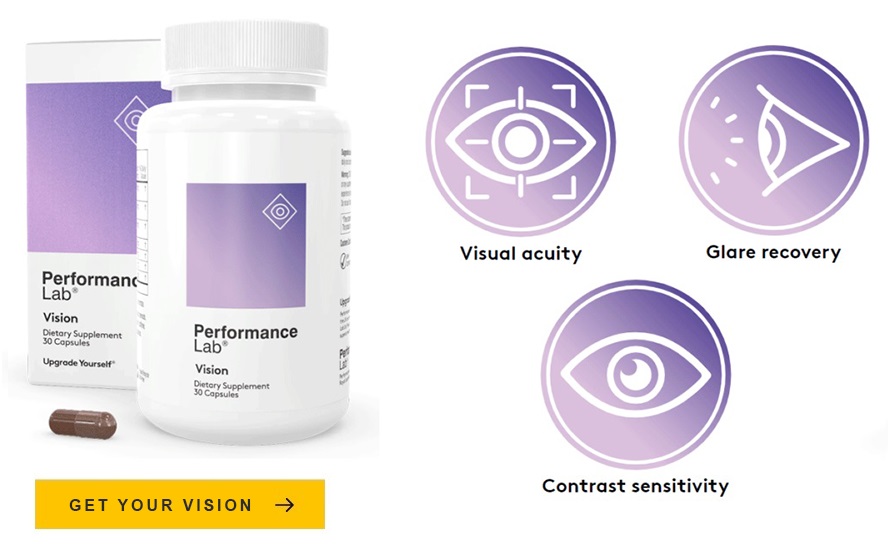
Performance Lab Vision lists its astaxanthin as 4 mg from Haematococcus pluvialis algal extract, which matches the source used in the human eye research above.