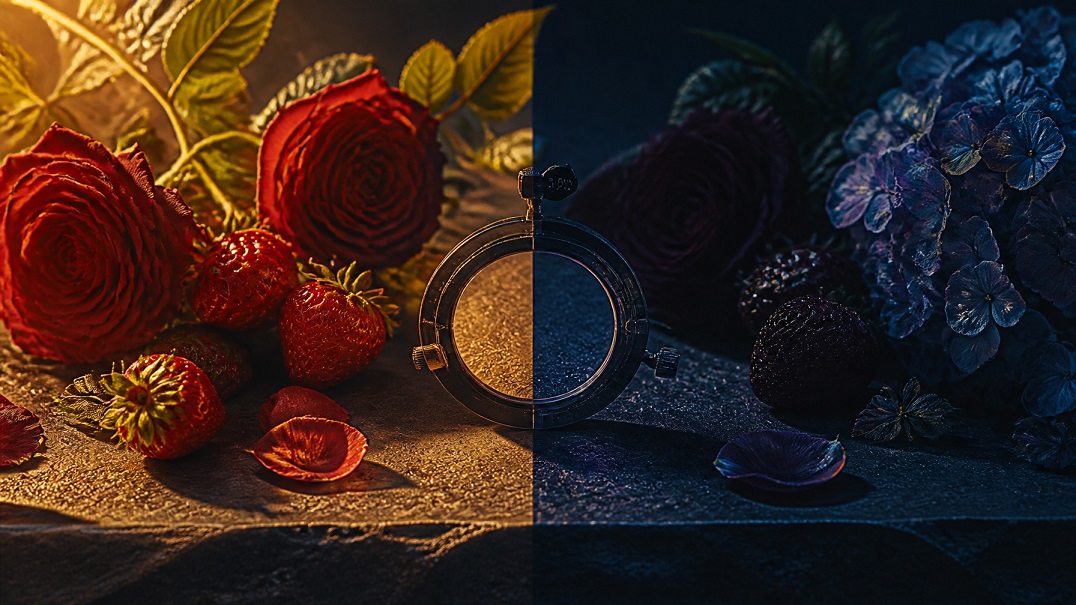
Colors look different at night because your eyes shift from cone cells, which detect color in bright light, to rod cells, which handle dim light but cannot tell colors apart. As light fades, colors look duller, and reds tend to darken while blues and greens hold up better. This is normal. A sudden, painful, or one-eye color change is not, and deserves a prompt eye exam.
Cones for Day, Rods for Night
Your retina has two kinds of light detectors. Cones work in bright light, and their three types, tuned roughly to red, green, and blue, build your sense of color. Rods work in dim light, and unlike cones they come in only one type, so they cannot distinguish colors, as Live Science explains. Small differences in the light-absorbing molecules inside cones make each type specialized, and the brain builds color by combining the responses of all three.
In bright light, the brain largely tunes out the rods because they get overwhelmed. For a full comparison, see our guide to rod cells vs. cone cells. Rods rely on a light-sensitive pigment you can read about in Rhodopsin Explained.
The Twilight Zone Called Mesopic Vision
Between daylight and true darkness, rods and cones both contribute. Scientists call this mesopic vision, and it covers dusk and dimly lit streets. A scientific review of dim-light color vision notes that as light falls, colors look less saturated, and both their hue and brightness shift, which makes color perception less reliable.
Rods may also contribute to color processing in this range, but researchers are still working out how. Because the handoff is gradual, color does not switch off at once. It drains away as the light drops.
The Purkinje Effect Explained
The Purkinje effect describes how your peak sensitivity moves toward the blue end of the spectrum as light dims. A glossary from the American Meteorological Society summarizes the result: to a dark-adapted eye, blues and greens tend to look brighter than reds.
In practice, a red car in a dim parking lot may look nearly black, while a green one beside it still reads as green. Nothing is wrong with your eyes. You are seeing the combined signal of two systems with different color sensitivities. The glossary adds that dim-light sensitivity peaks at shorter wavelengths than bright-light sensitivity, which is why the balance tips toward blue-green.
You can catch the effect during a total solar eclipse. CNN coverage explained that in the twilight light, bright reds look darker and sometimes almost black, while blues and greens become more vibrant, because rods and cones work at the same time.
How Long Your Eyes Need to Adjust
The switch takes time. According to the same glossary, after roughly seven to ten minutes in very low light, rods become more sensitive than cones, and sensitivity keeps climbing, reaching a maximum at about 20 to 30 minutes.
Our posts on how long dark adaptation takes and how your eyes adjust to low light go deeper. You can also read about why red light preserves night vision.
Artificial Light Changes the Picture
Some of what you notice at night is the lamp, not your eyes. A photography magazine article on color rendering describes how colors shift under high-pressure sodium streetlamps, and notes that even LEDs can distort colors somewhat. It also says older low-pressure sodium lamps had a negative color rendering index, a measure of how faithfully a light reveals color, while household LED bulbs score roughly 82. If a shade matters, check it indoors before judging it under a streetlight.
Age Can Shift Colors Too
Color perception also changes with age. The National Eye Institute says color vision may worsen over time, often because of cataracts, which are cloudy areas in the lens.
Our post on the lens yellowing process explains how an aging lens changes color. If night vision has become harder over the years, read why night vision gets worse with age.
When to See an Eye Doctor
Dimmer, less colorful evenings are normal. Book an exam if colors look washed out in only one eye, if color changes arrive suddenly, or if night vision trouble is new or worsening. Seek urgent care for sudden vision loss or eye pain. A slow change in how you see color at night is also worth mentioning at your next routine exam.
The National Eye Institute recommends talking with your eye doctor if you think you may have a color vision problem. A simple test can usually sort it out.