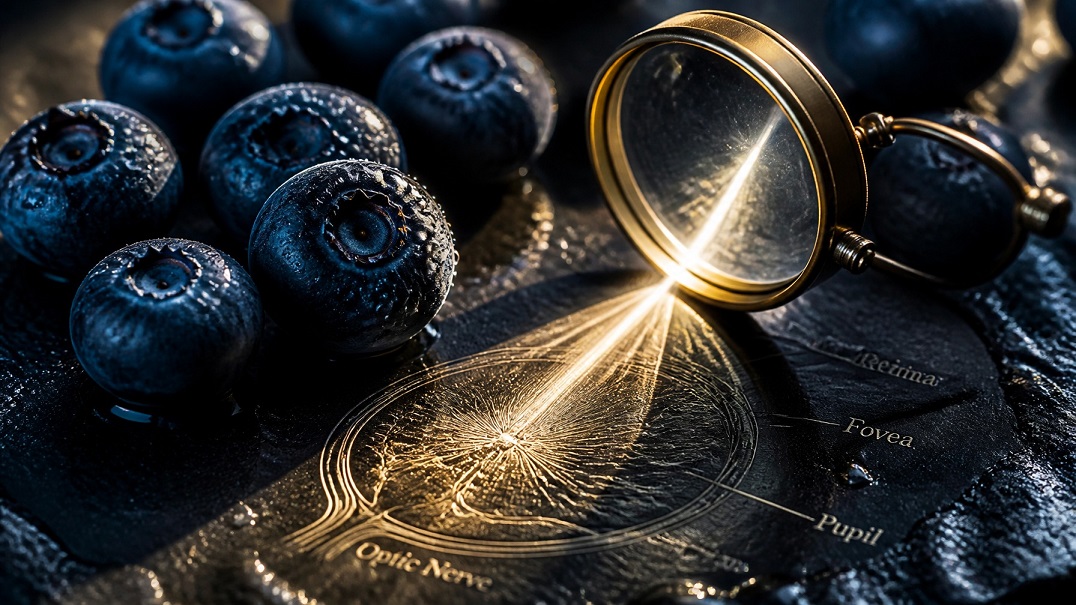
Blueberries are healthy, but there is no good evidence that eating them will sharpen your eyesight or replace glasses. In two placebo-controlled trials, blueberry anthocyanins did not improve night vision, though they modestly sped recovery after a bright flash. Berries may play a supporting role in eye health, but they are not a vision fix.
Where the Blueberry Reputation Comes From
The idea dates back decades. An American Chemical Society release notes that studies from long ago hinted blueberries might improve night vision, and lab experiments suggested that anthocyanins, the pigments in blueberries, encourage the regeneration of key light-sensing molecules in the eye.
The best-known version of the story is the bilberry pilot legend, which we unpack in the WWII pilot story and the real science.
What the Best Trials Found
A team led by Wilhelmina Kalt ran two placebo-controlled crossover trials. A blueberry-supplemented diet did not improve sight in the dark, according to the ACS release, but it did help people recover normal vision after exposure to a bright light.
The enhancement was small and not likely noticeable to most healthy people, the researchers concluded. In the second trial, 59 people took a single daily high dose over 12 weeks, followed by an eight-week washout.
Per the ClinicalTrials.gov record, one trial tested two doses of blueberry juice plus a placebo over three weeks, and the other tested one dose against a juice placebo over 12 weeks. The ACS release adds that anthocyanins might help people with existing eye disorders, but that this remains to be shown in well-designed studies.
The Older Studies Were Weaker
Kalt told NutraIngredients that most early European research on bilberries and night vision did not use a randomized, placebo-controlled design. She added that four of the five earlier trials that were placebo-controlled had negative results.
The team also called even the bright-light effect moderate. That context matters. Many of the claims you see online trace back to studies that would not meet today’s standards. The Hong Kong review below also notes that research findings suggest bilberry does not improve night vision, contrary to some product claims.
The Eye Comfort Evidence
Some research looks at eye comfort, not sharpness. A small randomized trial of a standardized bilberry extract in 21 people with dry eye, summarized by ESCOP, suggested that the extract may help preserve tear levels over four weeks. It tested a branded extract, not whole fruit.
A review in Molecules says anthocyanins are widely used as eye health supplements in Europe and East Asia. Its author describes a placebo-controlled crossover study of blackcurrant anthocyanins that reported improved dark adaptation, a different result from the blueberry trials, which suggests berry type, dose, and study design may matter. That is one research group’s finding, so treat it as preliminary. NutraIngredients notes the team felt that, given the limited positive results in normal populations, future studies might target specific eye conditions instead.
For the broader picture, see can anthocyanins help with eye fatigue and blackcurrant and eye health.
Fruit Versus Concentrated Extract
A 2008 Hong Kong Consumer Council review found that lab studies show some potential benefits of anthocyanins, but that no randomized trials had proven they translate into real vision benefits. It added that no evidence shows commercial extracts are better or worse than the whole fruit, and that anthocyanins also occur in strawberries, grapes, cherries, and sweet potatoes. It advised consulting a medical professional before taking any supplement.
Absorption is also a question. The same review reports that after a 200 mg oral dose, only about 0.1% of one anthocyanin type was recovered in urine. Our guide to anthocyanosides vs. anthocyanins covers the terminology.
Why Berries Still Belong on Your Plate
Nothing in these trials argues against eating blueberries. They fit into a varied diet, and our overviews of nutrition for night vision and the complete food guide for eye health cover nutrients with more established roles.
Just do not expect a bowl of berries to change your prescription.
What Actually Corrects Blurry Vision
Blurry vision from a refractive error is corrected with optics. AAPOS says nearsighted children are treated with glasses or contact lenses, and that refractive surgery is generally for adults once the prescription is stable.
If your vision has changed, book an exam instead of hoping food will fix it.
When a Vision Change Deserves an Exam
Do not self-treat new or worsening blur, especially in one eye, with diet. Sudden vision changes, flashes, or a curtain over your vision need urgent care.
Routine checkups are covered in eye exams as you age.